







Question: * Attempts: Do No Harm: /5 2. Balance sheet The balance sheet provides a snapshot of the financial condition of a company. Investors and analysts
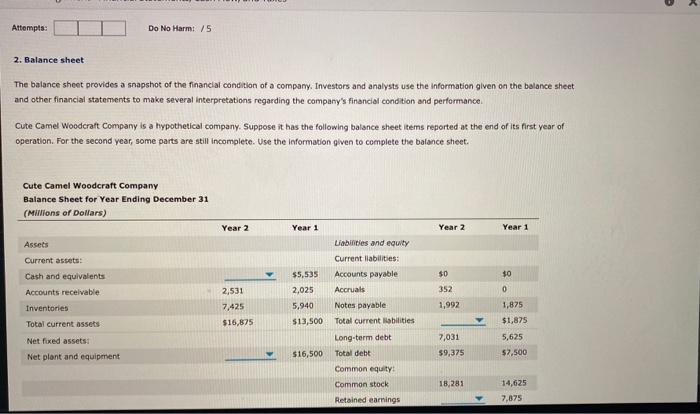
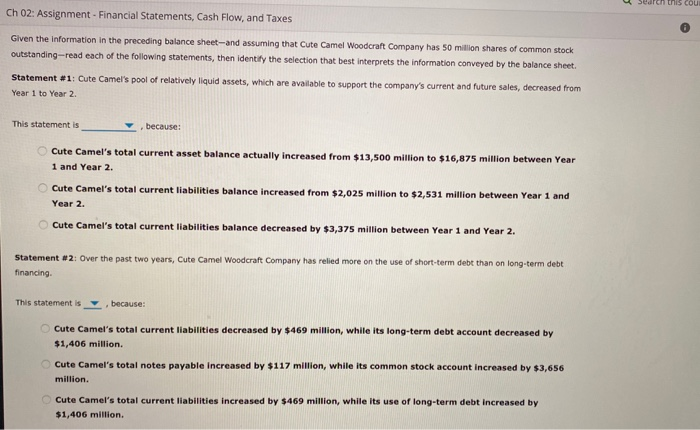
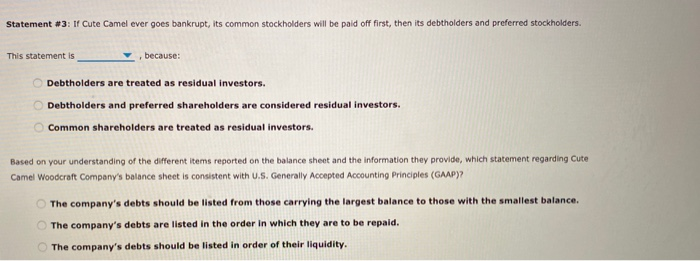
* Attempts: Do No Harm: /5 2. Balance sheet The balance sheet provides a snapshot of the financial condition of a company. Investors and analysts use the information given on the balance sheet and other financial statements to make several interpretations regarding the company's financial condition and performance. Cute Camel Woodcraft Company is a hypothetical company. Suppose it has the following balance sheet items reported at the end of its first year of operation. For the second year, some parts are still incomplete. Use the information given to complete the balance sheet. Cute Camel Woodcraft Company Balance Sheet for Year Ending December 31 (Millions of Dollars) Year 2 Year 1 Year 2 Year 1 Assets Current assets: $0 $0 Cash and equivalents Accounts receivable 0 $5,535 2,025 5,940 $13,500 2,531 7,425 $16,875 352 1,992 Inventories Total current assets Labinties and equity Current liabilities: Accounts payable Accruals Notes payable Total current liabilities Long-term debt Total debt Common equity Common stock 1,875 $1,875 7,031 Net fixed assets: 5,625 $16,500 Net plant and equipment $9,375 $7,500 18,281 14.625 Retained earnings 7,875 Search this cou Ch 02: Assignment - Financial Statements, Cash Flow, and Taxes Given the information in the preceding balance sheet-and assuming that Cute Camel Woodcraft Company has 50 million shares of common stock outstanding-read each of the following statements, then identify the selection that best interprets the information conveyed by the balance sheet. Statement #1: Cute Camel's pool of relatively liquid assets, which are available to support the company's current and future sales, decreased from Year 1 to Year 2 This statement is because: Cute Camel's total current asset balance actually increased from $13,500 million to $16,875 million between Year 1 and Year 2 Cute Camel's total current liabilities balance increased from $2,025 million to $2,531 million between Year 1 and Year 2. Cute Camel's total current liabilities balance decreased by $3,375 million between Year 1 and Year 2. Statement #2: Over the past two years, Cute Camel Woodcraft Company has relied more on the use of short-term debe than on long-term debt financing This statement is because: Cute Camel's total current liabilities decreased by $469 million, while its long-term debt account decreased by $1,406 million. Cute Camel's total notes payable Increased by $117 million, while its common stock account increased by $3,656 million. Cute Camel's total current liabilities increased by $469 million, while its use of long-term debt increased by $1,406 million. Statement #3: If Cute Camel ever goes bankrupt, its common stockholders will be paid off first, then its debtholders and preferred stockholders. This statement is because: Debtholders are treated as residual investors. Debtholders and preferred shareholders are considered residual investors. Common shareholders are treated as residual investors. Based on your understanding of the different items reported on the balance sheet and the information they provide, which statement regarding Cute Camel Woodcraft Company's balance sheet is consistent with U.S. Generally Accepted Accounting Principles (GAAP)? The company's debts should be listed from those carrying the largest balance to those with the smallest balance. The company's debts are listed in the order in which they are to be repaid. The company's debts should be listed in order of their liquidity
Step by Step Solution
There are 3 Steps involved in it

Get step-by-step solutions from verified subject matter experts
 Study Help