







Question: Attempts I Keep the Highest / 4 4. Minimum wage legislation The following graph gives the labor market for the fast-food industry of the imaginary
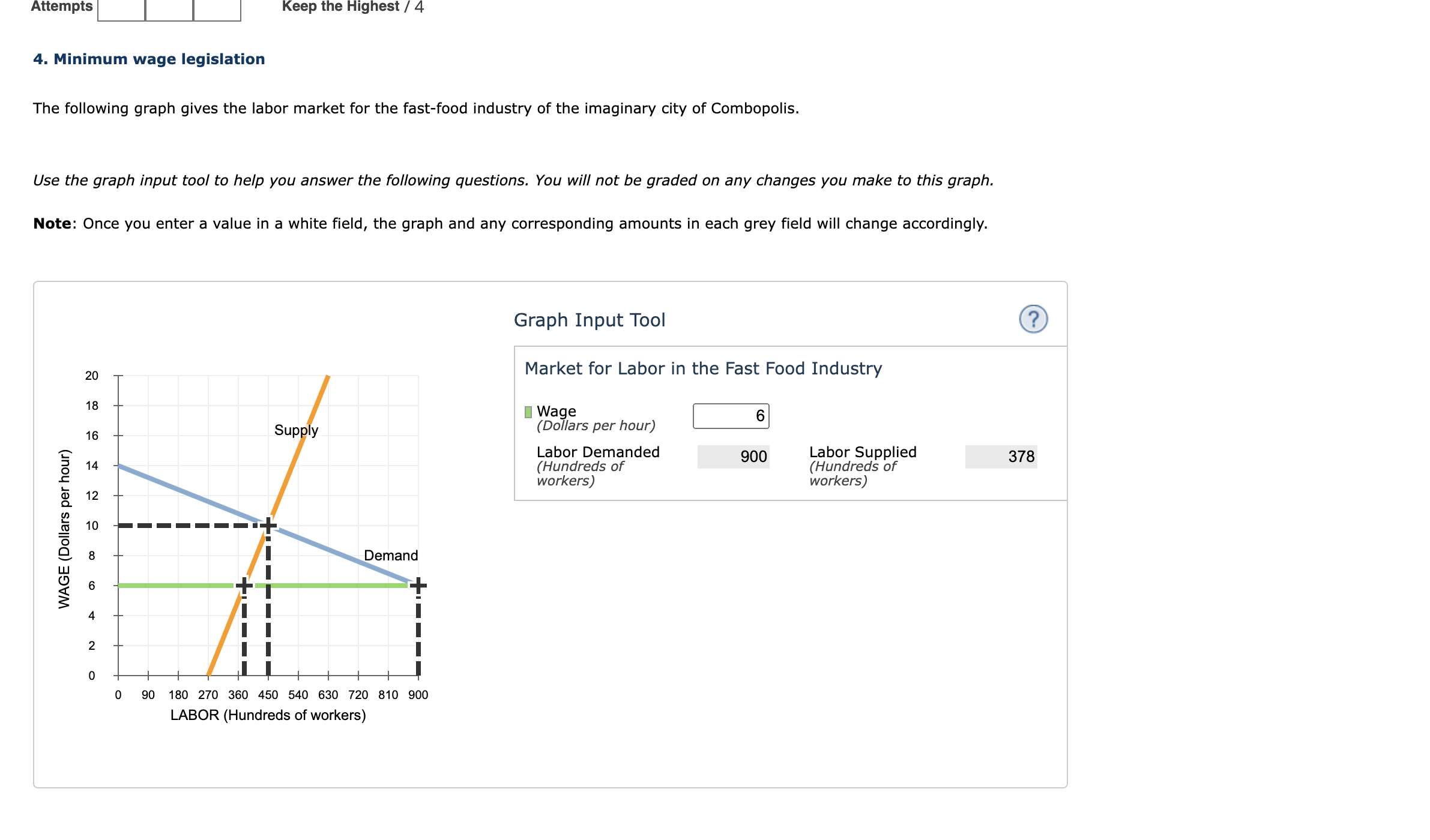
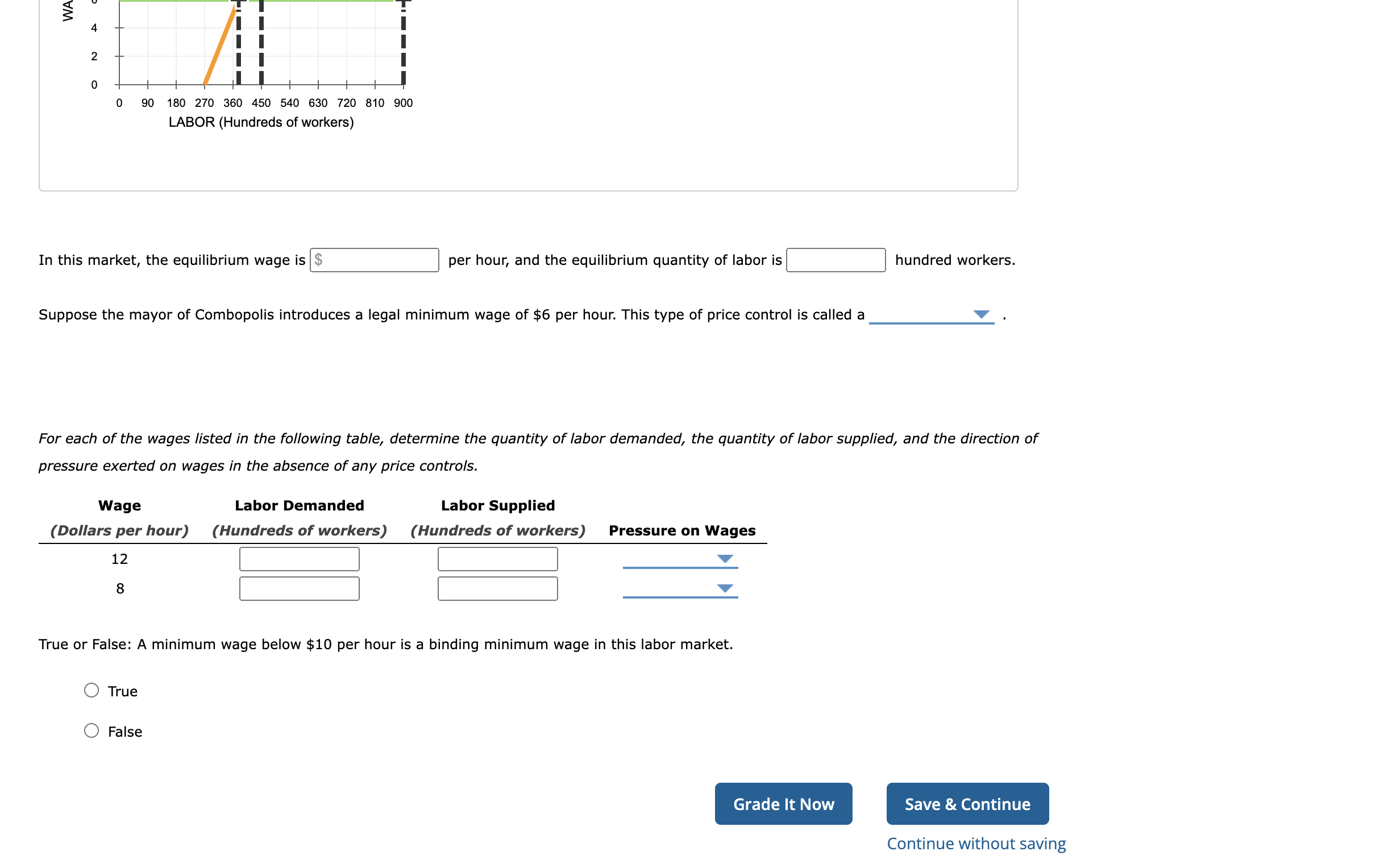
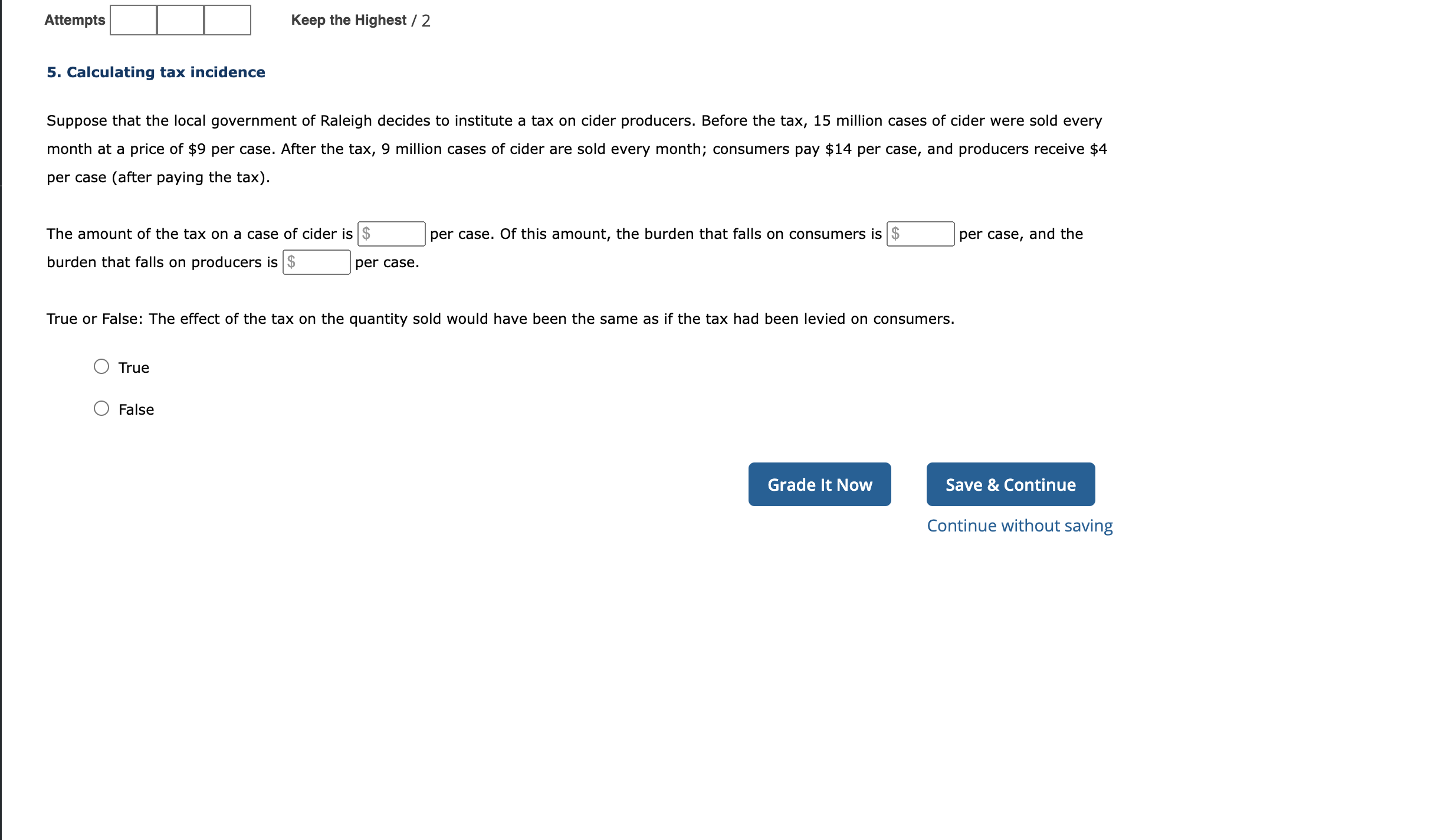
Attempts I Keep the Highest / 4 4. Minimum wage legislation The following graph gives the labor market for the fast-food industry of the imaginary city of Combopolis. Use the graph input tool to help you answer the following questions. You will not be graded on any changes you make to this graph. Note: Once you enter a value in a white field, the graph and any corresponding amounts in each grey field will change accordingly. WAGE (Dollars per hour) 20 15 16 14 12 10 Supply ______.+ Demand 1' I I I --+ illilii' o 90 180 270 360 450 540 630 720 810 900 LABOR (Hundreds of workers) Graph Input Tool Market for Labor in the Fast Food Industry D Wage (Dollars per hour) Labor Demanded (Hundreds of workers) E] 900 Labor Supplied (Hundreds of workers) 378 WA ---l ---l o lllllll. o 90 130 270 360 450 540 630 720 310 900 LABOR (Hundreds of workers) In this market, the equilibrium wage is $ per hour, and the equilibrium quantity of labor is hundred workers. Suppose the mayor of Combopolis introduces a legal minimum wage of $6 per hour. This type of price control is called a V . For each of the wages listed in the following table, determine the quantity of labor demanded, the quantity of labor supplied, and the direction of pressure exerted on wages in the absence of any price controls. Wage Labor Demanded Labor Supplied (Dollars per hour) (Hundreds of workers) (Hundreds of workers) Pressure on Wages 12 :_v s :4 True or False: A minimum wage below $10 per hour is a binding minimum wage in this labor market. 0 True 0 False Continue without saving Attempts I I Keep the Highest / 2 5. Calculating tax incidence Suppose that the local government of Raleigh decides to institute a tax on cider producers. Before the tax, 15 million cases of cider were sold every month at a price of $9 per case. After the tax, 9 million cases of cider are sold every month; consumers pay $14 per case, and producers receive $4 per case (after paying the tax). The amount of the tax on a case of cider is per case. Of this amount, the burden that falls on consumers is per case, and the burden that falls on producers is per case. True or False: The effect of the tax on the quantity sold would have been the same as if the tax had been levied on consumers. 0 True 0 False Continue without saving
Step by Step Solution
There are 3 Steps involved in it

Get step-by-step solutions from verified subject matter experts
 Study Help