







Question: au at Problem 4. Let r.ye R, so that the point (cy) belongs to Rn. Use the Fourier transform in (1,y), and the method of
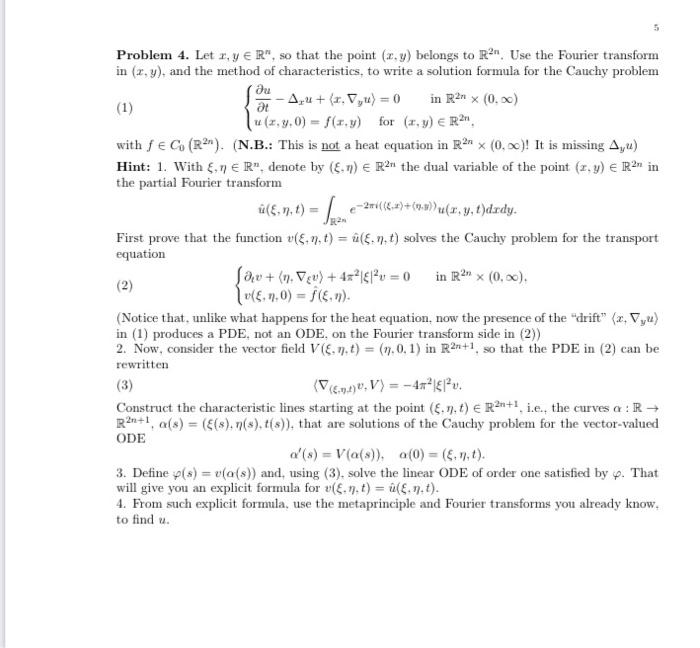
au at Problem 4. Let r.ye R", so that the point (cy) belongs to Rn. Use the Fourier transform in (1,y), and the method of characteristics, to write a solution formula for the Cauchy problem - A u + (x...) = 0 in R2 x (0.00) (1,4,0) = f(x,y) for (x,y) ER2 with f e Co (R2). (N.B.: This is not a heat equation in R24 (0,20)! It is missing Ayu) Hint: 1. With 6,11 R", denote by E. n) R2h the dual variable of the point (x,y) e R2n in the partial Fourier transform le,19,2) = Spreme=2014(8,4)= (as)u(x, y, t)dardy. First prove that the function v(: 9,t) = u(. 1. t) solves the Cauchy problem for the transport equation (2) av + (n. Veu) + 4x+|5/20 = 0 in R21 (0,00). (8,9,0) = f(6.1). (Notice that, unlike what happens for the heat equation, now the presence of the "drift" (x. Vyu) in (1) produces a PDE, not an ODE. on the Fourier transform side in (2) 2. Now, consider the vector field V6,7,t) = (1.0.1) in R2+1, so that the PDE in (2) can be rewritten (6.0.4),V) = -4|*v. Construct the characteristic lines starting at the point (6.1). t) R2n+1 i.e. the curves a: R R2+1, a(s) = (E(8), n (s), t(s)), that are solutions of the Cauchy problem for the vector-valued ODE d'(s) = V(a(s)), a(0) = (.7,t). 3. Define p(s) = vla(s)) and, using 3), solve the linear ODE of order one satisfied by p. That will give you an explicit formula for (f. 1. t) = ul. 17.t). 4. From such explicit formula, use the metaprinciple and Fourier transforms you already know. to find us (3) au at Problem 4. Let r.ye R", so that the point (cy) belongs to Rn. Use the Fourier transform in (1,y), and the method of characteristics, to write a solution formula for the Cauchy problem - A u + (x...) = 0 in R2 x (0.00) (1,4,0) = f(x,y) for (x,y) ER2 with f e Co (R2). (N.B.: This is not a heat equation in R24 (0,20)! It is missing Ayu) Hint: 1. With 6,11 R", denote by E. n) R2h the dual variable of the point (x,y) e R2n in the partial Fourier transform le,19,2) = Spreme=2014(8,4)= (as)u(x, y, t)dardy. First prove that the function v(: 9,t) = u(. 1. t) solves the Cauchy problem for the transport equation (2) av + (n. Veu) + 4x+|5/20 = 0 in R21 (0,00). (8,9,0) = f(6.1). (Notice that, unlike what happens for the heat equation, now the presence of the "drift" (x. Vyu) in (1) produces a PDE, not an ODE. on the Fourier transform side in (2) 2. Now, consider the vector field V6,7,t) = (1.0.1) in R2+1, so that the PDE in (2) can be rewritten (6.0.4),V) = -4|*v. Construct the characteristic lines starting at the point (6.1). t) R2n+1 i.e. the curves a: R R2+1, a(s) = (E(8), n (s), t(s)), that are solutions of the Cauchy problem for the vector-valued ODE d'(s) = V(a(s)), a(0) = (.7,t). 3. Define p(s) = vla(s)) and, using 3), solve the linear ODE of order one satisfied by p. That will give you an explicit formula for (f. 1. t) = ul. 17.t). 4. From such explicit formula, use the metaprinciple and Fourier transforms you already know. to find us (3)
Step by Step Solution
There are 3 Steps involved in it

Get step-by-step solutions from verified subject matter experts
 Study Help