







Question: Audio Compression Here is a randomly generated waveform: Variants of the DCT algorithm are used heavily in lossy audio compression. Because an audio signal is
Audio Compression
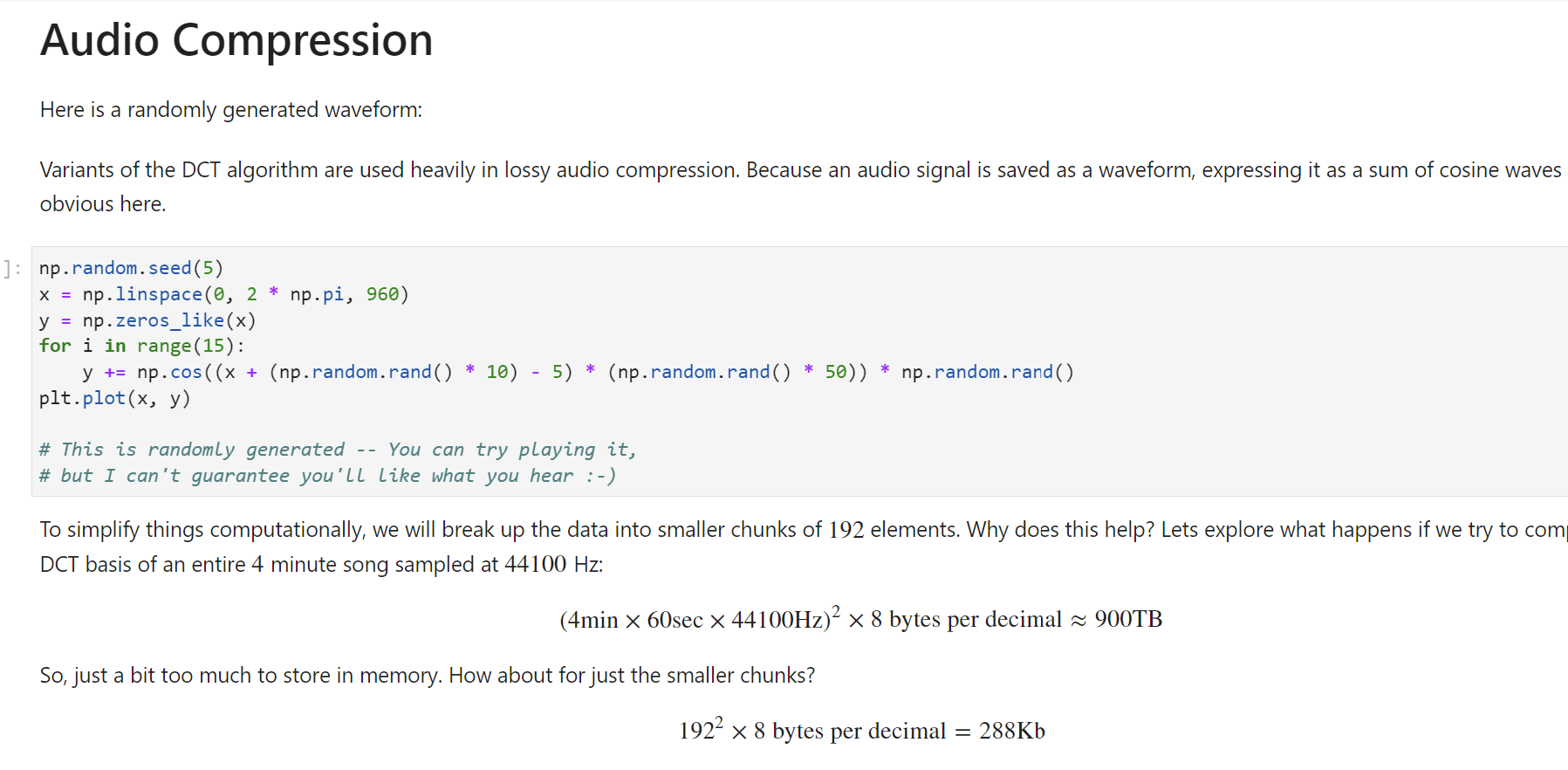
Here is a randomly generated waveform:
Variants of the DCT algorithm are used heavily in lossy audio compression. Because an audio signal is saved as a waveform, expressing it as a sum of cosine waves
obvious here.
nprandom.seed
linspace
ike
for in range:
pltplot
# This is randomly generated You can try playing it
# but I can't guarantee you'll like what you hear
To simplify things computationally, we will break up the data into smaller chunks of elements. Why does this help? Lets explore what happens if we try to com
DCT basis of an entire minute song sampled at :
min bytes per decimal ~~
So just a bit too much to store in memory. How about for just the smaller chunks?
bytes per decimal
Step by Step Solution
There are 3 Steps involved in it
1 Expert Approved Answer
Step: 1 Unlock

Question Has Been Solved by an Expert!
Get step-by-step solutions from verified subject matter experts
Step: 2 Unlock
Step: 3 Unlock
 Study Help