







Question: Audit Practice Set Part 3: Substantive Testing Part A Instructions: The audit program for Accounts Receivable includes mailing positive confirmations to a sample of customers.
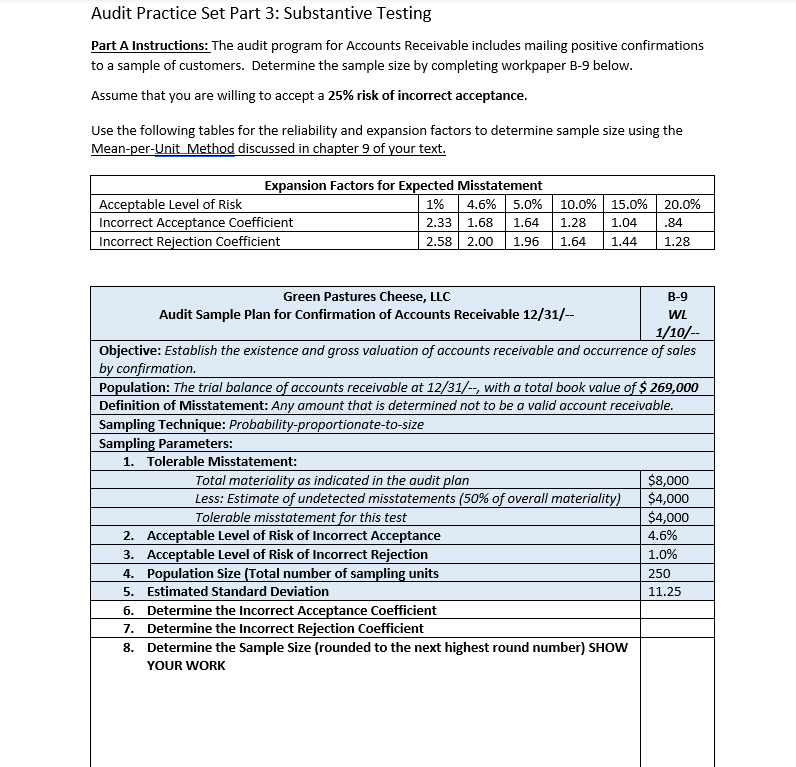
Audit Practice Set Part 3: Substantive Testing Part A Instructions: The audit program for Accounts Receivable includes mailing positive confirmations to a sample of customers. Determine the sample size by completing workpaper B-9 below. Assume that you are willing to accept a 25% risk of incorrect acceptance. Use the following tables for the reliability and expansion factors to determine sample size using the Mean-per-Unit Method discussed in chapter 9 of your text. Expansion Factors for Expected Misstatement Acceptable Level of Risk 1% Incorrect Acceptance Coefficient 4.6% 5.0% 10.0% 15.0% 20.0% 2.33 1.68 1.64 1.28 1.04 .84 2.58 2.00 1.96 1.64 1.28 Incorrect Rejection Coefficient 1.44 Green Pastures Cheese, LLC B-9 Audit Sample Plan for Confirmation of Accounts Receivable 12/31/-- WL 1/10/-- Objective: Establish the existence and gross valuation of accounts receivable and occurrence of sales by confirmation. Population: The trial balance of accounts receivable at 12/31/--, with a total book value of $ 269,000 Definition of Misstatement: Any amount that is determined not to be a valid account receivable. Sampling Technique: Probability-proportionate-to-size Sampling Parameters: 1. Tolerable Misstatement: Total materiality as indicated in the audit plan $8,000 $4,000 Less: Estimate of undetected misstatements (50% of overall materiality) Tolerable misstatement for this test $4,000 4.6% 2. Acceptable Level of Risk of Incorrect Acceptance Acceptable Level of Risk of Incorrect Rejection 3. 1.0% 4. Population Size (Total number of sampling units 250 5. Estimated Standard Deviation 11.25 6. Determine the Incorrect Acceptance Coefficient 7. Determine the Incorrect Rejection Coefficient 8. Determine the Sample Size (rounded to the next highest round number) SHOW YOUR WORK Audit Practice Set Part 3: Substantive Testing Part A Instructions: The audit program for Accounts Receivable includes mailing positive confirmations to a sample of customers. Determine the sample size by completing workpaper B-9 below. Assume that you are willing to accept a 25% risk of incorrect acceptance. Use the following tables for the reliability and expansion factors to determine sample size using the Mean-per-Unit Method discussed in chapter 9 of your text. Expansion Factors for Expected Misstatement Acceptable Level of Risk 1% Incorrect Acceptance Coefficient 4.6% 5.0% 10.0% 15.0% 20.0% 2.33 1.68 1.64 1.28 1.04 .84 2.58 2.00 1.96 1.64 1.28 Incorrect Rejection Coefficient 1.44 Green Pastures Cheese, LLC B-9 Audit Sample Plan for Confirmation of Accounts Receivable 12/31/-- WL 1/10/-- Objective: Establish the existence and gross valuation of accounts receivable and occurrence of sales by confirmation. Population: The trial balance of accounts receivable at 12/31/--, with a total book value of $ 269,000 Definition of Misstatement: Any amount that is determined not to be a valid account receivable. Sampling Technique: Probability-proportionate-to-size Sampling Parameters: 1. Tolerable Misstatement: Total materiality as indicated in the audit plan $8,000 $4,000 Less: Estimate of undetected misstatements (50% of overall materiality) Tolerable misstatement for this test $4,000 4.6% 2. Acceptable Level of Risk of Incorrect Acceptance Acceptable Level of Risk of Incorrect Rejection 3. 1.0% 4. Population Size (Total number of sampling units 250 5. Estimated Standard Deviation 11.25 6. Determine the Incorrect Acceptance Coefficient 7. Determine the Incorrect Rejection Coefficient 8. Determine the Sample Size (rounded to the next highest round number) SHOW YOUR WORK
Step by Step Solution
There are 3 Steps involved in it

Get step-by-step solutions from verified subject matter experts
 Study Help