


Question: AVS' . The standard significantly lower than the standard error in For TV/R ratio Txurate regression beta. bottom-up beta can be adjusted to reflect ch
AVS' . The standard significantly lower than
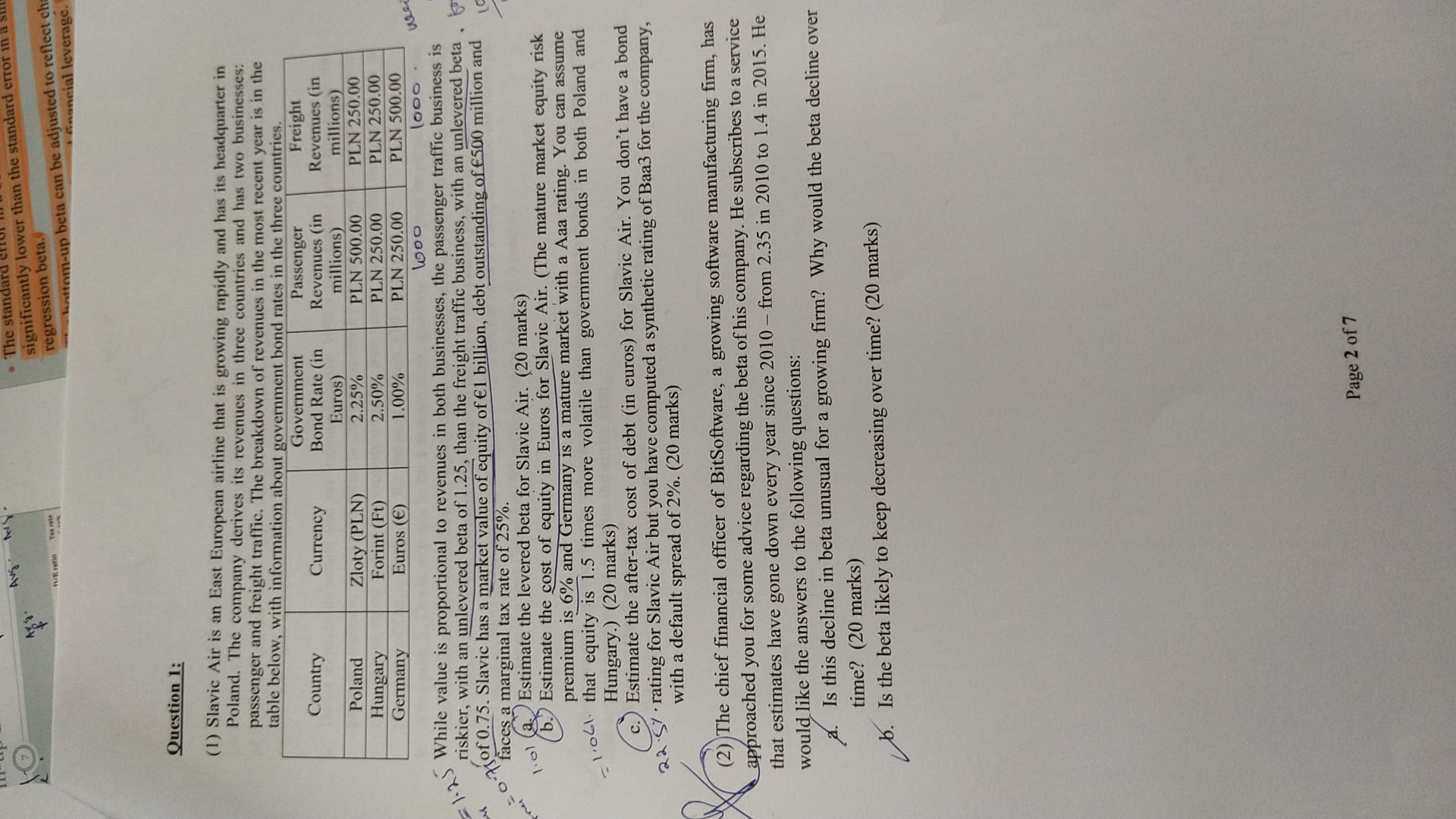
AVS' . The standard significantly lower than the standard error in For TV/R ratio Txurate regression beta. bottom-up beta can be adjusted to reflect ch cial leverage Question 1: (1) Slavic Air is an East European airline that is growing rapidly and has its headquarter in Poland. The company derives its revenues in three countries and has two businesses: passenger and freight traffic. The breakdown of revenues in the most recent year is in the table below, with information about government bond rates in the three countries. Government Passenger Freight Country Currency Bond Rate (in Revenues (in Revenues (in Euros) millions) millions) Poland Zloty (PLN) 2.25% PLN 500.00 PLN 250.00 Hungary Forint (Ft) 2.50% PLN 250.00 PLN 250.00 Germany Euros (E) 1.00% PLN 250.00 PLN 500.00 2 While value is proportional to revenues in both businesses, the passenger traffic business is riskier, with an unlevered beta of 1.25, than the freight traffic business, with an unlevered beta of 0.75. Slavic has a market value of equity of El billion, debt outstanding of (500 million and faces a marginal tax rate of 25%. 1.01 (a Estimate the levered beta for Slavic Air. (20 marks) . Estimate the cost of equity in Euros for Slavic Air. (The mature market equity risk premium is 6% and Germany is a mature market with a Aaa rating. You can assume 104. that equity is 1.5 times more volatile than government bonds in both Poland and Hungary.) (20 marks) Estimate the after-tax cost of debt (in euros) for Slavic Air. You don't have a bond 22 5% . rating for Slavic Air but you have computed a synthetic rating of Baa3 for the company, with a default spread of 2%. (20 marks) (2) The chief financial officer of BitSoftware, a growing software manufacturing firm, has approached you for some advice regarding the beta of his company. He subscribes to a service that estimates have gone down every year since 2010 - from 2.35 in 2010 to 1.4 in 2015. He would like the answers to the following questions: a. Is this decline in beta unusual for a growing firm? Why would the beta decline over time? (20 marks) b. Is the beta likely to keep decreasing over time? (20 marks) Page 2 of 7

Step by Step Solution

There are 3 Steps involved in it

1 Expert Approved Answer
Step: 1 Unlock blur-text-image

Question Has Been Solved by an Expert!

Get step-by-step solutions from verified subject matter experts

Step: 2 Unlock
Step: 3 Unlock

Students Have Also Explored These Related Accounting Questions!