



Question: Darcy's law states that v=ki. This simple law is generally valid for seepage in soils of particle size up to coarse sands only, why
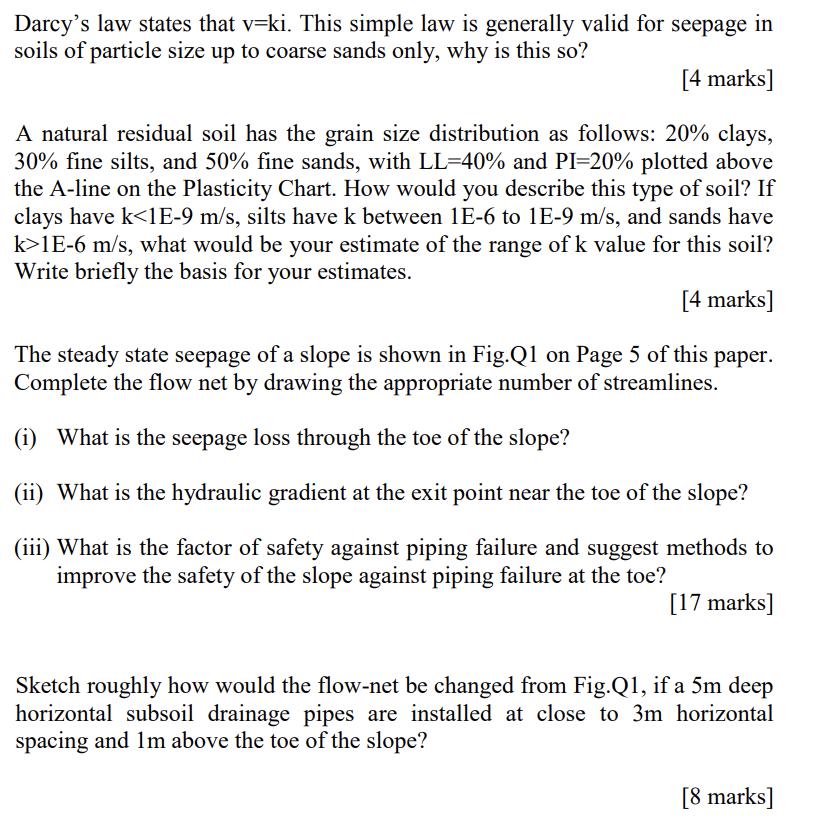
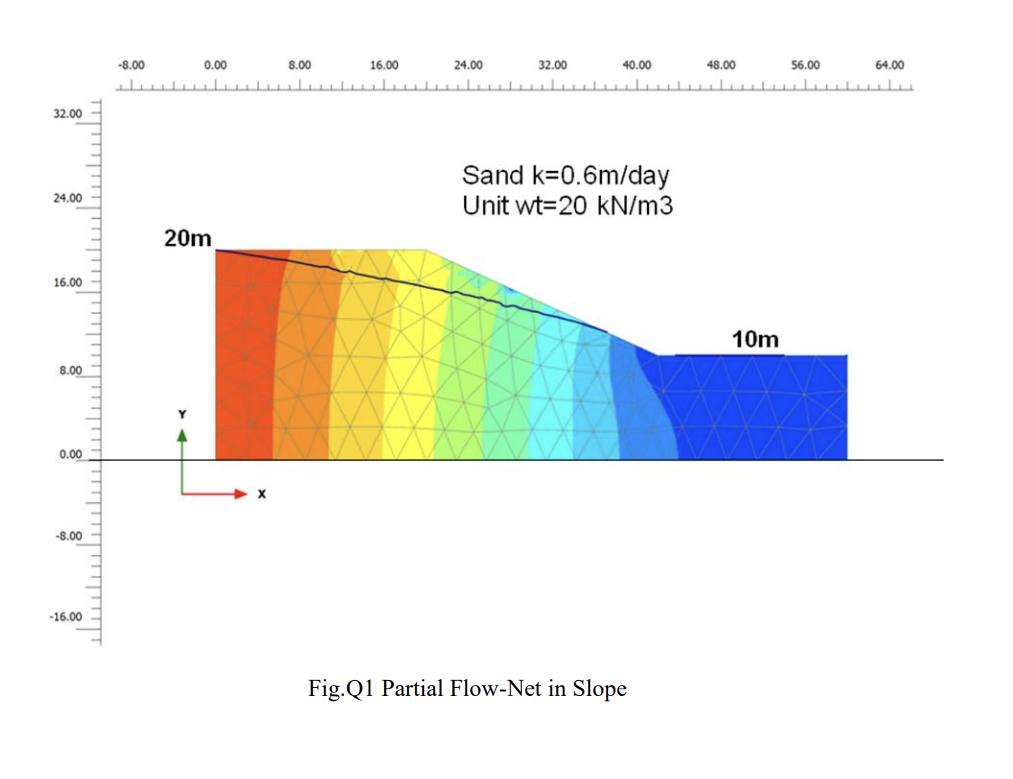
Darcy's law states that v=ki. This simple law is generally valid for seepage in soils of particle size up to coarse sands only, why is this so? [4 marks] A natural residual soil has the grain size distribution as follows: 20% clays, 30% fine silts, and 50% fine sands, with LL=40% and PI=20% plotted above the A-line on the Plasticity Chart. How would you describe this type of soil? If clays have k 1E-6 m/s, what would be your estimate of the range of k value for this soil? Write briefly the basis for your estimates. [4 marks] The steady state seepage of a slope is shown in Fig.Q1 on Page 5 of this paper. Complete the flow net by drawing the appropriate number of streamlines. (i) What is the seepage loss through the toe of the slope? (ii) What is the hydraulic gradient at the exit point near the toe of the slope? (iii) What is the factor of safety against piping failure and suggest methods to improve the safety of the slope against piping failure at the toe? [17 marks] Sketch roughly how would the flow-net be changed from Fig.Q1, if a 5m deep horizontal subsoil drainage pipes are installed at close to 3m horizontal spacing and 1m above the toe of the slope? [8 marks] 32.00 24.00 16.00 8.00 0.00 -8.00 -16.00 -8.00 0.00 8.00 20m 16.00 ..... 24.00 32.00 40.00 Sand k=0.6m/day Unit wt 20 kN/m3 Fig. Q1 Partial Flow-Net in Slope 48.00 10m 56.00 64.00
Step by Step Solution
There are 3 Steps involved in it
Darcys law states that the velocity of fluid flow through a porous medium is directly proportional to the hydraulic gradient ie the rate of change of ... View full answer

Get step-by-step solutions from verified subject matter experts