







Question: (b) (2 points) Suppose we decide to aggregate the polls by taking a simple average: Find the bias7 variance7 and MSE of X}; in terms
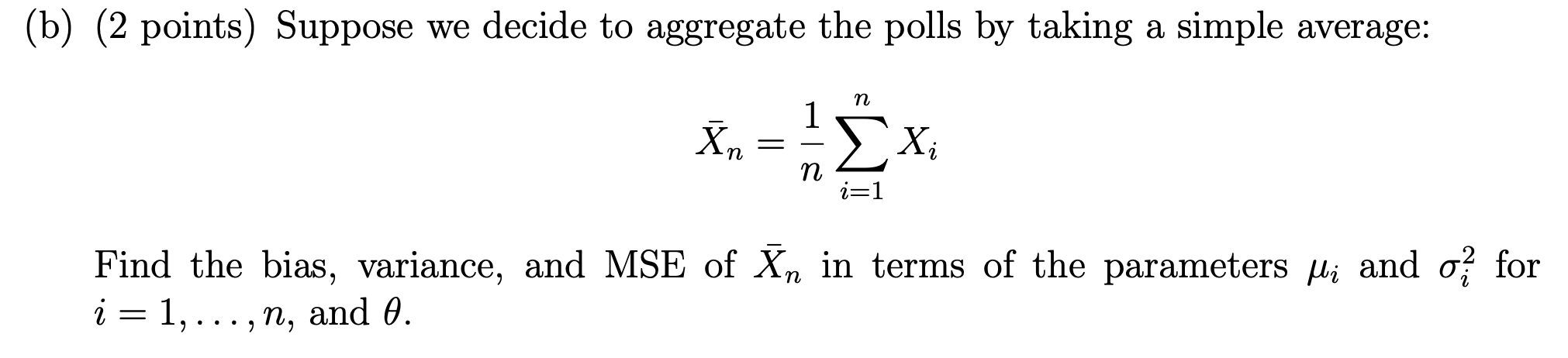
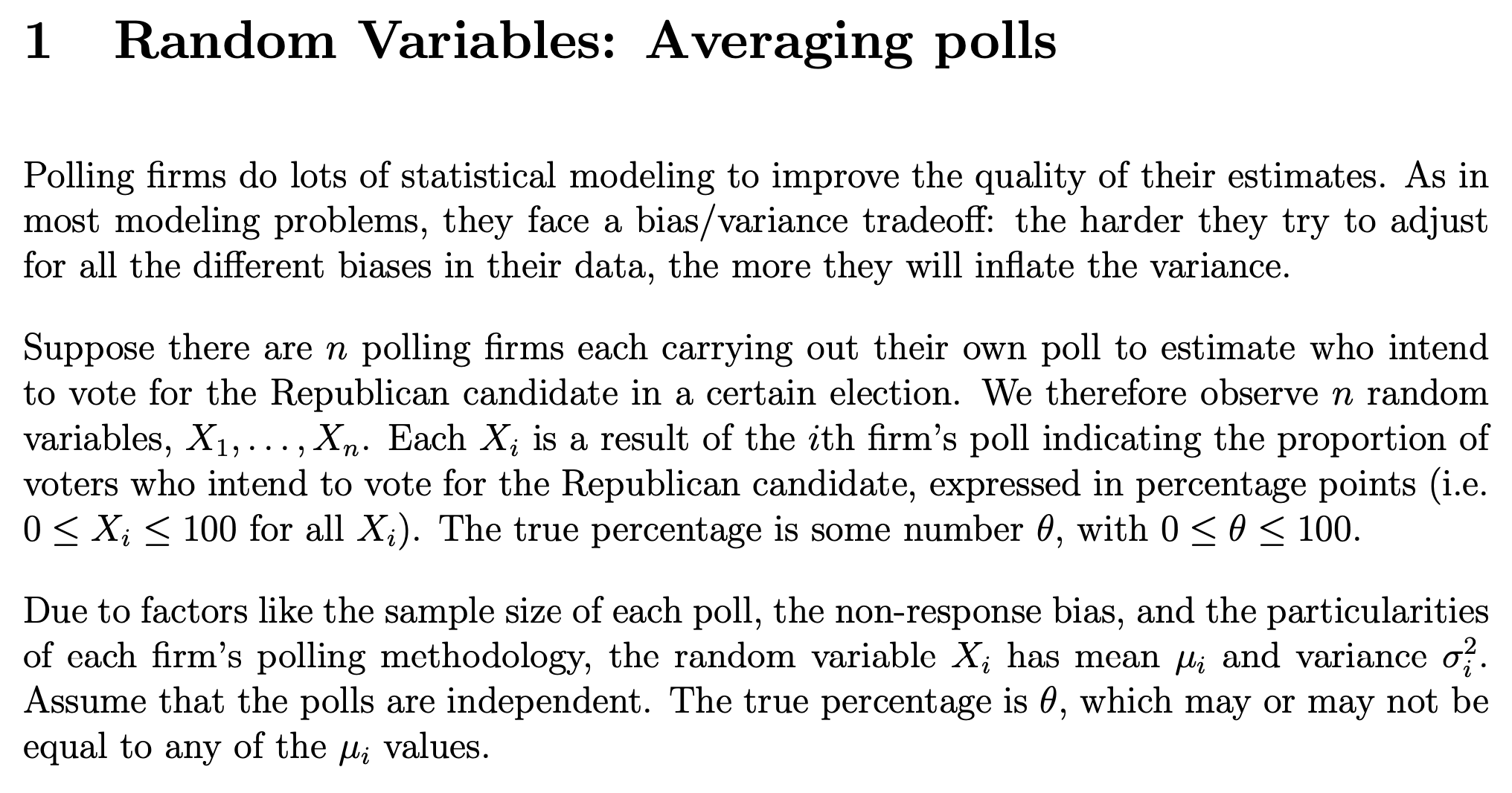
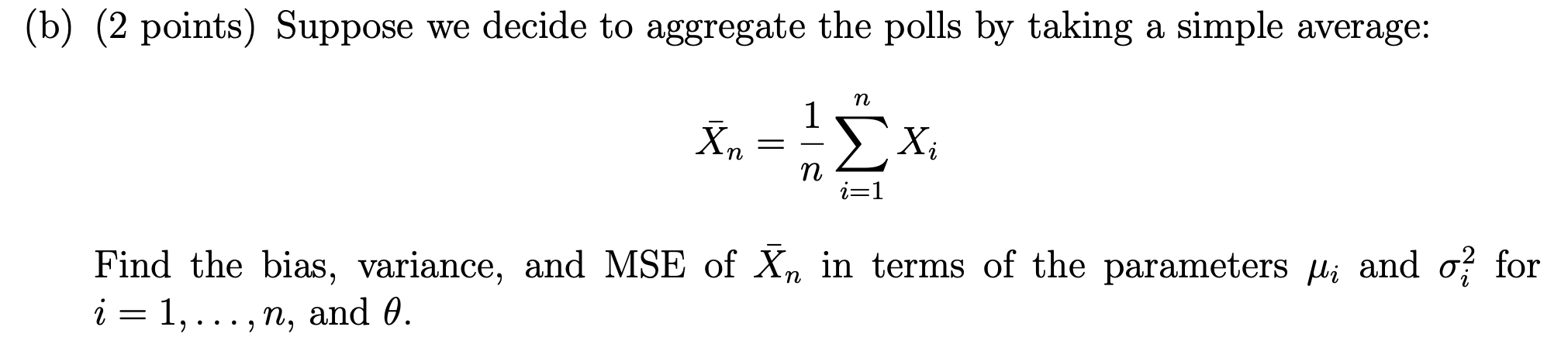
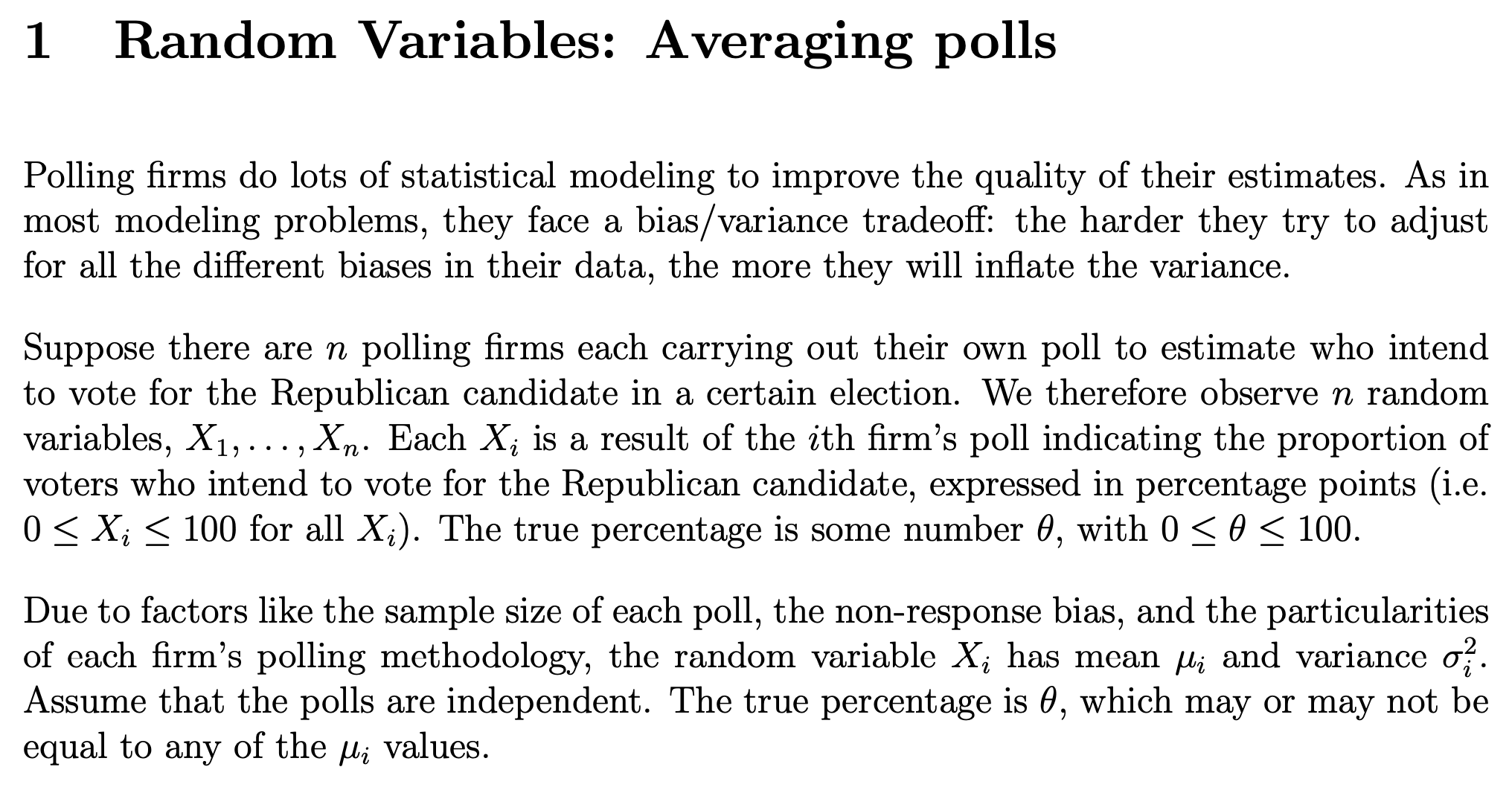
(b) (2 points) Suppose we decide to aggregate the polls by taking a simple average: Find the bias7 variance7 and MSE of X}; in terms of the parameters M and 012 for i=1,...,n, andH. 1 Random Variables: Averaging polls Polling rms do lots of statistical modeling to improve the quality of their estimates. As in most modeling problems, they face a bias/ variance tradeoff: the harder they try to adjust for all the different biases in their data, the more they will inate the variance. Suppose there are n polling rms each carrying out their own poll to estimate who intend to vote for the Republican candidate in a certain election. We therefore observe n random variables, X1, . . . ,Xn. Each X, is a result of the ith rm's poll indicating the proportion of voters who intend to vote for the Republican candidate, expressed in percentage points (i.e. 0 g X, g 100 for all X,). The true percentage is some number 6, with 0 S 6 S 100. Due to factors like the sample size of each poll, the nonresponse bias, and the particularities of each rm's polling methodology, the random variable X,- has mean ,LL, and variance of. Assume that the polls are independent. The true percentage is 6, which may or may not be equal to any of the ,u, values
Step by Step Solution
There are 3 Steps involved in it

Get step-by-step solutions from verified subject matter experts
 Study Help