



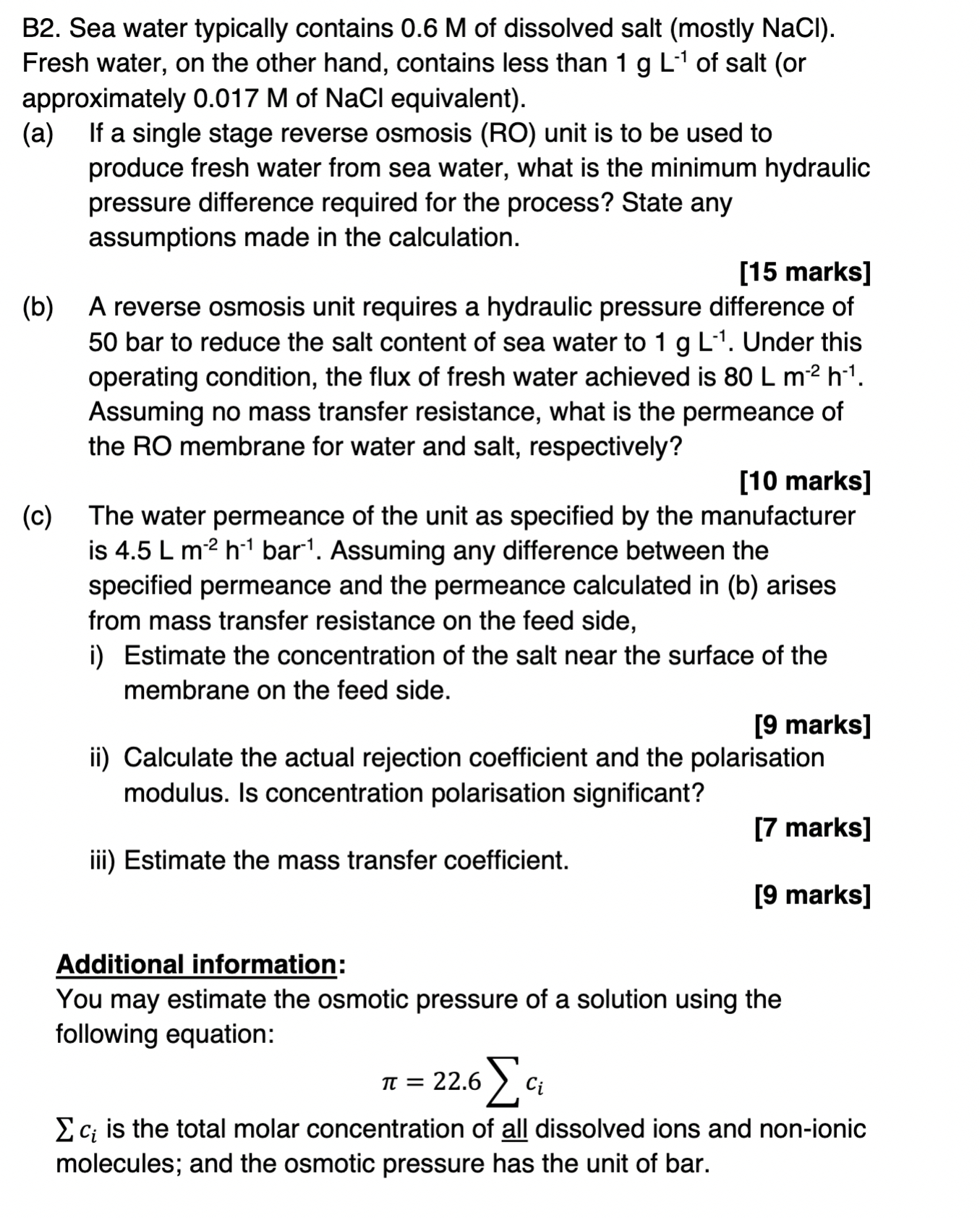
Question: B 2 . Sea water typically contains 0 . 6 M of dissolved salt ( mostly NaCl ) . Fresh water, on the other hand,
B Sea water typically contains of dissolved salt mostly NaCl
Fresh water, on the other hand, contains less than of salt or
approximately of NaCl equivalent
a If a single stage reverse osmosis RO unit is to be used to
produce fresh water from sea water, what is the minimum hydraulic
pressure difference required for the process? State any
assumptions made in the calculation.
marks
b A reverse osmosis unit requires a hydraulic pressure difference of
bar to reduce the salt content of sea water to Under this
operating condition, the flux of fresh water achieved is
Assuming no mass transfer resistance, what is the permeance of
the RO membrane for water and salt, respectively?
marks
c The water permeance of the unit as specified by the manufacturer
is bar Assuming any difference between the
specified permeance and the permeance calculated in b arises
from mass transfer resistance on the feed side,
i Estimate the concentration of the salt near the surface of the
membrane on the feed side.
marks
ii Calculate the actual rejection coefficient and the polarisation
modulus. Is concentration polarisation significant?
iii Estimate the mass transfer coefficient.
marks
marks
Additional information:
You may estimate the osmotic pressure of a solution using the
following equation:
is the total molar concentration of all dissolved ions and nonionic
molecules; and the osmotic pressure has the unit of bar.
Step by Step Solution
There are 3 Steps involved in it
1 Expert Approved Answer
Step: 1 Unlock

Question Has Been Solved by an Expert!
Get step-by-step solutions from verified subject matter experts
Step: 2 Unlock
Step: 3 Unlock