







Question: b) 2n ln(n + 2) 2 + (n + 2) 2 ln(n/2). Here ln stands for natural logarithm log e. 2) Obtain c 1, c
b) 2n ln(n + 2)2 + (n + 2)2 ln(n/2). Here ln stands for natural logarithm loge.
2) Obtain c1, c2 and n0 as in the definition to show that g(n) = 2n2 - 5n + 6 belongs to (n2). Always show your work as done in worked out examples.
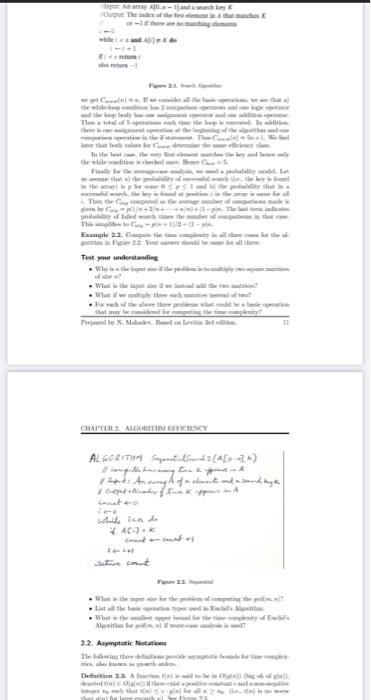
1) For each of the following functions, find the basic efficiency class it belongs to (as Theta of). Must prove your assertion. You may use any theorems stated in Chap2.pdf.
a) (n2+1)10
b) 2n ln(n + 2)2 + (n + 2)2 ln(n/2). Here ln stands for natural logarithm loge.
2) Obtain c1, c2 and n0 as in the definition to show that g(n) = 2n2 - 5n + 6 belongs to (n2). Always show your work as done in worked out examples.
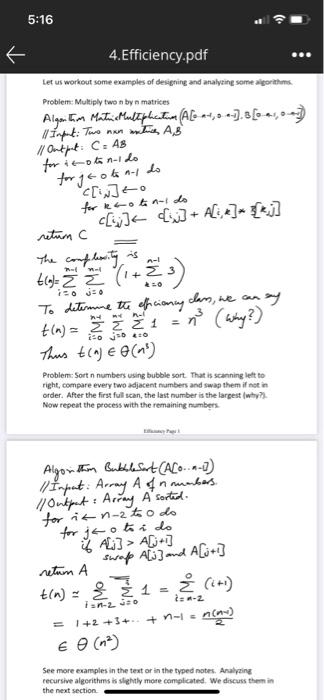
1) For each of the following functions, find the basic efficiency class it belongs to (as Theta of). Must prove your assertion. You may use any theorems stated in Chap2.pdf.
a) (n2+1)10
b) 2n ln(n + 2)2 + (n + 2)2 ln(n/2). Here ln stands for natural logarithm loge.
2) Obtain c1, c2 and n0 as in the definition to show that g(n) = 2n2 - 5n + 6 belongs to (n2). Always show your work as done in worked out examples.
ARA The Index de trishp water The te wo with that both th This Example 2.2. Test your understanding . We . With the hotele that may become them PN. Mit CHAR ALGORITY ALGORITM Sfants(E-2) CA et Arany Addedebarching ZACJE * Wh ti , , 7 Dit all the contes . With Alexie 2.2. Asymptotic Nation Te De O is tal CO 5:16 4.Efficiency.pdf Let us workout some examples of designing and analyzing some sigorithms Problem: Multiply twen by n matrices Algo. Im Materi Multiplication Alex, 5.3.3[04,0) Input: Two nun antico AB antpt: C 48 for coton-ido for geoton-l do C[w]to for kao to n-ido [] + Acce]*[47] retum C & 10 t(a)-ZE Tojs To determine the efficiency class, we can say tim = 2221 En (why?) Thus t(a () Problem: Sort n numbers using bubble sort. That is scanning left to right, compare every two adjacent numbers and swap them if not in order. After the first full scan, the last number is the largest (why?) Now repeat the process with the remaining numbers Alyon ton BubbleSort (Aco. .--3) 1 Input: Array A of numbers. 11 Output: Array A sorted. for it n-2 to o do for je o to i do 4L3 > A[+] Swop AC3] and AC +1] retum A t(m) = 3 1 ion-2 320 () -2 E (na) See more examples in the text or in the typed notes. Analyzing recursive algorithms is slightly more complicated. We discuss them in the next
Step by Step Solution
There are 3 Steps involved in it

Get step-by-step solutions from verified subject matter experts
 Study Help