



Question: b) Anna currently places orders for bread flour every 14 days and the quantity she orders is exactly the quantity needed to satisfy her consumption
b) Anna currently places orders for bread flour every 14 days and the quantity she orders is exactly the quantity needed to satisfy her consumption of bread flour between two orders and she times the ordering so that the delivery arrives just as she runs out of bread flour. What is her average total cost per week (setup + inventory holding + purchasing)?
c) Assume the inputs in part b, What should Anna's reorder point be?
d) Suppose that Anna's friend Gilbert is only available to help with the receiving and storing of a delivery at most once a week and Anna cannot find anyone else to help her with that task. How much should Anna order every time she calls her supplier then? Explain why.
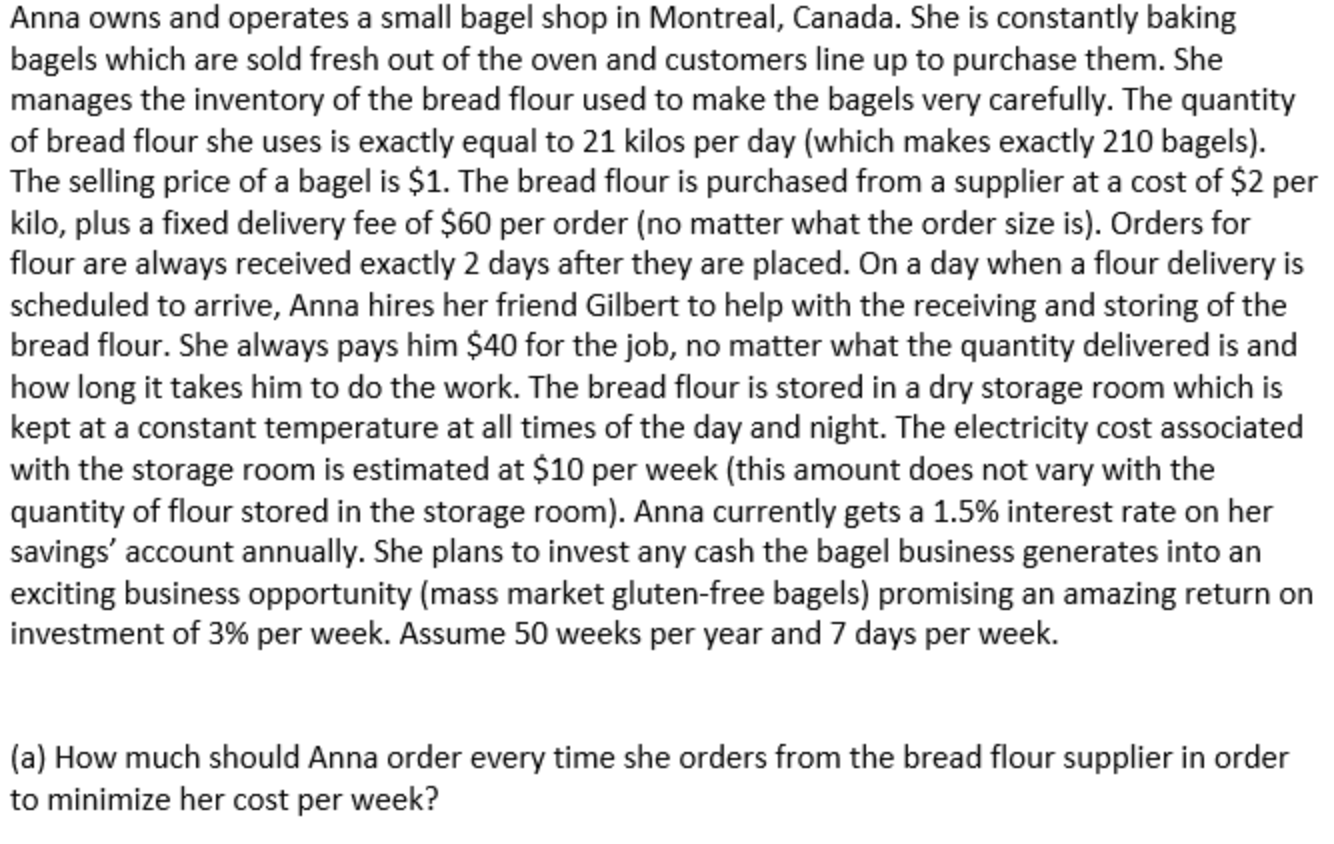
Anna owns and operates a small bagel shop in Montreal, Canada. She is constantly baking bagels which are sold fresh out of the oven and customers line up to purchase them. She manages the inventory of the bread flour used to make the bagels very carefully. The quantity of bread flour she uses is exactly equal to 21 kilos per day (which makes exactly 210 bagels). The selling price of a bagel is $1. The bread flour is purchased from a supplier at a cost of $2 per kilo, plus a fixed delivery fee of $60 per order (no matter what the order size is). Orders for flour are always received exactly 2 days after they are placed. On a day when a flour delivery is scheduled to arrive, Anna hires her friend Gilbert to help with the receiving and storing of the bread flour. She always pays him $40 for the job, no matter what the quantity delivered is and how long it takes him to do the work. The bread flour is stored in a dry storage room which is kept at a constant temperature at all times of the day and night. The electricity cost associated with the storage room is estimated at $10 per week (this amount does not vary with the quantity of flour stored in the storage room). Anna currently gets a 1.5% interest rate on her savings' account annually. She plans to invest any cash the bagel business generates into an exciting business opportunity (mass market gluten-free bagels) promising an amazing return on investment of 3% per week. Assume 50 weeks per year and 7 days per week. (a) How much should Anna order every time she orders from the bread flour supplier in order to minimize her cost per weekStep by Step Solution
There are 3 Steps involved in it

Get step-by-step solutions from verified subject matter experts