



Question: b. Assume you are filing under single status. Using the income tax table provided below, answer the following questions. TABLE 7-ANNUAL Payroll Period (a) SINGLE
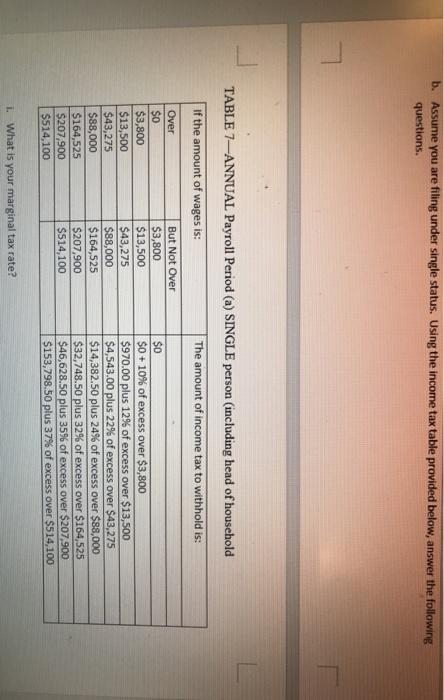

b. Assume you are filing under single status. Using the income tax table provided below, answer the following questions. TABLE 7-ANNUAL Payroll Period (a) SINGLE person (including head of household If the amount of wages is: The amount of income tax to withhold is: Over $0 $3,800 $13,500 $43,275 $88,000 $164,525 $207,900 $514,100 But Not Over $3,800 $13,500 $43,275 $88,000 $164,525 $207,900 $514,100 $0 $0 + 10% of excess over $3,800 $970.00 plus 12% of excess over $13,500 $4,543.00 plus 22% of excess over $43,275 $14,382.50 plus 24% of excess over $88,000 $32,748.50 plus 32% of excess over $164,525 $46,628.50 plus 35% of excess over $207,900 $153,798.50 plus 37% of excess over $514,100 i. What is your marginal tax rate? 1. What is your marginal tax rate? 1. What is your average (effective) tax rate? First determine the actual tax withheld from your income. Use the income calculated in part 1.a. Why do the two tax rates vary? Explain why the US tax code is structured in this manner. Do you agree with this structure? Why or why not? iv. Calculate your take-home pay using the pay in part 1.a. and the taxes calculated in part 1.b.l. (ignore employment taxes) V. Which is the relevant tax rate (marginal or average) as you consider whether or not you should work a second job to help you pay off your student loans more quickly? Why
Step by Step Solution
There are 3 Steps involved in it

Get step-by-step solutions from verified subject matter experts