



Question: b) c) d) . Consider a two person (1 and 2), two good (A and B) economy. Social welfare for the economy is: W=2U+U.,. Draw
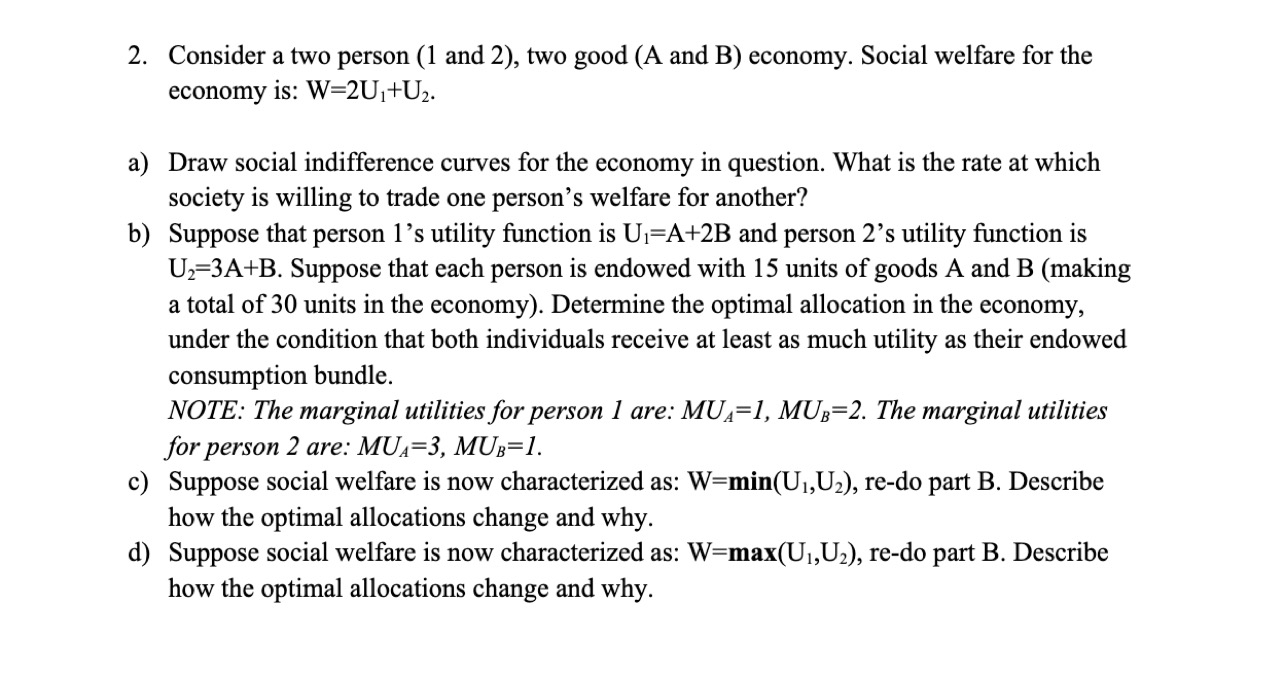
b) c) d) . Consider a two person (1 and 2), two good (A and B) economy. Social welfare for the economy is: W=2U+U.,. Draw social indifference curves for the economy in question. What is the rate at which society is willing to trade one person's welfare for another? Suppose that person 1's utility function is U;=A+2B and person 2's utility function is U,=3A+B. Suppose that each person is endowed with 15 units of goods A and B (making a total of 30 units in the economy). Determine the optimal allocation in the economy, under the condition that both individuals receive at least as much utility as their endowed consumption bundle. NOTE: The marginal utilities for person 1 are: MU,=1, MUy=2. The marginal utilities Jor person 2 are: MU,=3, MUp=1. Suppose social welfare is now characterized as: W=min(U,,U,), re-do part B. Describe how the optimal allocations change and why. Suppose social welfare is now characterized as: W=max(U,,U,), re-do part B. Describe how the optimal allocations change and why
Step by Step Solution
There are 3 Steps involved in it

Get step-by-step solutions from verified subject matter experts