







Question: B C D E F G H I 1 Perfect Parties, Inc. has several divisions. One division provides birthday parties at their facility. 2 Each
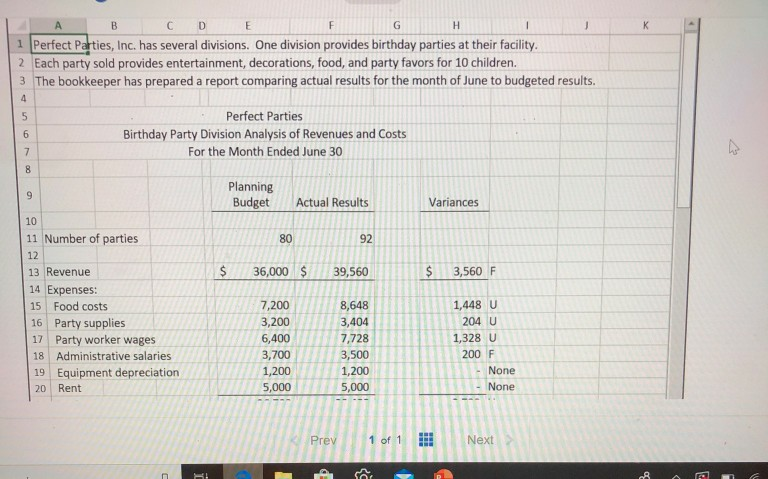
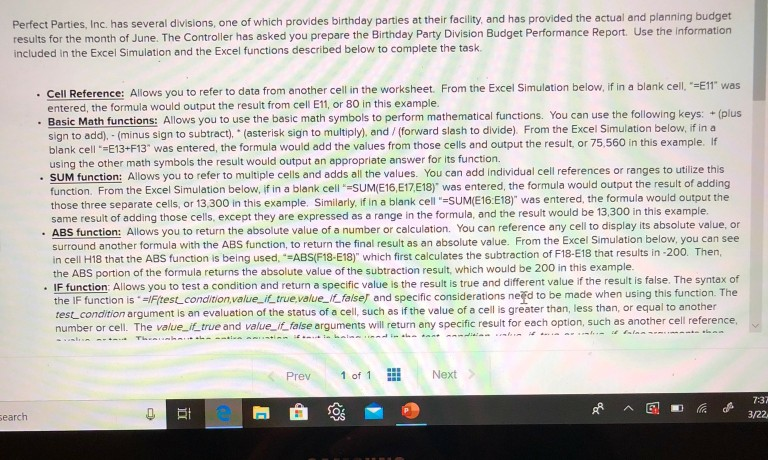
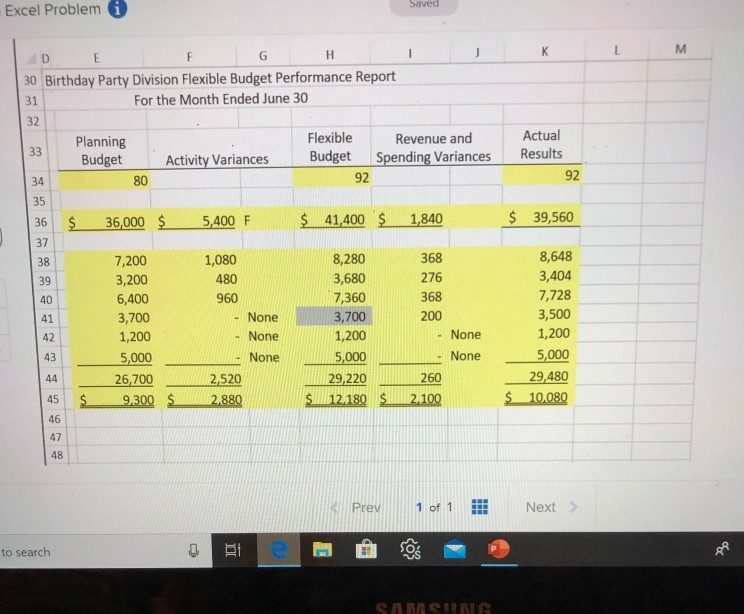
B C D E F G H I 1 Perfect Parties, Inc. has several divisions. One division provides birthday parties at their facility. 2 Each party sold provides entertainment, decorations, food, and party favors for 10 children. 3 The bookkeeper has prepared a report comparing actual results for the month of June to budgeted results. Perfect Parties Birthday Party Division Analysis of Revenues and Costs For the Month Ended June 30 Planning Budget Actual Results Variances 11 Number of parties 92 39,560 36,000 $ $ 3,560 F 13 Revenue 14 Expenses: 15 Food costs 16 Party supplies 17 Party worker wages Administrative salaries Equipment depreciation 20 Rent 7,200 3,200 6,400 3,700 1,2001 5,000 ---- 18 8,648 3,404 7,728 3,500 ,200 5,000 ----- 1,448 U 204 U 1,328 U 200 F - None - None 19 Next n ! A Perfect Parties, Inc. has several divisions, one of which provides birthday parties at their facility, and has provided the actual and planning budget results for the month of June. The Controller has asked you prepare the Birthday Party Division Budget Performance Report. Use the information included in the Excel Simulation and the Excel functions described below to complete the task. Cell Reference: Allows you to refer to data from another cell in the worksheet. From the Excel Simulation below, if in a blank cell, "=E11" was entered, the formula would output the result from cell E11, or 80 in this example, Basic Math functions: Allows you to use the basic math symbols to perform mathematical functions. You can use the following keys: + (plus sign to add). - (minus sign to subtract). (asterisk sign to multiply), and / (forward slash to divide). From the Excel Simulation below, if in a blank cell =E13+F13' was entered, the formula would add the values from those cells and output the result, or 75,560 in this example. If using the other math symbols the result would output an appropriate answer for its function. SUM function: Allows you to refer to multiple cells and adds all the values. You can add individual cell references or ranges to utilize this function. From the Excel Simulation below, if in a blank cell =SUM(E16, E17.E18) was entered, the formula would output the result of adding those three separate cells, or 13.300 in this example. Similarly, if in a blank cell =SUM(E16.E18)" was entered the formula would output the same result of adding those cells, except they are expressed as a range in the formula, and the result would be 13,300 in this example, ABS function: Allows you to return the absolute value of a number or calculation. You can reference any cell to display its absolute value, or surround another formula with the ABS function, to return the final result as an absolute value. From the Excel Simulation below, you can see in cell H18 that the ABS function is being used, "=ABS(F18-E18)" which first calculates the subtraction of F18-E18 that results in -200. Then, the ABS portion of the formula returns the absolute value of the subtraction result, which would be 200 in this example. . IF function: Allows you to test a condition and return a specific value is the result is true and different value if the result is false. The syntax of the IF function is =/F/test_condition value_it_true value_l_false) and specific considerations need to be made when using this function. The test condition argument is an evaluation of the status of a cell, such as if the value of a cell is greater than, less than or equal to another number or cell. The value_it_true and value_it_false arguments will return any specific result for each option, such as another cell reference, Prev 1 of 1 ! Next > A se earch of A 22 Saved Excel Problem 30 Birthday Party Division Flexible Budget Performance Report For the Month Ended June 30 Planning Budget Flexible Budget Revenue and Spending Variances Actual Results Activity Variances 92 $ 36,000 $ 5,400 F $ 41,400 $ 1,840 $ 39,560 1,080 480 7,200 3,200 6,400 3,700 1,200 5,000 26,700 9.300 $ 960 None None None 2.520 2,880 8,280 3,680 7,360 3,700 1,200 5,000 29,220 12.180 $ 8,648 3,404 7,728 3,500 1,200 5,000 29,480 10.080 None - None 260 2.100 $ $ Prev 1 of 1 !!! Next > to search SAMSUNG
Step by Step Solution
There are 3 Steps involved in it

Get step-by-step solutions from verified subject matter experts
 Study Help