







Question: (b) (C) Let Y1, Y2, ....,Yn be a random sample from a distribution of the form 1 l f(Vll3l= 1 exp{} ; y>0, B>0. y'
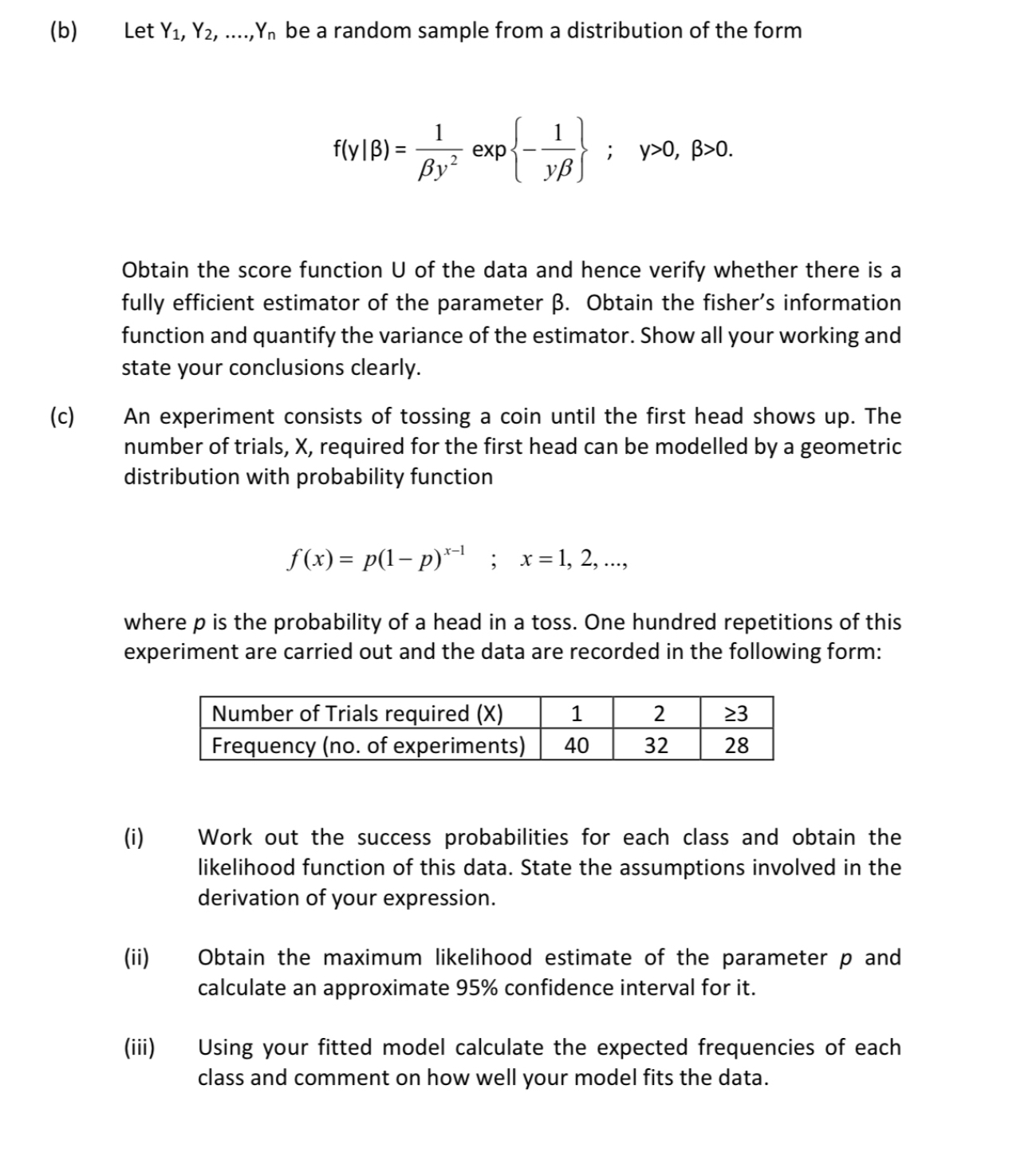
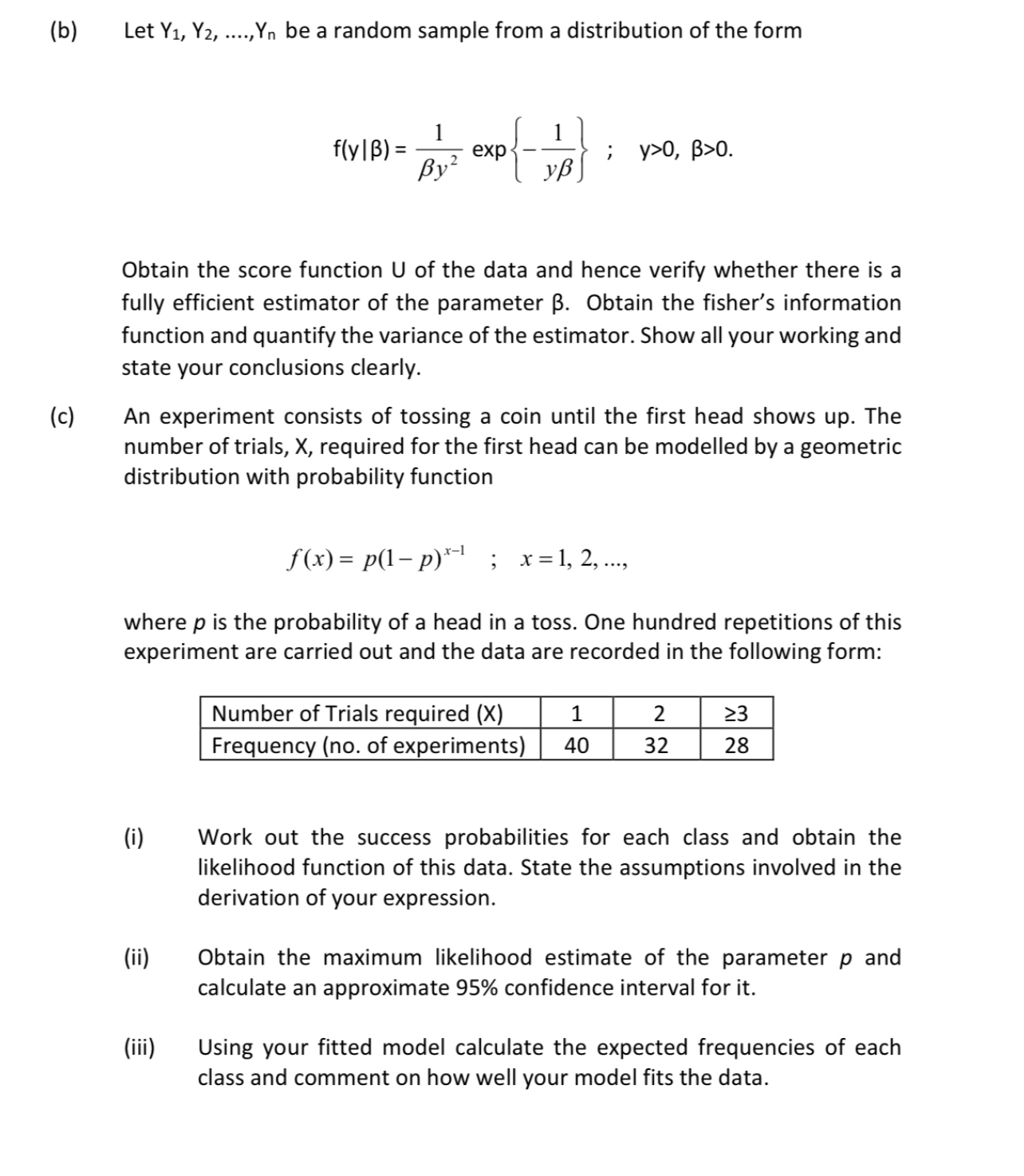
(b) (C) Let Y1, Y2, ....,Yn be a random sample from a distribution of the form 1 l f(Vll3l= 1 exp{} ; y>0, B>0. y' y Obtain the score function U of the data and hence verify whether there is a fully efficient estimator of the parameter [3. Obtain the fisher's information function and quantify the variance ofthe estimator. Show all your working and state your conclusions clearly. An experiment consists of tossing a coin until the first head shows up. The number of trials, X, required for the first head can be modelled by a geometric distribution with probability function fix)=p(1-p)"\" ; x=1, 2 where p is the probability of a head in a toss. One hundred repetitions of this experiment are carried out and the data are recorded in the following form: Number of Trials required (X) Frequency (no. of experiments) m__ (i) Work out the success probabilities for each class and obtain the likelihood function of this data. State the assumptions involved in the derivation of your expression. (ii) Obtain the maximum likelihood estimate of the parameter p and calculate an approximate 95% confidence interval for it. (iii) Using your fitted model calculate the expected frequencies of each class and comment on how well your model fits the data
Step by Step Solution
There are 3 Steps involved in it

Get step-by-step solutions from verified subject matter experts
 Study Help