



Question: (b) Calculate the interquartile range for just the cereals rated good. Is this value greater than, less than, or about equal to the interquartile range
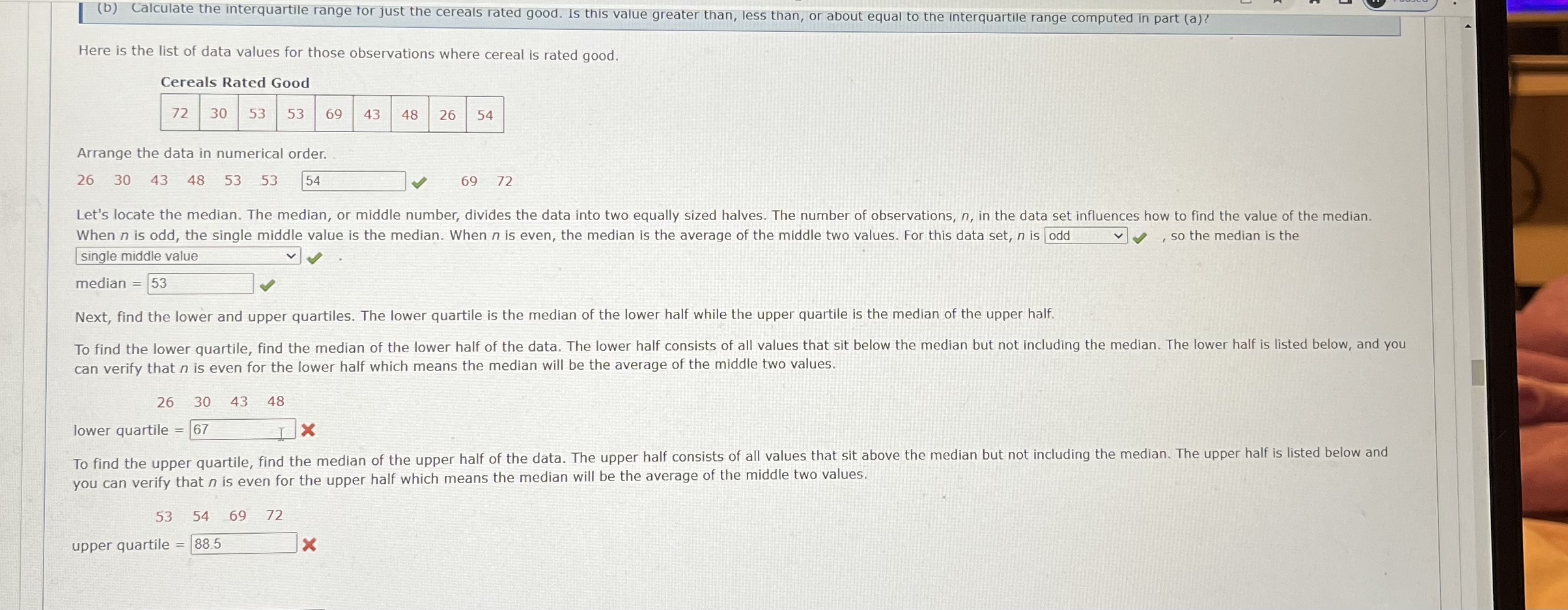
(b) Calculate the interquartile range for just the cereals rated good. Is this value greater than, less than, or about equal to the interquartile range computed in part (a)? Here is the list of data values for those observations where cereal is rated good. Cereals Rated Good 72 30 53 53 69 43 48 26 54 Arrange the data in numerical order. 26 43 48 53 53 54 69 72 Let's locate the median. The median, or middle number, divides the data into two equally sized halves. The number of observations, n, in the data set influences how to find the value of the median. When n is odd, the single middle value is the median. When n is even, the median is the average of the middle two values. For this data set, n is odd v , so the median is the single middle value median = 53 Next, find the lower and upper quartiles. The lower quartile is the median of the lower half while the upper quartile is the median of the upper half. To find the lower quartile, find the median of the lower half of the data. The lower half consists of all values that sit below the median but not including the median. The lower half is listed below, and you can verify that n is even for the lower half which means the median will be the average of the middle two values. 30 43 48 lower quartile = 67 X To find the upper quartile, find the median of the upper half of the data. The upper half consists of all values that sit above the median but not including the median. The upper half is listed below and you can verify that n is even for the upper half which means the median will be the average of the middle two values. 53 54 69 72 upper quartile = 88.5 X
Step by Step Solution
There are 3 Steps involved in it

Get step-by-step solutions from verified subject matter experts