



Question: (b) Choose the best polynomial model obtained from the previous part, and use to it regress the entire dataset. Report the polynomial coefficients and make
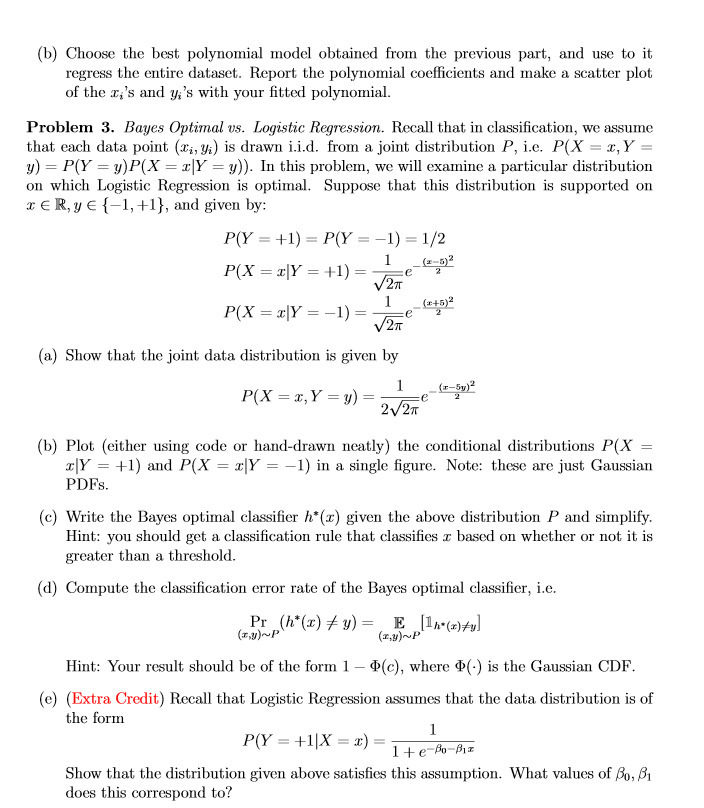
(b) Choose the best polynomial model obtained from the previous part, and use to it regress the entire dataset. Report the polynomial coefficients and make a scatter plot of the my's and ye's with your fitted polynomial. Problem 3. Bayes Optimal us. Logistic Regression. Recall that in classification, we assume that each data point (2;, y;) is drawn i.i.d. from a joint distribution P, i.e. P(X = x, Y = y) = P(Y = y)P(X = =\\Y = y)). In this problem, we will examine a particular distribution on which Logistic Regression is optimal. Suppose that this distribution is supported on rER,y ( {-1, +1}, and given by: P(Y = +1) = P(Y = -1) =1/2 P(X = x|Y = +1) = 1 - (1 5)2 V27T 1 (2+5)2 P(X = x|Y = -1) = V2T (a) Show that the joint data distribution is given by P(X = x, Y = y) = 1 (x-5y)2 (b) Plot (either using code or hand-drawn neatly) the conditional distributions P(X = x Y = +1) and P(X = x|Y = -1) in a single figure. Note: these are just Gaussian PDFS. (c) Write the Bayes optimal classifier h*(x) given the above distribution P and simplify. Hint: you should get a classification rule that classifies z based on whether or not it is greater than a threshold. (d) Compute the classification error rate of the Bayes optimal classifier, i.e. Pr (h*(x) / y) = E liot] Hint: Your result should be of the form 1 - (c), where d(.) is the Gaussian CDF. (e) (Extra Credit) Recall that Logistic Regression assumes that the data distribution is of the form P(Y = +1[X = x) = 1 te Po-Biz Show that the distribution given above satisfies this assumption. What values of Do, B1 does this correspond to
Step by Step Solution
There are 3 Steps involved in it

Get step-by-step solutions from verified subject matter experts