







Question: (b) Compare the conversion profiles in a conventional PFR with those of a membrane reactor from part (a). What generalizations can you make? (c) Would
(b) Compare the conversion profiles in a conventional PFR with those of a membrane reactor from part (a). What generalizations can you make?
(c) Would the conversion of A be greater or smaller if C were diffusing out instead of B?
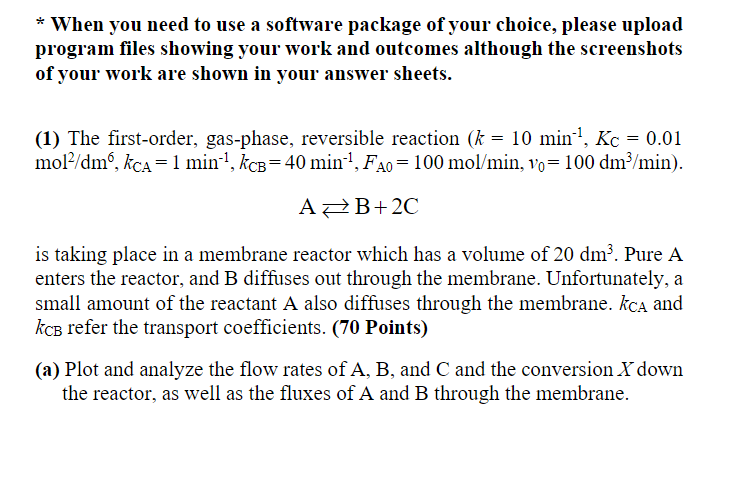
* When you need to use a software package of your choice, please upload program files showing your work and outcomes although the screenshots of your work are shown in your answer sheets. (1) The first-order, gas-phase, reversible reaction ( k=10min1,KC=0.01 mol2/dm6,kCA=1min1,kCB=40min1,FA0=100mol/min,v0=100dm3/min). AB+2C is taking place in a membrane reactor which has a volume of 20dm3. Pure A enters the reactor, and B diffuses out through the membrane. Unfortunately, a small amount of the reactant A also diffuses through the membrane. kCA and kCB refer the transport coefficients. (70 Points) (a) Plot and analyze the flow rates of A,B, and C and the conversion X down the reactor, as well as the fluxes of A and B through the membrane. * When you need to use a software package of your choice, please upload program files showing your work and outcomes although the screenshots of your work are shown in your answer sheets. (1) The first-order, gas-phase, reversible reaction ( k=10min1,KC=0.01 mol2/dm6,kCA=1min1,kCB=40min1,FA0=100mol/min,v0=100dm3/min). AB+2C is taking place in a membrane reactor which has a volume of 20dm3. Pure A enters the reactor, and B diffuses out through the membrane. Unfortunately, a small amount of the reactant A also diffuses through the membrane. kCA and kCB refer the transport coefficients. (70 Points) (a) Plot and analyze the flow rates of A,B, and C and the conversion X down the reactor, as well as the fluxes of A and B through the membrane
Step by Step Solution
There are 3 Steps involved in it

Get step-by-step solutions from verified subject matter experts
 Study Help