







Question: B. Conservative and Non-conservative Forces In this activity you will explore the meaning of path-independent work and its relation to the definition of a conservative
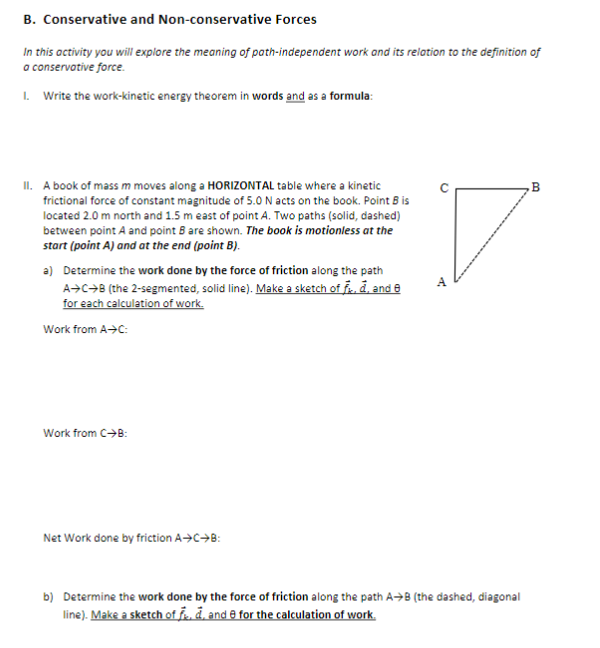
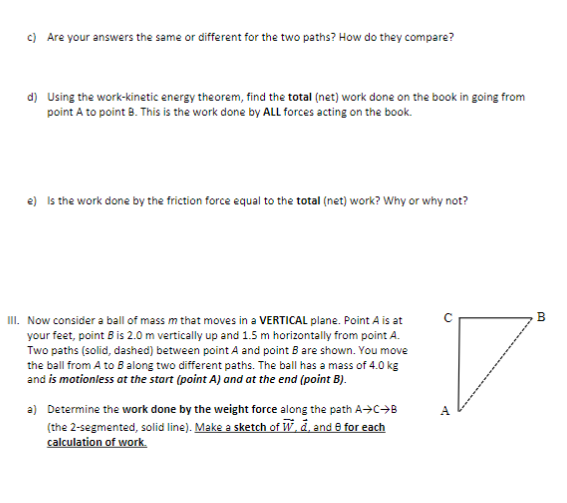
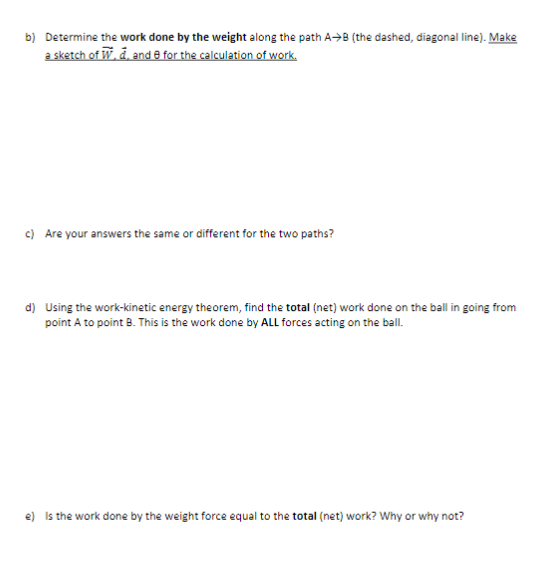
B. Conservative and Non-conservative Forces In this activity you will explore the meaning of path-independent work and its relation to the definition of a conservative force. I. Write the work-kinetic energy theorem in words and as a formula: Il. A book of mass m moves along a HORIZONTAL table where a kinetic C B frictional force of constant magnitude of 5.0 N acts on the book. Point B is located 2.0 m north and 1.5 m east of point A. Two paths (solid, dashed) between point A and point S are shown. The book is motionless at the start (point A) and at the end (point B). a) Determine the work done by the force of friction along the path A-C+B (the 2-segmented, solid line). Make a sketch of fic, d, and e A for each calculation of work. Work from A-C: Work from C-B: Net Work done by friction A-C- B: b) Determine the work done by the force of friction along the path A-+8 (the dashed, diagonal line). Make a sketch of fic. d. and e for the calculation of work.c) Are your answers the same or different for the two paths? How do they compare? d) Using the work-kinetic energy theorem, find the total (net) work done on the book in going from point A to point B. This is the work done by ALL forces acting on the book. e) Is the work done by the friction force equal to the total (net) work? Why or why not? Ill. Now consider a bell of mass m that moves in a VERTICAL plane. Point A is at C B your feet, point B is 2.0 m vertically up and 1.5 m horizontally from point A. Two paths (solid, dashed) between point A and point B are shown. You move the bell from A to B along two different paths. The ball has a mass of 4.0 kg and is motionless at the start (point A) and at the end (point B). e) Determine the work done by the weight force along the path A-C-B A (the 2-segmented, solid line). Make a sketch of W. d, and e for each calculation of work.b) Determine the work done by the weight along the path A-+ 8 (the dashed, diagonal line). Make a sketch of W. d. and @ for the calculation of work. c) Are your answers the same or different for the two paths? dj Using the work-kinetic energy theorem, find the total (net) work done on the ball in going from point A to point B. This is the work done by ALL forces acting on the ball. e) Is the work done by the weight force equal to the total (net) work? Why or why not
Step by Step Solution
There are 3 Steps involved in it

Get step-by-step solutions from verified subject matter experts
 Study Help