



Question: (b) Consider that you are asked to design a permanent magnet motor that will fit to each of the wheels of a popular electric vehicle
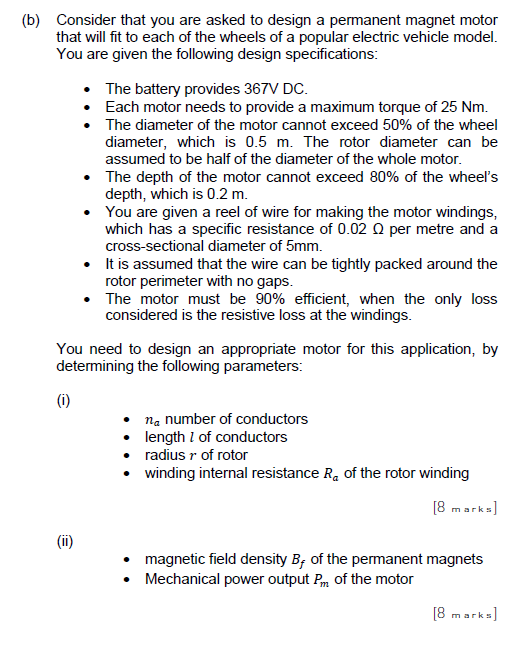
(b) Consider that you are asked to design a permanent magnet motor that will fit to each of the wheels of a popular electric vehicle model. You are given the following design specifications: The battery provides 367V DC. Each motor needs to provide a maximum torque of 25 Nm. The diameter of the motor cannot exceed 50% of the wheel diameter, which is 0.5 m. The rotor diameter can be assumed to be half of the diameter of the whole motor. The depth of the motor cannot exceed 80% of the wheel's depth, which is 0.2 m. You are given a reel of wire for making the motor windings, which has a specific resistance of 0.02 per metre and a cross-sectional diameter of 5mm. It is assumed that the wire can be tightly packed around the rotor perimeter with no gaps. The motor must be 90% efficient, when the only loss considered is the resistive loss at the windings. You need to design an appropriate motor for this application, by determining the following parameters: (i) na number of conductors length 1 of conductors radius r of rotor winding internal resistance Ra of the rotor winding [8 marks] (ii) magnetic field density Bf of the permanent magnets Mechanical power output Pm of the motor [8 marks] (b) Consider that you are asked to design a permanent magnet motor that will fit to each of the wheels of a popular electric vehicle model. You are given the following design specifications: The battery provides 367V DC. Each motor needs to provide a maximum torque of 25 Nm. The diameter of the motor cannot exceed 50% of the wheel diameter, which is 0.5 m. The rotor diameter can be assumed to be half of the diameter of the whole motor. The depth of the motor cannot exceed 80% of the wheel's depth, which is 0.2 m. You are given a reel of wire for making the motor windings, which has a specific resistance of 0.02 per metre and a cross-sectional diameter of 5mm. It is assumed that the wire can be tightly packed around the rotor perimeter with no gaps. The motor must be 90% efficient, when the only loss considered is the resistive loss at the windings. You need to design an appropriate motor for this application, by determining the following parameters: (i) na number of conductors length 1 of conductors radius r of rotor winding internal resistance Ra of the rotor winding [8 marks] (ii) magnetic field density Bf of the permanent magnets Mechanical power output Pm of the motor [8 marks]
Step by Step Solution
There are 3 Steps involved in it

Get step-by-step solutions from verified subject matter experts