







Question: b) Efficient Power. Consider the power(x,n) function, with ? any number, and n a non-negative integer, that computes Since we love recursion we may consider
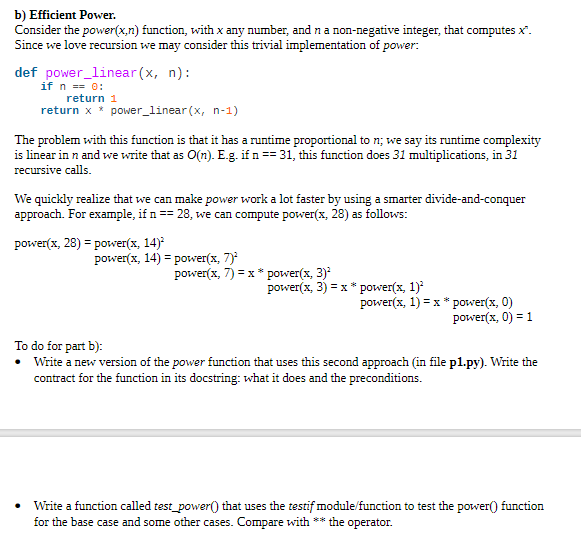
b) Efficient Power. Consider the power(x,n) function, with ? any number, and n a non-negative integer, that computes Since we love recursion we may consider this trivial implementation of power: def power_linear(x, n): return 1 return x * power-linear(x, n-1) The problem with this function is that it has a runtime proportional to n; we say its runtime complexity is linear in n and we write that as O(n). E.g. if n-31, this function does 31 multiplications, in 31 recursive calls. We quickly realize that we can make power work a lot faster by using a smarter divide-and-conquer approach. For example, if n = 28, we can compute power(, 28) as follows: To do for part b): * Write a new version of the power function that uses this second approach (in file p1.py). Write the contract for the function in its docstring: what it does and the preconditions. * Write a function called test_power that uses the testif module/function to test the power function for the base case and some other cases. Compare with ** the operator
Step by Step Solution
There are 3 Steps involved in it

Get step-by-step solutions from verified subject matter experts
 Study Help