Question: b. Evaluate the manner in which Diversified Electronics has implemented the investment center concept. What pitfalls did it apparently not anticipate? What, if anything, should
b. Evaluate the manner in which Diversified Electronics has implemented the investment center concept. What pitfalls did it apparently not anticipate? What, if anything, should be done with regard to the investment center approach and the use of ROI as a measure of performance?
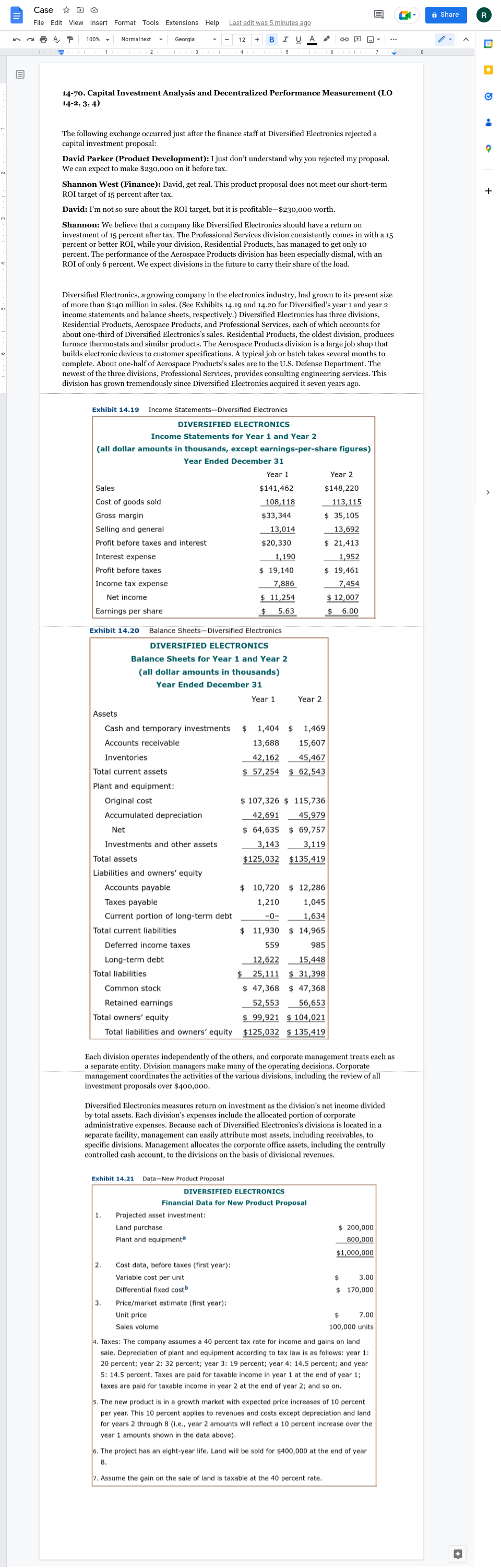
Case * Share File Edit View Insert Format Tools Extensions Help Last edit was 5 minutes ago 100% - Normal text Georgia BIU A GO H - ... 14-70. Capital Investment Analysis and Decentralized Performance Measurement (LO Q 14-2, 3, 4) The following exchange occurred just after the finance staff at Diversified Electronics rejected a capital investment proposal: David Parker (Product Development): I just don't understand why you rejected my proposal. We can expect to make $230,000 on it before tax. hannon West (Finance): David, get real. This product proposal does not meet our short-term ROI target of 15 percent after tax. David: I'm not so sure about the ROI target, but it is profitable-$230,000 worth. Shannon: We believe that a company like Diversified Electronics should have a return on investment of 15 percent after tax. The Professional Services division consistently comes in with a 15 percent or better ROI, while your division, Residential Products, has managed to get only 10 percent. The performance of the Aerospace Products division has been especially dismal, with an ROI of only 6 percent. We expect divisions in the future to carry their share of the load. Diversified Electronics, a growing company in the electronics industry, had grown to its present size of more than $140 million in sales. (See Exhibits 14.19 and 14.20 for Diversified's year 1 and year 2 income statements and balance sheets, respectively.) Diversified Electronics has three divisions, Residential Products, Aerospace Products, and Professional Services, each of which accounts for about one-third of Diversified Electronics's sal Residential Products, the oldest division, produces furnace thermostats and similar products. The Aerospace Products division is a large job shop that builds electronic devices to customer specifications. A A typical job or batch takes several months to complete. About one-half of Aerospace Products's sales are to the U.S. Defense Department. The newest of the three divisions, Professional Services, provides consulting engineering services. This division has grown tremendously since Diversified Electronics acquired it seven years ago. Exhibit 14.19 Income Statements-Diversified Electronics DIVERSIFIED ELECTRONICS Income Statements for Year 1 and Year 2 (all dollar amounts in thousands, except earnings-per-share figures) Year Ended December 31 Year 1 Year 2 Sales $141,462 $148,220 Cost of goods sold 108,118 113,115 Gross margin $33,344 $ 35,105 Selling and general 13,014 13,692 Profit before taxes and interest $20,330 21,413 Interest expense 1,190 1,952 Profit before taxes $ 19,140 19,461 Income tax expense 7,886 7,454 Net income $ 11,254 $ 12,007 Earnings per share $ 5.63 $ 6.00 Exhibit 14.20 Balance Sheets-Diversified Electronics DIVERSIFIED ELECTRONICS Balance Sheets for Year 1 and Year 2 (all dollar amounts in thousands) Year Ended December 31 Year 1 Year 2 Assets Cash and temporary investments $ 1,404 $ 1,469 Accounts receivable 13,688 15,607 Inventories 42,162 45,467 Total current assets $ 57,254 $ 62,543 Plant and equipment: Original cost $ 107,326 $ 115,736 Accumulated depreciation 42,691 45,979 Net $ 64,635 $ 69,757 Investments and other assets 3,143 3,119 Total assets $125,032 $135,419 Liabilities and owners' equity Accounts payable $ 10,720 $ 12,286 Taxes payable 1,210 ,045 Current portion of long-term debt -0- 1,634 Total current liabilities 11,930 $ 14,965 Deferred income taxes 559 985 Long-term debt 12,622 15,448 Total liabilities $ 25,111 $ 31,398 Common stock $ 47,368 $ 47,368 Retained earnings 52,553 56,653 Total owners' equity $ 99,921 $ 104,021 Total liabilities and owners' equity $125,032 $ 135,419 Each division operates independently of the others, and corporate management treats each as a separate entity. Division managers make many of the operating decisions. Corporate management coordinates the activities of the various divisions, including the review of all investment proposals over $400,000. Diversified Electronics measures return on investment as the division's net income divided by total assets. Each division's expenses include the allocated portion of corporate administrative expenses. Because each of Diversified Electronics's divisions is located in a separate facility, management can easily attribute most assets, including receivables, to specific divisions. Management allocates the corporate office assets, including the centrally controlled cash account, to the divisions on the basis of divisional revenues. Exhibit 14.21 Data-New Product Proposal DIVERSIFIED ELECTRONICS Financial Data for New Product Proposal Projected asset investment: Land purchase $ 200,000 Plant and equipmenta 800,000 $1,000,000 Cost data, before taxes (first year): Variable cost per unit 3.00 Differential fixed cost $ 170,000 Price/market estimate (first year): Unit price $ 7.00 Sales volume 100,000 units 4. Taxes: The company assur come and gains on land sale. Depreciation of plant and equipment according to tax law is as follows: year 1: 20 percent; year 2: 32 percent; year 3: 19 percent; year 4: 14.5 percent; and year 5: 14.5 percent. Taxes are paid for taxable income in year 1 at the end of year 1; taxes are paid for taxable in in year 2 at the end of year 2; and so on. 5. The new product is in a growth market with expected price increases of 10 percent per year. This 10 percent applies to revenues and costs except depreciation and land for years 2 through 8 (i.e., year 2 amounts will reflect a 10 percent increase over the year 1 amounts shown in the data above). 6. The project has an eight-year life. Land will be sold for $400,000 at the end of year 8. . Assume the gain on the sale of land is taxable at the 40 percent rate
Step by Step Solution
There are 3 Steps involved in it
1 Expert Approved Answer
Step: 1 Unlock
Question Has Been Solved by an Expert!
Get step-by-step solutions from verified subject matter experts
Step: 2 Unlock
Step: 3 Unlock
Students Have Also Explored These Related Accounting Questions!









 Study Help