





Question: (b) Find px(x), the probability density function for X. (c) Let Y be a random variable obtained from X as follows: Y = 1 if
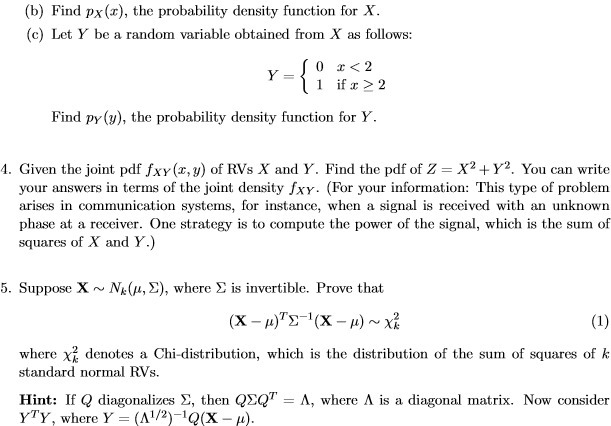
(b) Find px(x), the probability density function
(b) Find px(x), the probability density function for X. (c) Let Y be a random variable obtained from X as follows: Y = 1 if x > 2 Find py(y), the probability density function for Y. 1. Given the joint pdf fxy(x, y) of RVs X and Y. Find the pdf of Z = X? + Y?. You can write your answers in terms of the joint density fxy. (For your information: This type of problem arises in communication systems, for instance, when a signal is received with an unknown phase at a receiver. One strategy is to compute the power of the signal, which is the sum of squares of X and Y.) 5. Suppose X ~ Ne(u, E), where E is invertible. Prove that (X -/) TE- (X -H) ~ Xk (1) where x, denotes a Chi-distribution, which is the distribution of the sum of squares of k standard normal RVs. Hint: If Q diagonalizes E, then QEQ" = A, where A is a diagonal matrix. Now consider YTY, where Y = (A1/2)-1Q(X - u)

Step by Step Solution

There are 3 Steps involved in it

1 Expert Approved Answer
Step: 1 Unlock blur-text-image

Question Has Been Solved by an Expert!

Get step-by-step solutions from verified subject matter experts

Step: 2 Unlock
Step: 3 Unlock

Students Have Also Explored These Related Mathematics Questions!