







Question: B) find the interval of decrease C) find the local maximum and minimum valuesD) find the interval on which f is a concave upFind the
B) find the interval of decrease C) find the local maximum and minimum valuesD) find the interval on which f is a concave upFind the interval on which f is concave down
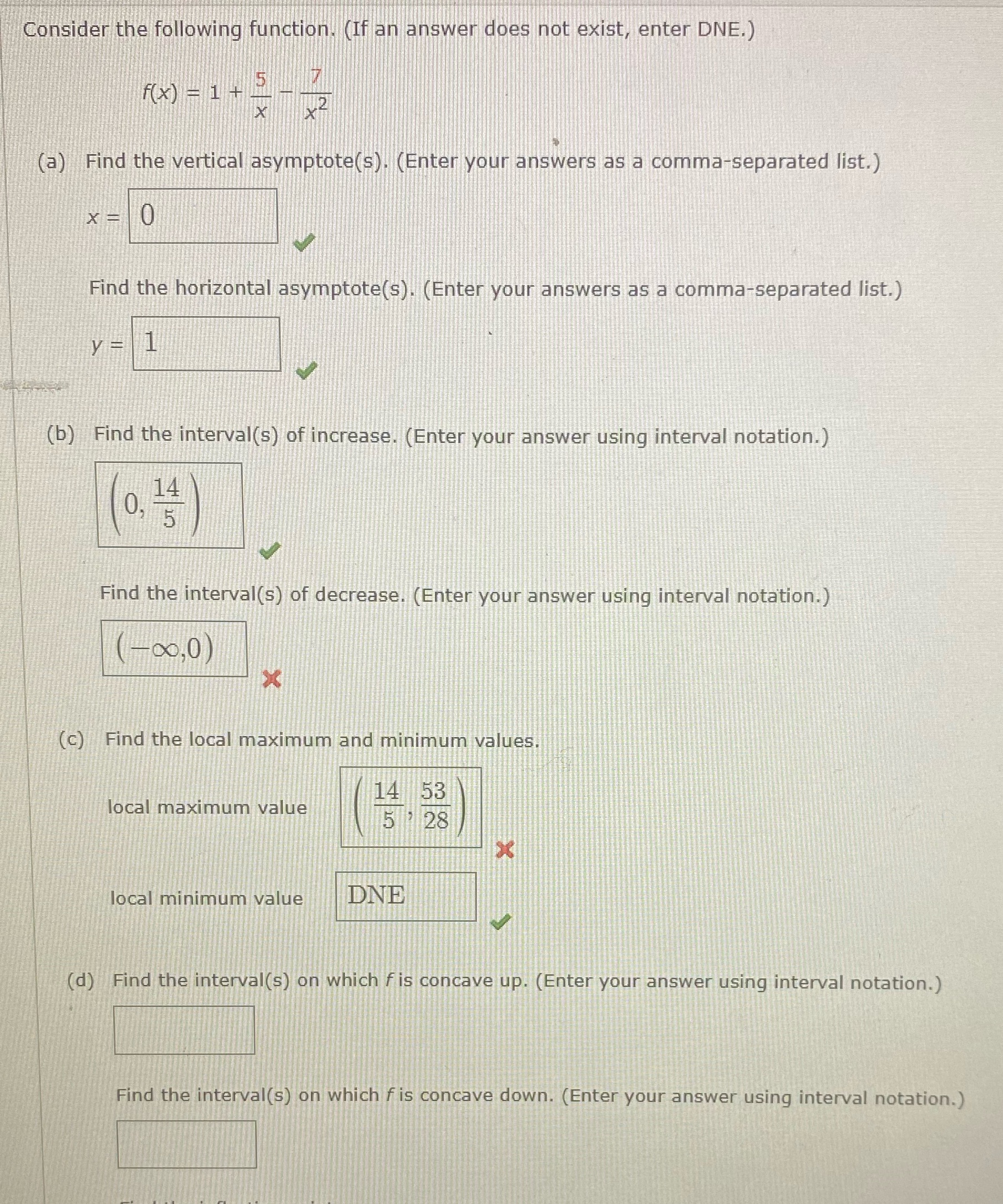
Consider the following function. (If an answer does not exist, enter DNE.) f(x) - 1 + 3 (a) Find the vertical asymptote(s). (Enter your answers as a comma-separated list.) 0 Find the horizontal asymptote(s). (Enter your answers as a comma-separated list.) (b) Find the interval(s) of increase. (Enter your answer using interval notation.) 14 Find the interval(s) of decrease. (Enter your answer using interval notation.) (-00,0) X (c) Find the local maximum and minimum values. 14 53 local maximum value 5 28 local minimum value DNE (d) Find the interval(s) on which f is concave up. (Enter your answer using interval notation.) Find the interval(s) on which f is concave down. (Enter your answer using interval notation.)
Step by Step Solution
There are 3 Steps involved in it

Get step-by-step solutions from verified subject matter experts
 Study Help