







Question: ( b ) friction, and ( c ) indicated mean effective pressures; the ( d ) indicated and ( e ) fuel equivalent power; (
b friction, and c indicated mean effective pressures; the d indicated and e
fuel equivalent power; f the brake thermal efficiency, g the new rate of fuel
consumption, and h the new BSFCi eomparing results from Problems
and does the engine run more efficiently at the lower on higher speed? Why? Table Comparison of properties of several fuels.
a Minimum cetane rating for diesel fuel
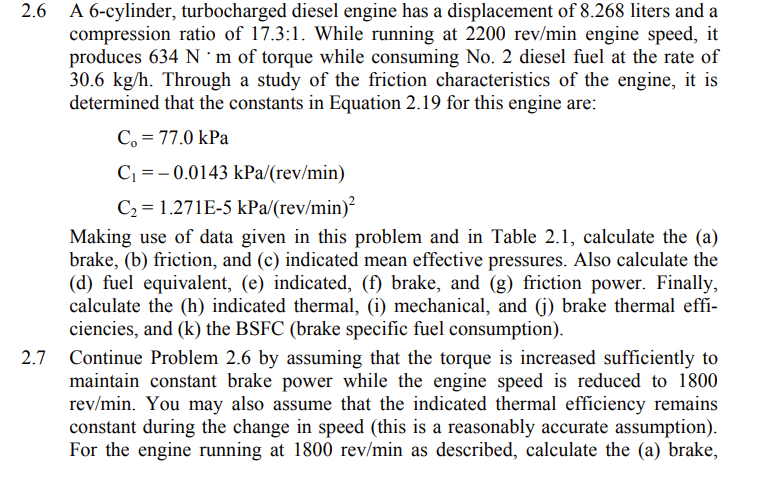
b Cetane rating A cylinder, turbocharged diesel engine has a displacement of liters and a
compression ratio of : While running at engine speed, it
produces of torque while consuming No diesel fuel at the rate of
Through a study of the friction characteristics of the engine, it is
determined that the constants in Equation for this engine are:
kPa
Making use of data given in this problem and in Table calculate the a
brake, b friction, and c indicated mean effective pressures. Also calculate the
d fuel equivalent, e indicated, f brake, and g friction power. Finally,
calculate the h indicated thermal, i mechanical, and j brake thermal effi
ciencies, and k the BSFC brake specific fuel consumption
Continue Problem by assuming that the torque is increased sufficiently to
maintain constant brake power while the engine speed is reduced to
You may also assume that the indicated thermal efficiency remains
constant during the change in speed this is a reasonably accurate assumption
For the engine running at as described, calculate the a brake,
Step by Step Solution
There are 3 Steps involved in it
1 Expert Approved Answer
Step: 1 Unlock

Question Has Been Solved by an Expert!
Get step-by-step solutions from verified subject matter experts
Step: 2 Unlock
Step: 3 Unlock
 Study Help