



Question: b) Given R1 and R2 be the relations on set B = {1, 2, 3, 4). R1 = {(1, 1), (1, 2), (2, 1), (2,
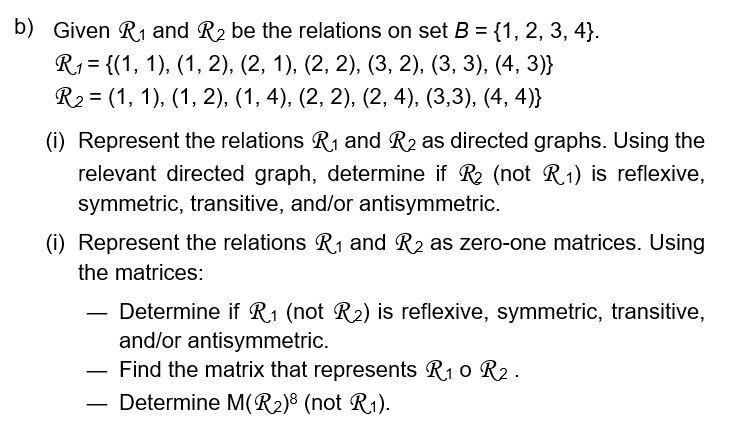
b) Given R1 and R2 be the relations on set B = {1, 2, 3, 4). R1 = {(1, 1), (1, 2), (2, 1), (2, 2), (3, 2), (3, 3), (4,3)} R2 = (1, 1), (1, 2), (1,4), (2, 2), (2, 4), (3,3), (4,4)} (i) Represent the relations R1 and R2 as directed graphs. Using the relevant directed graph, determine if R2 (not R1) is reflexive, symmetric, transitive, and/or antisymmetric. (i) Represent the relations R1 and R2 as zero-one matrices. Using the matrices: Determine if R 1 (not R2) is reflexive, symmetric, transitive, and/or antisymmetric. Find the matrix that represents R1 0 R2. Determine M(R2)8 (not R1)
Step by Step Solution
There are 3 Steps involved in it
1 Expert Approved Answer
Step: 1 Unlock

Question Has Been Solved by an Expert!
Get step-by-step solutions from verified subject matter experts
Step: 2 Unlock
Step: 3 Unlock