







Question: b. Here are data on three hedge funds. Each fund charges its investors an incentive fee of 20% of total returns. Suppose initially that a
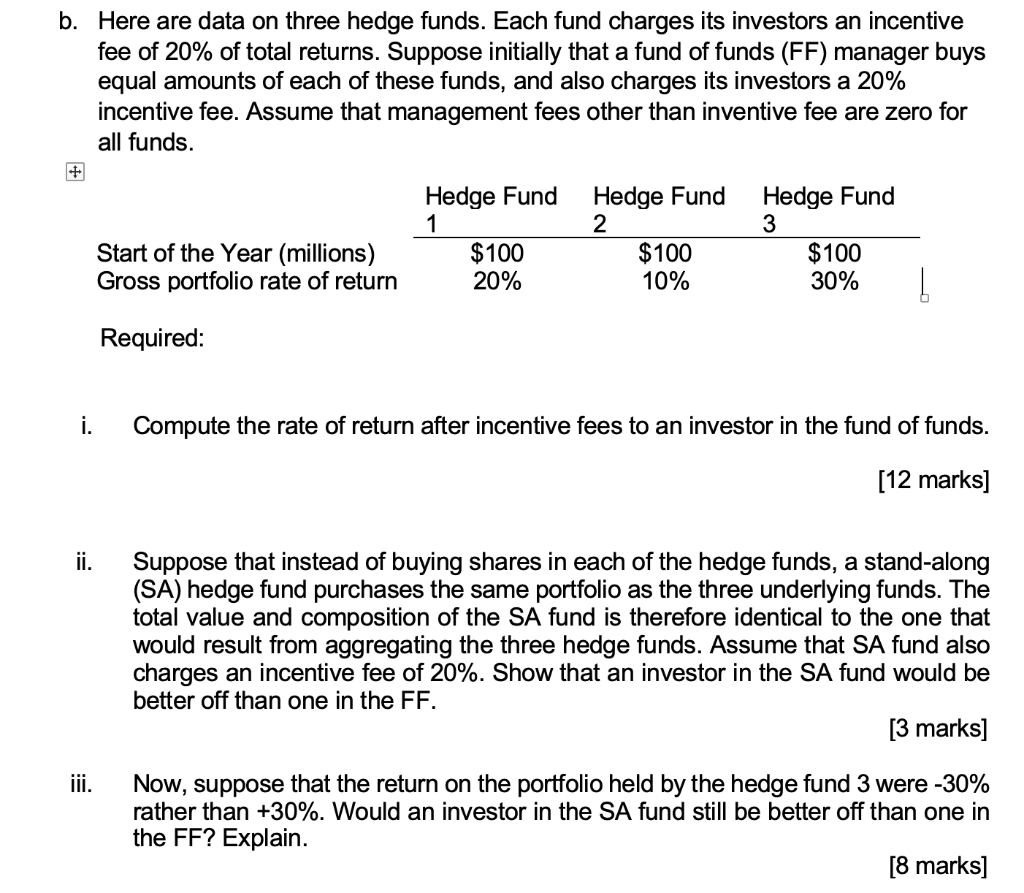
b. Here are data on three hedge funds. Each fund charges its investors an incentive fee of 20% of total returns. Suppose initially that a fund of funds (FF) manager buys equal amounts of each of these funds, and also charges its investors a 20% incentive fee. Assume that management fees other than inventive fee are zero for all funds. Hedge Fund Hedge Fund Hedge Fund 1 2 3 $100 $100 $100 Start of the Year (millions) Gross portfolio rate of return 20% 10% 30% Required: i. Compute the rate of return after incentive fees to an investor in the fund of funds. [12 marks] ii. Suppose that instead of buying shares in each of the hedge funds, a stand-along (SA) hedge fund purchases the same portfolio as the three underlying funds. The total value and composition of the SA fund is therefore identical to the one that would result from aggregating the three hedge funds. Assume that SA fund also charges an incentive fee of 20%. Show that an investor in the SA fund would be better off than one in the FF. [3 marks] iii. Now, suppose that the return on the portfolio held by the hedge fund 3 were -30% rather than +30%. Would an investor in the SA fund still be better off than one in the FF? Explain. [8 marks]
Step by Step Solution
There are 3 Steps involved in it

Get step-by-step solutions from verified subject matter experts
 Study Help