







Question: B) higher or lower. C) rise or fall. D) tax advantage, risk advantage or the lower dividend payout. Higher than l, Lowery than, or equal
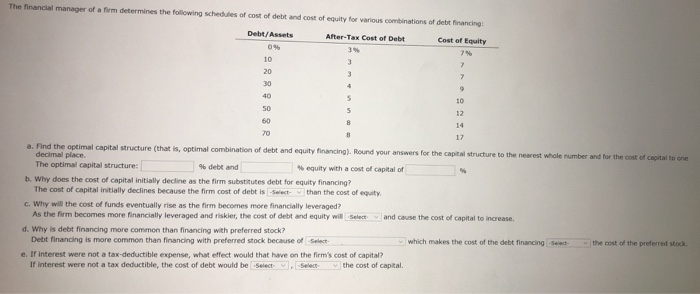
The financial manager of a firm determines the folowing schedules of cost of debt and cost of equity for various combinations of debt financing Debt/Assets After-Tax Cost of Debt Cost of Equity 3% 10 30 40 10 12 60 70 17 a. Find the optimal capital structure (that is, optimal combination of debt and equity financing). Round your answers for the capital structure to the nearest whole number and for the cost of capital to decimal place. %debt and %equity with a cf capital of b. Why does the cost of capital initially decline as the firm substitutes debt for equity financing? c. Why will the cost of funds eventually rise as the firm becomes more financially leveraged? d. Why is debt financing more common than financing with preferred stocki? e. If interest were not a tax-deductible expense, what effect would that have on the firms cost of capital? The optimal capital structure The cost of capital initially declines because the firm cost of debt is -Select than the cost of equity As the firm becomes more financially leveraged and riskier, the cost of debt and equity will Select and cause the cost of capital to increase. Debt financing is more common than financing with preferred stock because of -Select If interest were not a tax deductible, the cost of debt would be SelectSelect the cost of capital. which makes the cost of the debt financing Select the cost of the preferred stock
Step by Step Solution
There are 3 Steps involved in it

Get step-by-step solutions from verified subject matter experts
 Study Help