



Question: (b) In this exercise, you are going to prove a statement from the lecture. Assume that there are constants (a;)?=1 and c such that =14;R;
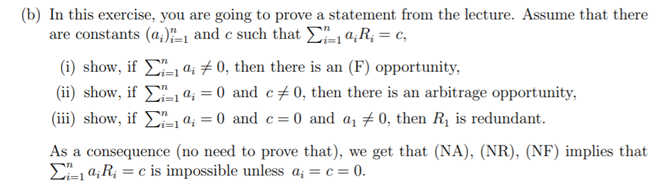
(b) In this exercise, you are going to prove a statement from the lecture. Assume that there are constants (a;)?=1 and c such that =14;R; = C, (i) show, if D1=1 Q; #0, then there is an (F) opportunity, (ii) show, if p_1a; = 0 and c#0, then there is an arbitrage opportunity, (iii) show, if i=12; = 0 and c= 0 and an # 0, then R, is redundant. As a consequence (no need to prove that), we get that (NA), (NR), (NF) implies that Di-a;R; = c is impossible unless a; = c= 0. (b) In this exercise, you are going to prove a statement from the lecture. Assume that there are constants (a;)?=1 and c such that =14;R; = C, (i) show, if D1=1 Q; #0, then there is an (F) opportunity, (ii) show, if p_1a; = 0 and c#0, then there is an arbitrage opportunity, (iii) show, if i=12; = 0 and c= 0 and an # 0, then R, is redundant. As a consequence (no need to prove that), we get that (NA), (NR), (NF) implies that Di-a;R; = c is impossible unless a; = c= 0
Step by Step Solution
There are 3 Steps involved in it

Get step-by-step solutions from verified subject matter experts