







Question: ( b ) King Arthur has problems to administer his realm. His court contains n knights and he rules over m counties. The knights differ
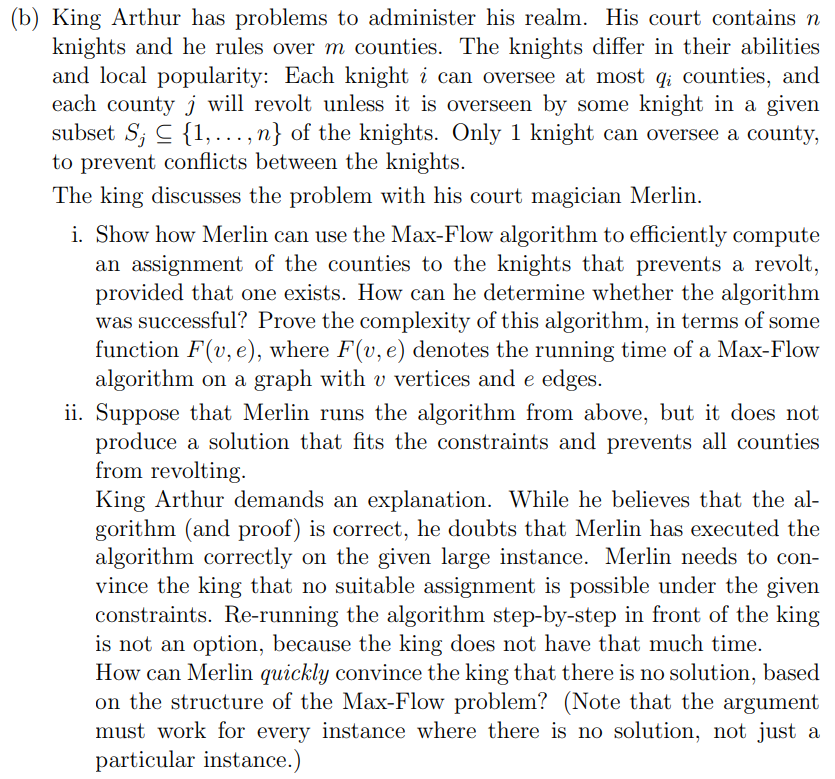
b King Arthur has problems to administer his realm. His court contains
knights and he rules over counties. The knights differ in their abilities
and local popularity: Each knight i can oversee at most counties, and
each county will revolt unless it is overseen by some knight in a given
subset subedots, of the knights. Only knight can oversee a county,
to prevent conflicts between the knights.
The king discusses the problem with his court magician Merlin.
i Show how Merlin can use the MaxFlow algorithm to efficiently compute
an assignment of the counties to the knights that prevents a revolt,
provided that one exists. How can he determine whether the algorithm
was successful? Prove the complexity of this algorithm, in terms of some
function where denotes the running time of a MaxFlow
algorithm on a graph with vertices and edges.
ii Suppose that Merlin runs the algorithm from above, but it does not
produce a solution that fits the constraints and prevents all counties
from revolting.
King Arthur demands an explanation. While he believes that the al
gorithm and proof is correct, he doubts that Merlin has executed the
algorithm correctly on the given large instance. Merlin needs to con
vince the king that no suitable assignment is possible under the given
constraints. Rerunning the algorithm stepbystep in front of the king
is not an option, because the king does not have that much time.
How can Merlin quickly convince the king that there is no solution, based
on the structure of the MaxFlow problem? Note that the argument
must work for every instance where there is no solution, not just a
particular instance.
Step by Step Solution
There are 3 Steps involved in it
1 Expert Approved Answer
Step: 1 Unlock

Question Has Been Solved by an Expert!
Get step-by-step solutions from verified subject matter experts
Step: 2 Unlock
Step: 3 Unlock
 Study Help