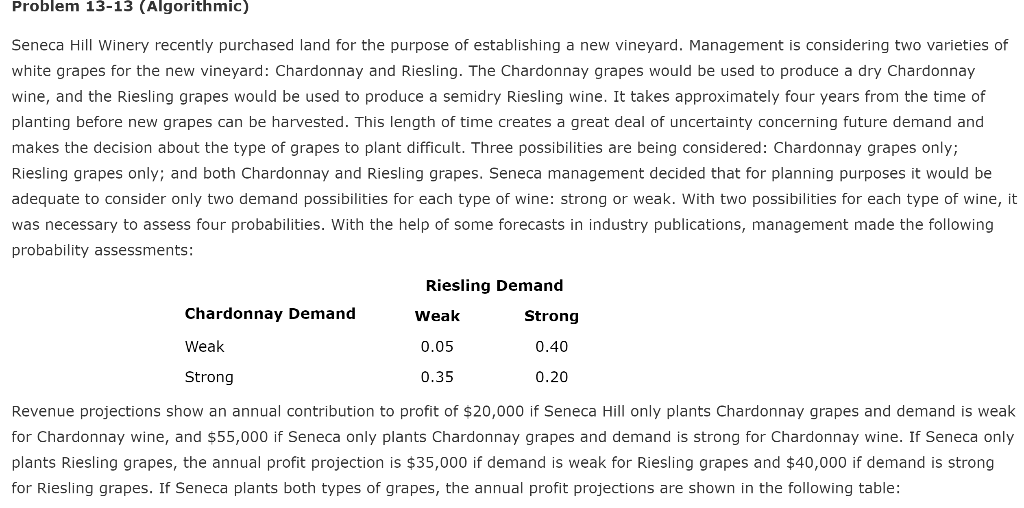
Question: b. Make a decision tree Problem 13-13 (Algorithmic) Seneca Hill Winery recently purchased land for the purpose establishing a new vineyard. Management is considering two
b. Make a decision tree
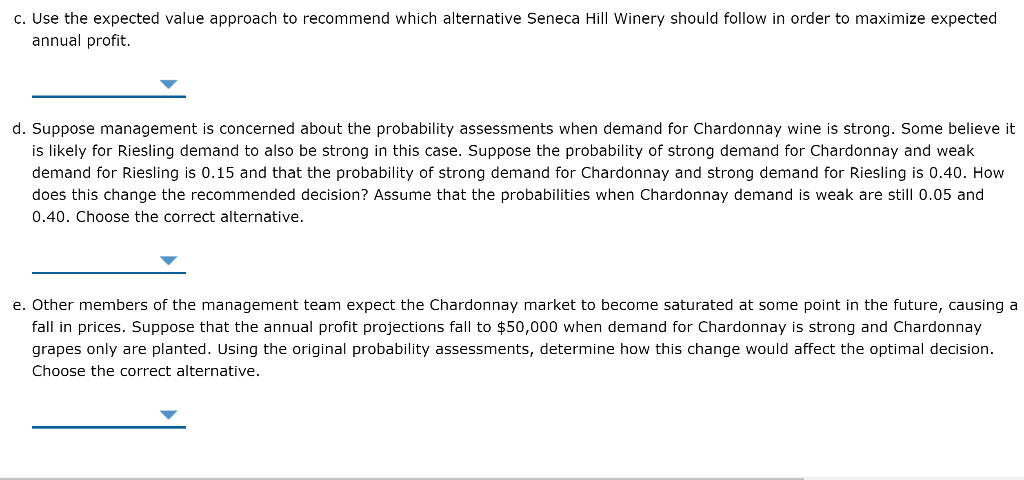
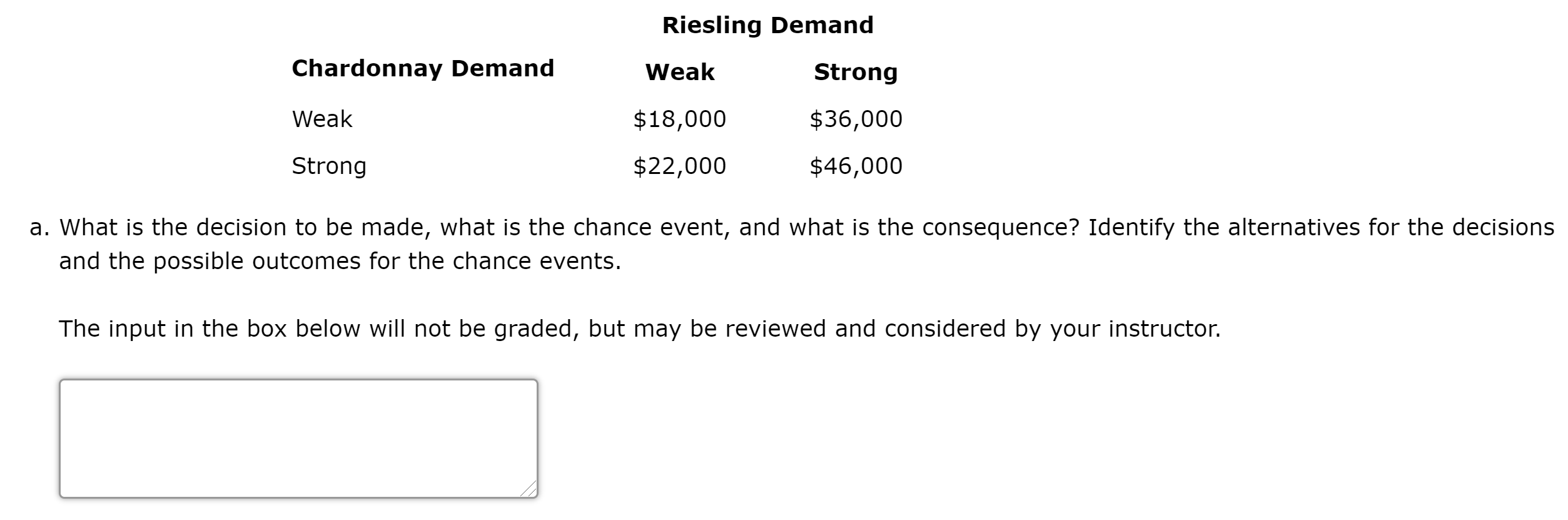
Problem 13-13 (Algorithmic) Seneca Hill Winery recently purchased land for the purpose establishing a new vineyard. Management is considering two varieties of white grapes for the new vineyard: Chardonnay and Riesling. The Chardonnay grapes would be used to produce a dry Chardonnay wine, and the Riesling grapes would be used to produce a semidry Riesling wine. It takes approximately four years from the time of planting before new grapes can be harvested. This length of time creates a great deal of uncertainty concerning future demand and makes the decision about the type of grapes to plant difficult. Three possibilities are being considered: Chardonnay grapes only; Riesling grapes only; and both Chardonnay and Riesling grapes. Seneca management decided that for planning purposes it would be adequate to consider only two demand possibilities for each type of wine: strong or weak. With two possibilities for each type of wine, it was necessary to assess four probabilities. With the help of some forecasts in industry publications, management made the following probability assessments: Riesling Demand Chardonnay Demand Weak Strong Weak 0.05 0.40 Strong 0.35 0.20 Revenue projections show an annual contribution to profit of $20,000 if Seneca Hill only plants Chardonnay grapes and demand is weak for Chardonnay wine, and $55,000 if Seneca only plants Chardonnay grapes and demand is strong for Chardonnay wine. If Seneca only plants Riesling grapes, the annual profit projection is $35,000 if demand is weak for Riesling grapes and $40,000 if demand is strong for Riesling grapes. If Seneca plants both types of grapes, the annual profit projections are shown in the following table: Riesling Demand Chardonnay Demand Weak Strong Weak $18,000 $36,000 Strong $22,000 $46,000 a. What is the decision to be made, what is the chance event, and what is the consequence? Identify the alternatives for the decisions and the possible outcomes for the chance events. The input in the box below will not be graded, but may be reviewed and considered by your instructor. c. Use the expected value approach to recommend which alternative Seneca Hill Winery should follow in order to maximize expected annual profit. d. Suppose management is concerned about the probability assessments when demand for Chardonnay wine is strong. Some believe it is likely for Riesling demand to also be strong in this case. Suppose the probability of strong demand for Chardonnay and weak demand for Riesling is 0.15 and that the probability of strong demand for Chardonnay and strong demand for Riesling is 0.40. How does this change the recommended decision? Assume that the probabilities when Chardonnay demand is weak are still 0.05 and 0.40. Choose the correct alternative. e. Other members of the management team expect the Chardonnay market to become saturated at some point in the future, causing a fall in prices. Suppose that the annual profit projections fall to $50,000 when demand for Chardonnay is strong and Chardonnay grapes only are planted. Using the original probability assessments, determine how this change would affect the optimal decision. Choose the correct alternative









 Study Help