



Question: . . . B nature.com M 1 of 1... Article. 1 'Little F.. Dash.. M Macm... 'Little Foot' hominin emerges from stone after millions of
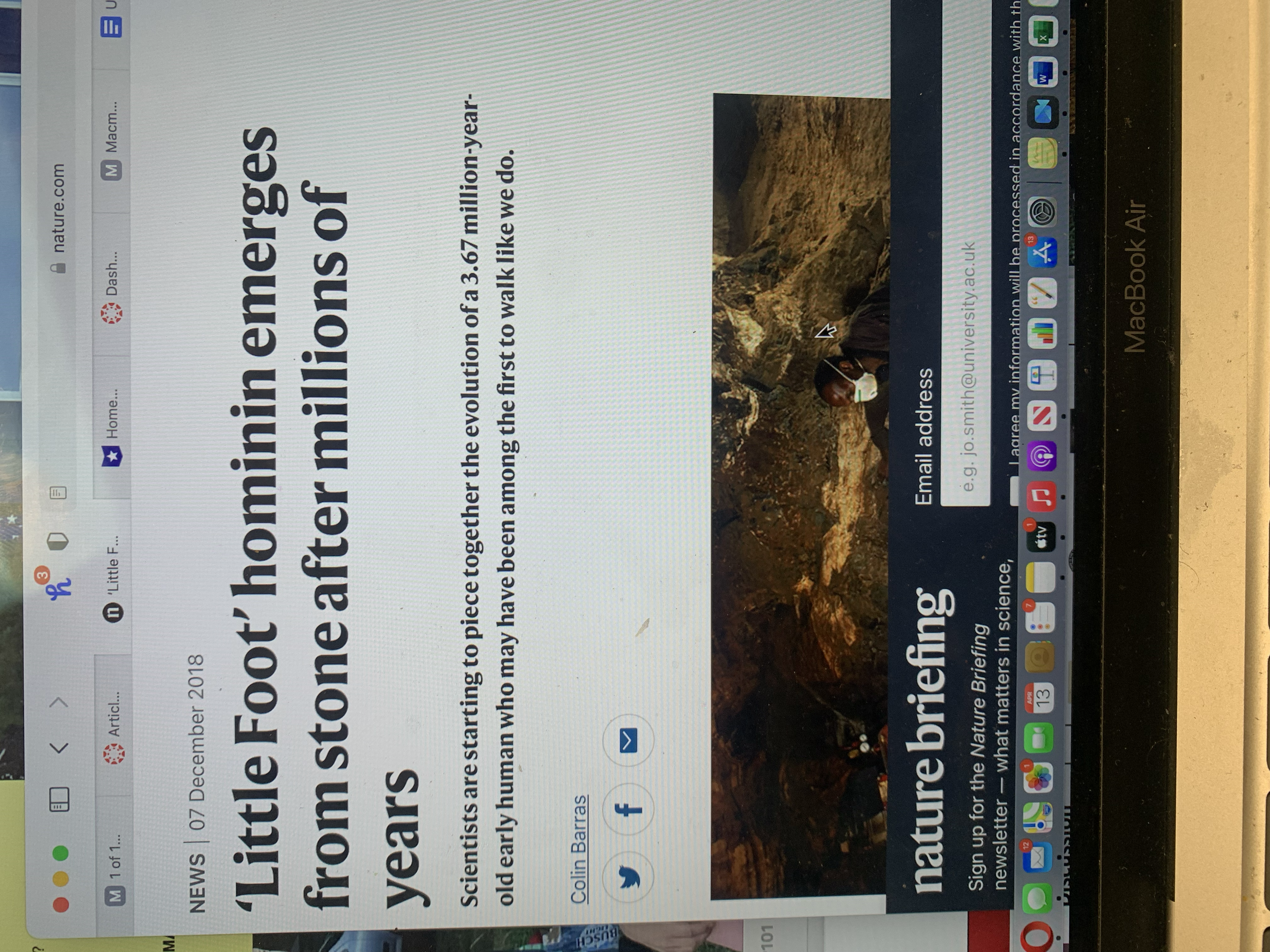



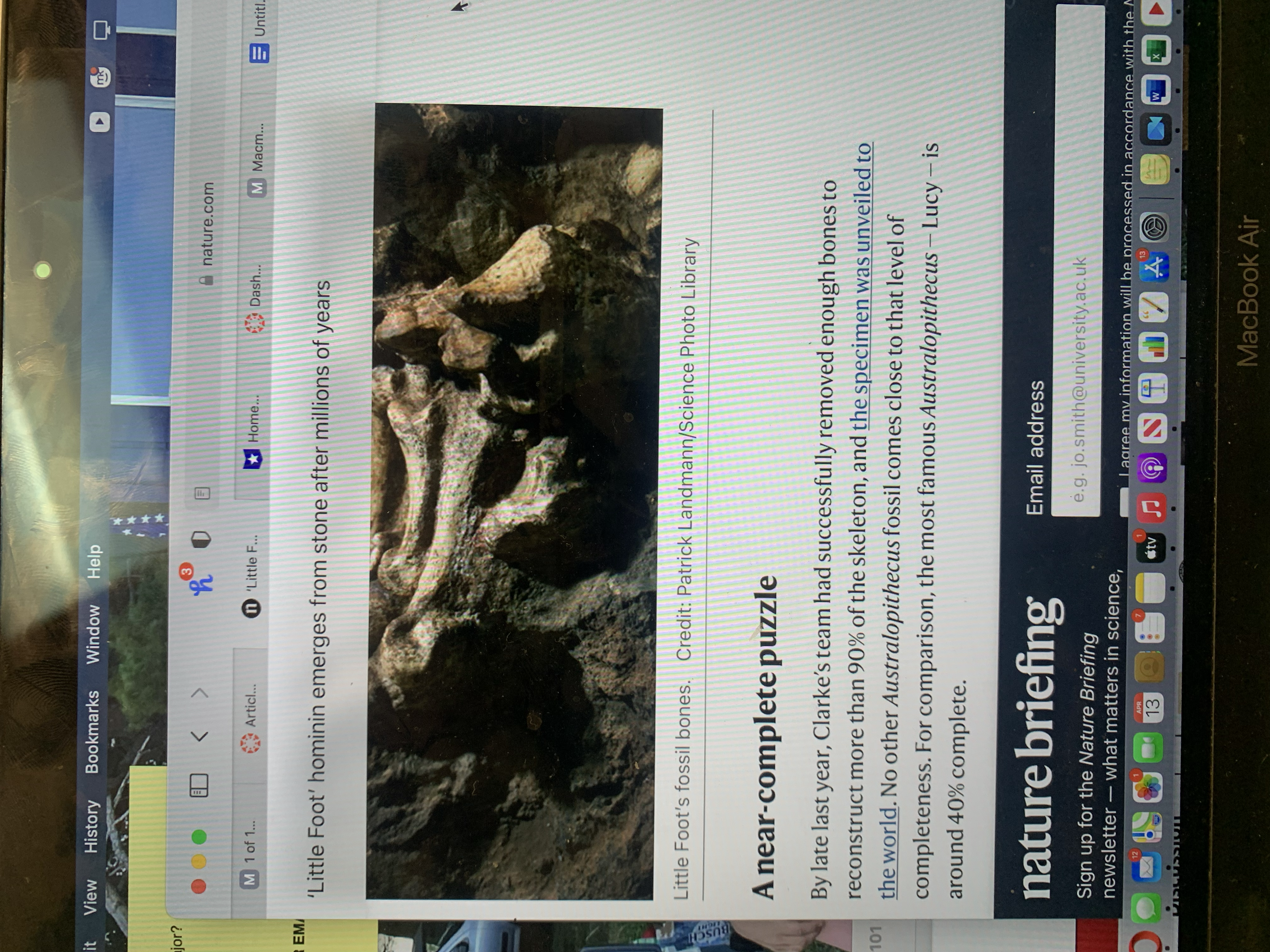



. . . B nature.com M 1 of 1... Article. 1 'Little F.. Dash.. M Macm... 'Little Foot' hominin emerges from stone after millions of years On 29 November, Clarke's team, posted two papers on Little Foot to the bioRxiv preprint server - one on the age of the specimens, the other on the limbs and locomotion'. On 4 December, the researchers posted a third, on the skull and on the potential relationship to a known hominin species. The team posted a fourth papers, this time focusing on the arms and an injury Little Foot received during her life, on 5 December. Further papers, on the hand, teeth and inner ear, are expected in the near future, says Crompton. Most will ultimately appear in a special edition of the Journal of Human Evolution. The bioRxiv papers crystallize ideas that emerged in earlier publications about the age of the fossil. They also cover some new ground, suggesting that Little Foot was an adult female and stood about 130 centimetres tall - just 10 centimetres shorter than the average woman in some modern-human populations. "Little Foot was quite big," says Crompton. The paper covering limbs and locomotion reveals that Little Foot's legs are longer than her arms, similar to modern humans, making her the oldest nature briefing Email address Sign up for the Nature Briefing e.g. jo.smith@university.ac.uk newsletter - what matters in science, Lagree my information will be processed in accordance 13 atv Wor? . . . E nature.com Article.. 1 'Little F.. * Home.. Dash... M Macm... M 1 of 1... EM 'Little Foot' hominin emerges from stone after millions of years Palaeoanthropologists recovering Little Foot from a rock inside a cave. Credit: Patrick Landmann/Science Photo Library After a tortuous 20-year-long excavation, a mysterious ancient skeleton is starting to give up its secrets about human evolution The first of a raft of papers about 'Little Foot' suggests that the fossil is a female who showed some of the earliest signs of human-like bipedal walking around 3.67 million years ago. She may also belong to a distinct species that most researchers haven't previously recognized "It's almost a miracle it's come out intact," says Robin Crompton, a musculoskeletal biologist at the University of Liverpool, UK, who has collaborated with the research team that excavated the skeleton. As well echoing the mythical Bigfoot', the nickname Little Foot comes from the P101 small size of the foot bones that were among the first parts of the skeleton to be discovered. The first signs that there was an invaluable hominin specimen up for grabs came nature briefing Email address Sign up for the Nature Briefing e.g. jo.smith@university.ac.uk newsletter - what matters in science, unLagree my information will be processed in accordance O 13 as tv MacBook AirView History Bookmarks Window Help jor? . . . D nature.com M 1 of 1... Article. 1 'Little F.. Home... Dash... M Macm... E Untitl EM 'Little Foot' hominin emerges from stone after millions of years Little Foot's fossil bones. Credit: Patrick Landmann/Science Photo Library A near-complete puzzle By late last year, Clarke's team had successfully removed enough bones to reconstruct more than 90% of the skeleton, and the specimen was unveiled to 101 the world. No other Australopithecus fossil comes close to that level of completeness. For comparison, the most famous Australopithecus - Lucy - is around 40% complete. nature briefing Email address Sign up for the Nature Briefing e.g. jo.smith@university.ac.uk newsletter - what matters in science, Lagree my information will be processed in accordance with the O 13 MacBook Airdit View History Bookmarks Window Help A major? . . . D > nature.com M 1 of 1.. Article.. 1 'Little F... Dash... M Macm... R EM 'Little Foot' hominin emerges from stone after millions of years Crompton responds that the locomotion paper is essentially an overview that attempts to reconstruct how Little Foot moved by drawing on the solid data given in the other papers. More-detailed data can be found in the team's other papers, he says. Gabriele Macho, a biological anthropologist at the University of Oxford, UK, agrees that the locomotion paper is light on solid data, but notes that the team acknowledges that it is a work in progress. She looks forward to see more-detailed papers in the future. "The positive thing is this skeleton is tremendously important," she says. "No question about it." Nature 564, 169-170 (2018) doi: https://doi.org/10.1038/d41586-018-07651-z P101 References nature briefing Email address Sign up for the Nature Briefing e.g. jo.smith@university.ac.uk newsletter - what matters in science, Lagree my information will be processed in accordance APRnature.com M 1 of 1.. Article.. 1 'Little F.. Home... Dash... M Macm... 'Little Foot' hominin emerges from stone after millions of years The first signs that there was an invaluable hominin specimen up for grabs came in 1994. Ronald Clarke, a palaeoanthropologist at the University of the Witwatersrand (Wits University) in Johannesburg, South Africa, was rifling through boxes of fossils at a field laboratory at the Sterkfontein caves, about 40 kilometres northwest of Johannesburg. He realized that a handful of small bones in the collection belonged to an early hominin. He established that the bones were those of a species of Australopithecus - ape- like hominins that were present in Africa between about 4 million and 2 million years ago, before the human genus Homo rose to dominance-. Clarke and his colleagues then found many more bones embedded in a matrix of solid rock deep in the Sterkfontein caves. They began carefully excavating Little Foot, piece by fragile piece, using hammers and chisels, followed by precision tools. The entire process took them almost 20 years. "The fossilized bone is actually softer than the matrix," says Crompton. "It's been an absolute devil to get it out." nature briefing Email address Sign up for the Nature Briefing e.g. jo.smith@university.ac.uk newsletter - what matters in science, Lagree my information will be processed in accordance with 13 at tv MacBook AirA E View History Bookmarks Window Help .. . nature.com M 1 of 1... Article.. 1 'Little F.. Home. Dash.. M Macm... 'Little Foot' hominin emerges from stone after millions of years The preprint also suggests that A. prometheus is potentially an ancestor of a group of hominins called Paranthropus+, which co-existed with early Homo species for about a million years. Lee Berger, an archaeologist also at Wits University who was not involved in the excavations, but is working on publications about Little Foot, disagrees with the decision to resurrect A. prometheus. In a paper that is scheduled to be published on 10 December in the American Journal of Physical Anthropology, Berger argues that the name A. prometheus was never properly defined. He hasn't yet decided whether Little Foot constitutes a distinct species - but if she does, Berger thinks a new name is needed Berger adds he is disappointed by the lack of solid information in the papers on the age and locomotion findings - he would have liked to have seen detailed measurements of the fossil bones, for instance. "There's no data - there are almost no measurements of the fossils," he says. Berger hopes to provide those data in his own publications - although he is still at an early stage of his analysis. nature briefing Email address Sign up for the Nature Briefing e.g. jo.smith@university.ac.uk newsletter - what matters in science, Lagree my information will be processed in accordance utv
Step by Step Solution
There are 3 Steps involved in it

Get step-by-step solutions from verified subject matter experts