







Question: ( b ) The CIBSE Lighting Guide and British Standards recommend the following formula to calculate the average daylight factor for a side - lit
b The CIBSE Lighting Guide and British Standards recommend the following formula to calculate the average daylight factor for a sidelit room under a standard overcast sky with a lean glazing as follows:
Please explain each of the parameters used in the formula. Which of these parameters are related to the amount of daylight available at the window?
marks
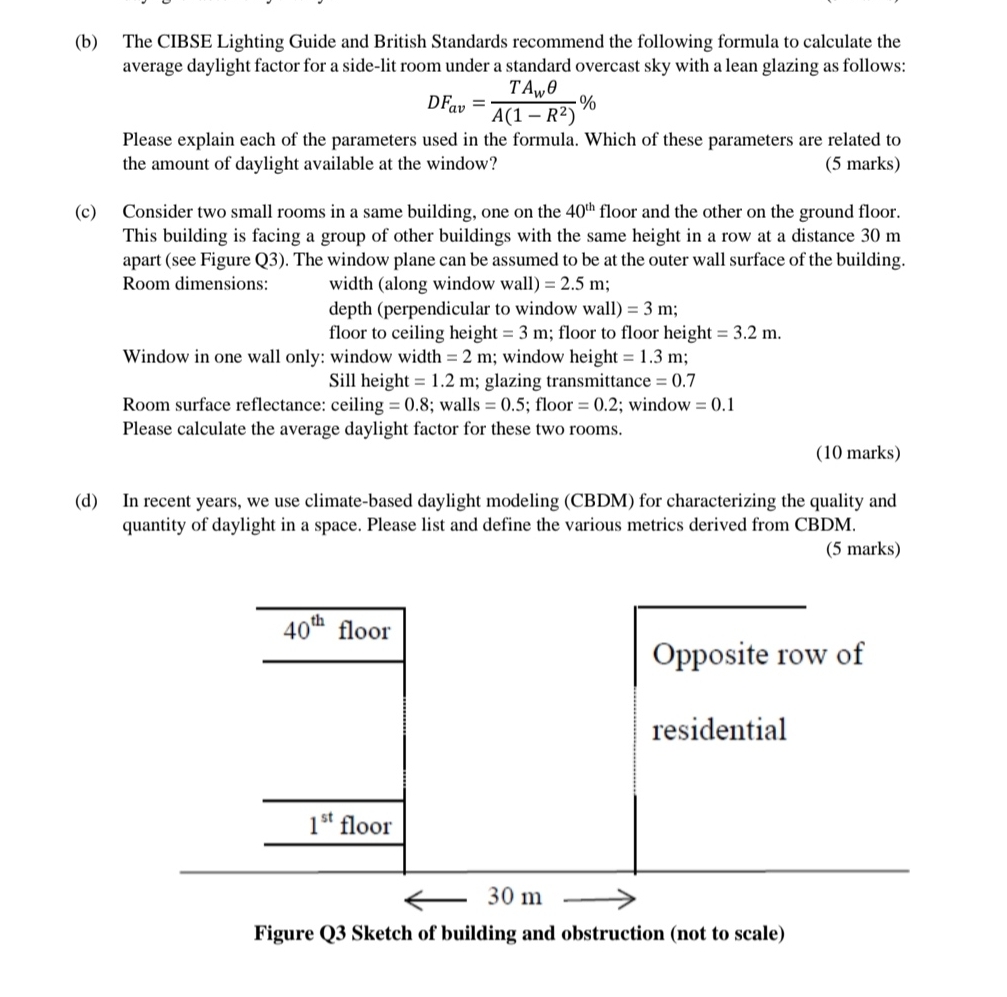
c Consider two small rooms in a same building, one on the floor and the other on the ground floor. This building is facing a group of other buildings with the same height in a row at a distance m apart see Figure Q The window plane can be assumed to be at the outer wall surface of the building. Room dimensions: width along window wall;
depth perpendicular to window wall;
floor to ceiling height ; floor to floor height
Window in one wall only: window width ; window height ;
Sill height ; glazing transmittance
Room surface reflectance: ceiling ; walls ; floor ; window
Please calculate the average daylight factor for these two rooms.
marks
d In recent years, we use climatebased daylight modeling CBDM for characterizing the quality and quantity of daylight in a space. Please list and define the various metrics derived from CBDM
marks
for c part need detailed solution for both rooms
fig is given and use b part equation
Step by Step Solution
There are 3 Steps involved in it
1 Expert Approved Answer
Step: 1 Unlock

Question Has Been Solved by an Expert!
Get step-by-step solutions from verified subject matter experts
Step: 2 Unlock
Step: 3 Unlock
 Study Help