







Question: b. The stopped train can be modeled as a system in static equilibrium. What are thegeneral equilibrium conditions? c. Because of the tilt, the forces
b. The stopped train can be modeled as a system in static equilibrium. What are thegeneral equilibrium conditions? c. Because of the tilt, the forces on the upper and lower rails will be different. Let L bethe vertical force from the lower rail on the wheels, and U be the vertical force of the upper rail on the other wheels. Each of the conditions in the previous part give you one equation. Label the mass of the train m; the remaining variables are defined in the right hand panel of Figure 2. Show that the two conditions giveL+U= mg L-U= (2mgh/d) tan thetaWhen calculating torques, choosing the point labeled "A" in the Figure may simplifyyour calculations. d. Solve the equations of the previous item for L and U.
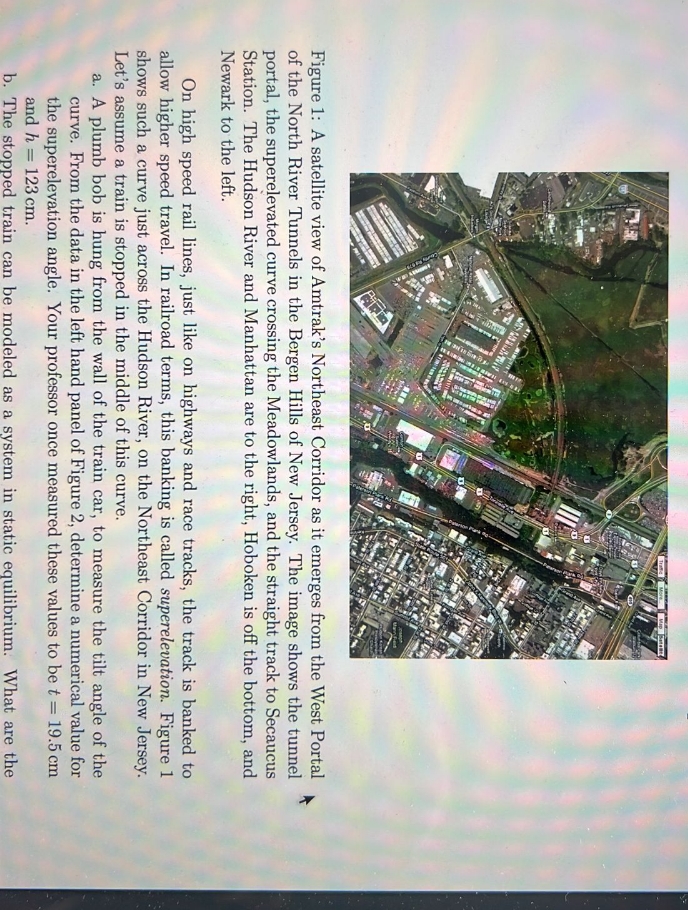
Figure 1: A satellite view of Amtrak's Northeast Corridor as it emerges from the West Portal of the North River Tunnels in the Bergen Hills of New Jersey. The image shows the tunnel portal, the superelevated curve crossing the Meadowlands, and the straight track to Secaucus Station. The Hudson River and Manhattan are to the right, Hoboken is off the bottom, and Newark to the left. On high speed rail lines, just like on highways and race tracks, the track is banked to allow higher speed travel. In railroad terms, this banking is called superelevation. Figure 1 shows such a curve just across the Hudson River, on the Northeast Corridor in New Jersey. Let's assume a train is stopped in the middle of this curve. a. A plumb bob is hung from the wall of the train car, to measure the tilt angle of the curve. From the data in the left hand panel of Figure 2, determine a numerical value for the superelevation angle. Your professor once measured these values to be t = 19.5 cm and h = 123 cm. b. The stopped train can be modeled as a system in static equilibrium. What are the
Step by Step Solution
There are 3 Steps involved in it

Get step-by-step solutions from verified subject matter experts
 Study Help