







Question: B. (Tucker 1.2 Example 2) Consider a linear economic supply-demand model described by: Industrial Demand Consumer Demand Total Demand Energy: d I = Ener.
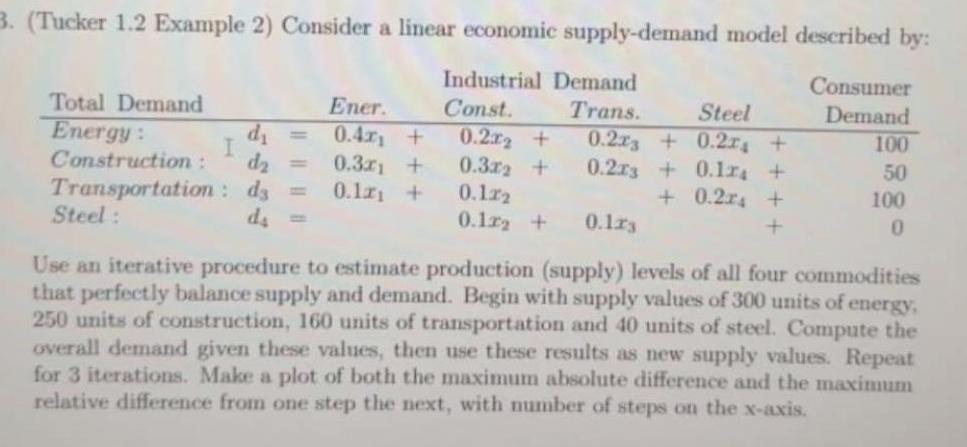
B. (Tucker 1.2 Example 2) Consider a linear economic supply-demand model described by: Industrial Demand Consumer Demand Total Demand Energy: d I = Ener. 0.4x1 + Const. Trans. Steel 0.2x2 + 0.23 +0.224 + 100 Construction: d == 0.3x1 + 0.3x2 + 0.213 +0.124 + 50 0.122 da 0.122 + 0.123 + 0.2% + + 100 0 Transportation: ds = 0.1x1 + Steel: Use an iterative procedure to estimate production (supply) levels of all four commodities that perfectly balance supply and demand. Begin with supply values of 300 units of energy, 250 units of construction, 160 units of transportation and 40 units of steel. Compute the overall demand given these values, then use these results as new supply values. Repeat for 3 iterations. Make a plot of both the maximum absolute difference and the maximum relative difference from one step the next, with number of steps on the x-axis.
Step by Step Solution
There are 3 Steps involved in it

Get step-by-step solutions from verified subject matter experts
 Study Help