







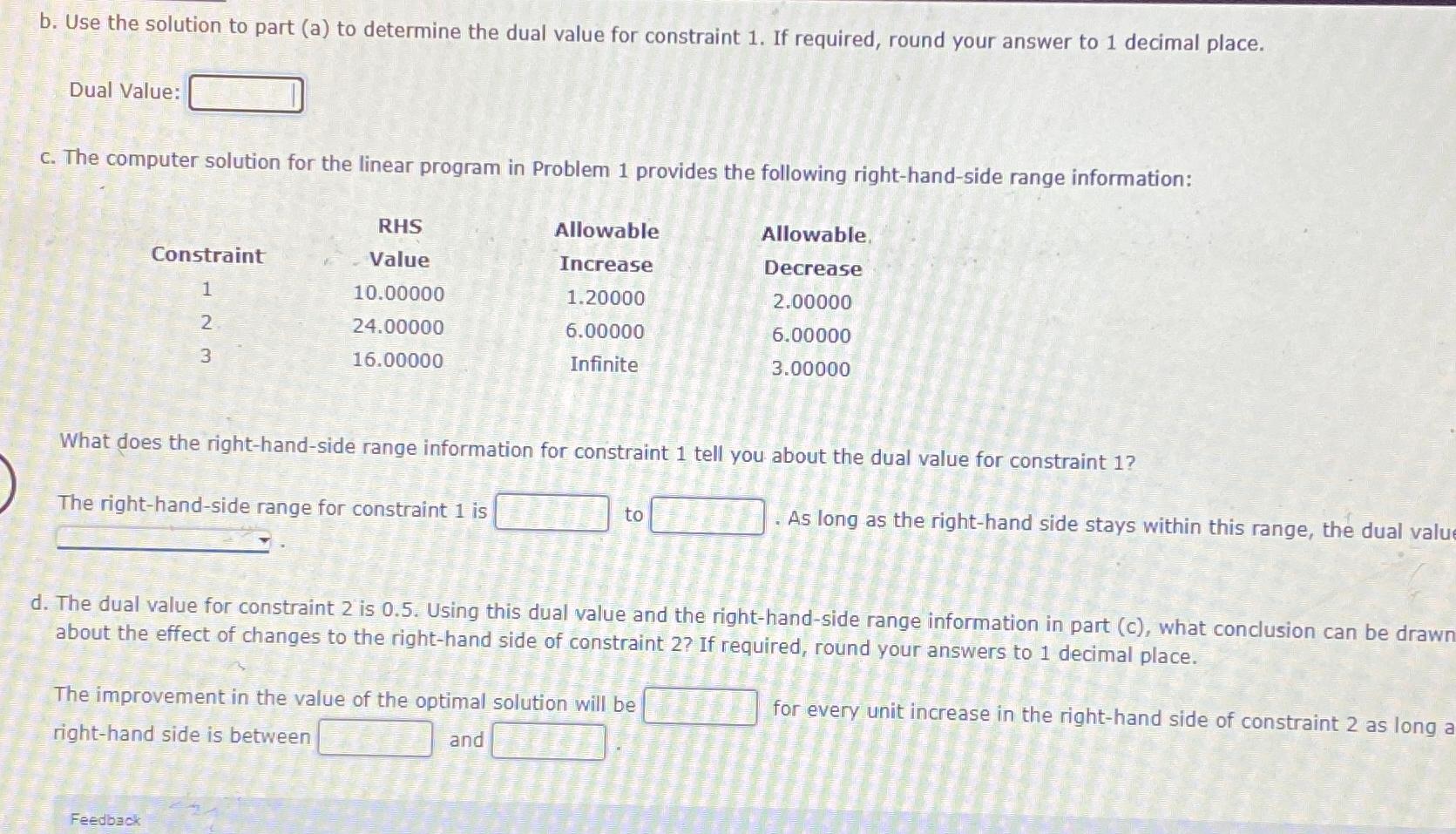
Question: b . Use the solution to part ( a ) to determine the dual value for constraint 1 . If required, round your answer to
b Use the solution to part a to determine the dual value for constraint If required, round your answer to decimal place.
Dual Value:
c The computer solution for the linear program in Problem provides the following righthandside range information:
tableRHSAllowable,Allowable,ConstraintValue,Increase,DecreaseInfinite,
What does the righthandside range information for constraint tell you about the dual value for constraint
The righthandside range for constraint is to As long as the righthand side stays within this range, the dual valu
d The dual value for constraint is Using this dual value and the righthandside range information in part c what conclusion can be drawn about the effect of changes to the righthand side of constraint If required, round your answers to decimal place.
The improvement in the value of the optimal solution will be for every unit increase in the righthand side of constraint as long a righthand side is between and
Feedback
Step by Step Solution
There are 3 Steps involved in it
1 Expert Approved Answer
Step: 1 Unlock

Question Has Been Solved by an Expert!
Get step-by-step solutions from verified subject matter experts
Step: 2 Unlock
Step: 3 Unlock
 Study Help