







Question: (b) When a fluid percolates through assemblies of particles, each particle experiences two forces from the fluid namely a buoyancy-type force Fb due to
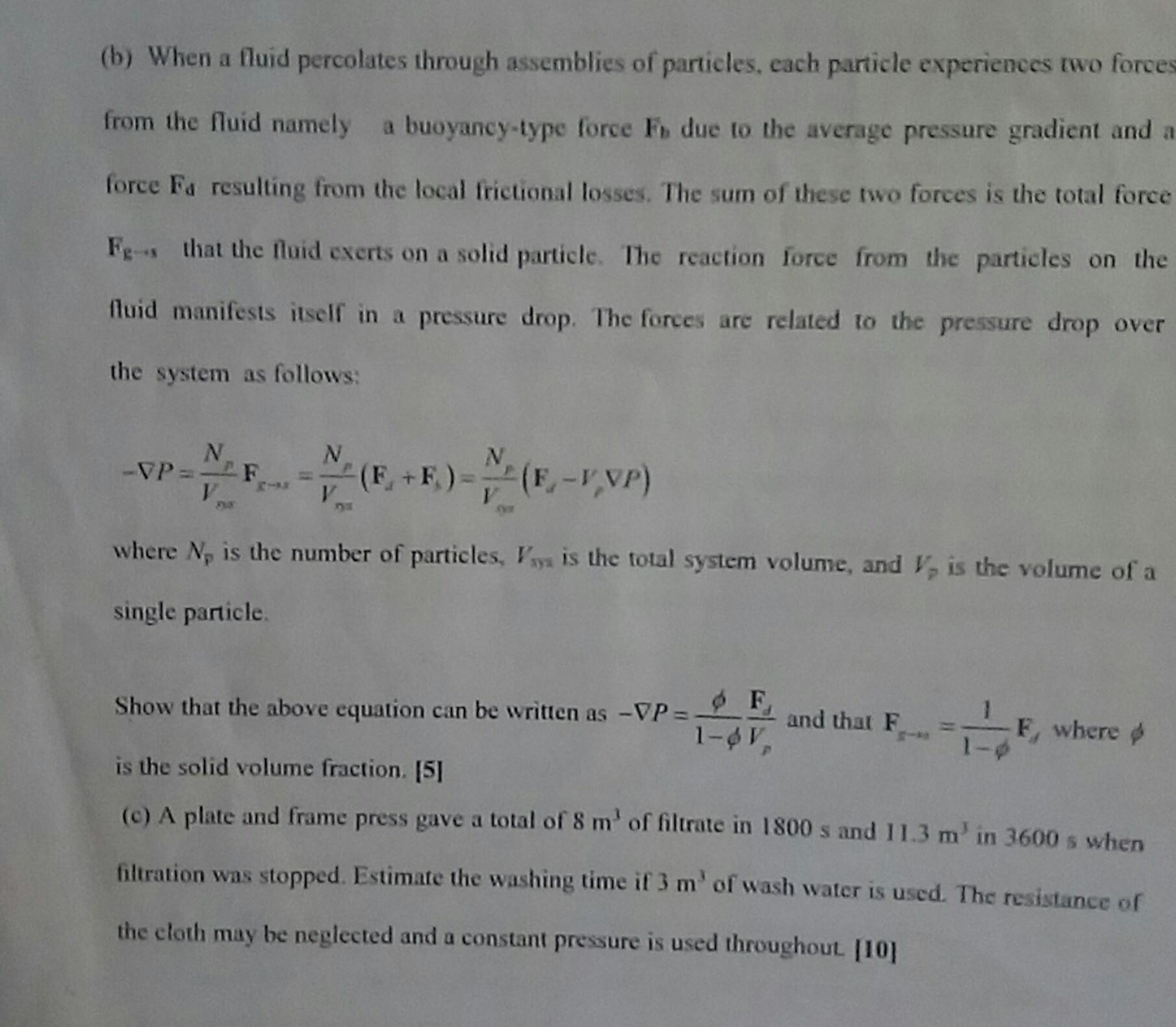
(b) When a fluid percolates through assemblies of particles, each particle experiences two forces from the fluid namely a buoyancy-type force Fb due to the average pressure gradient and a force Fa resulting from the local frictional losses. The sum of these two forces is the total force Fg that the fluid exerts on a solid particle. The reaction force from the particles on the fluid manifests itself in a pressure drop. The forces are related to the pressure drop over the system as follows: -VP= F V (F+F.)-(F-V,VP) V. F18 where N is the number of particles, Vya is the total system volume, and V, is the volume of a single particle. Show that the above equation can be written as -VP = 1- V and that F F where is the solid volume fraction. [5] (c) A plate and frame press gave a total of 8 m' of filtrate in 1800 s and 11.3 m' in 3600 s when filtration was stopped. Estimate the washing time if 3 m' of wash water is used. The resistance of the cloth may be neglected and a constant pressure is used throughout [10]
Step by Step Solution
3.35 Rating (161 Votes )
There are 3 Steps involved in it
b F d local frictional forces F b buoyancy force F g total force that fluid e... View full answer

Get step-by-step solutions from verified subject matter experts
Document Format (2 attachments)

60d5e1d221102_201817.pdf
180 KBs PDF File

60d5e1d221102_201817.docx
120 KBs Word File
 Study Help