







Question: B. When Only U is Constant 8. Click here pen the PHYS 2425 Lab 8. Part. B Simulation Here is the direct Link https:/www.geogebra.org/mf5kq89z 9.
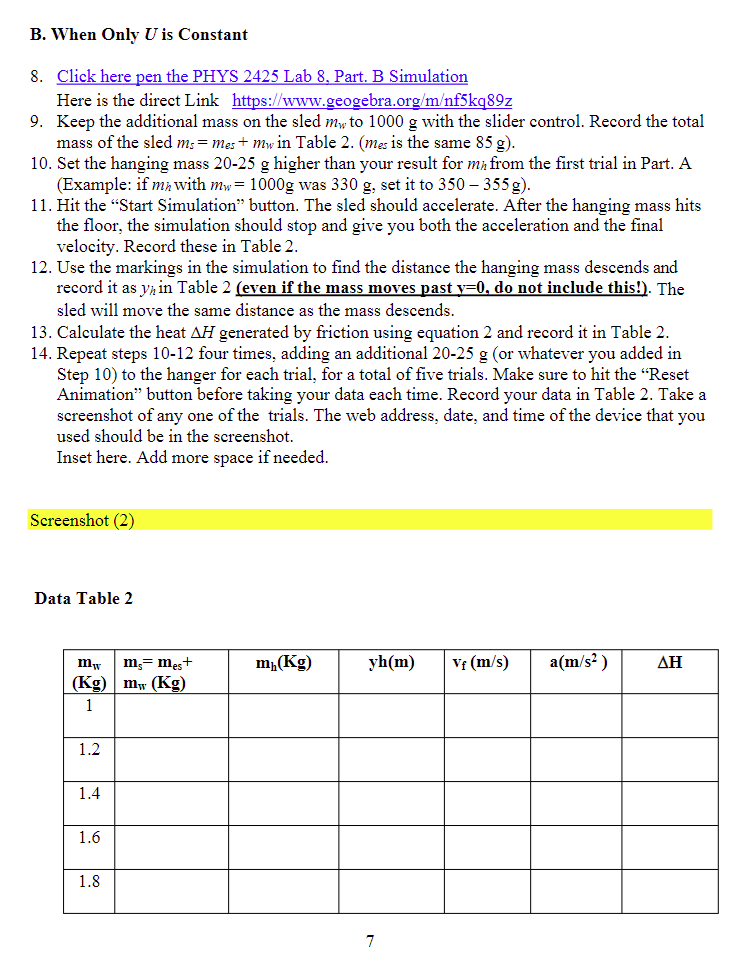


B. When Only U is Constant 8. Click here pen the PHYS 2425 Lab 8. Part. B Simulation Here is the direct Link https:/www.geogebra.org/mf5kq89z 9. Keep the additional mass on the sled m, to 1000 g with the slider control. Record the total mass of the sled ms = mes + mwin Table 2. (mes is the same 85 g). 10. Set the hanging mass 20-25 g higher than your result for my from the first trial in Part. A (Example: if ma with mw = 1000g was 330 g, set it to 350 -355 g) 1 1. Hit the "Start Simulation" button. The sled should accelerate. After the hanging mass hits the floor, the simulation should stop and give you both the acceleration and the final velocity. Record these in Table 2 12. Use the markings in the simulation to find the distance the hanging mass descends and record it as y in Table 2 (even if the mass moves past y=0. do not include this!). The sled will move the same distance as the mass descends. 13. Calculate the heat AH generated by friction using equation 2 and record it in Table 2. 14. Repeat steps 10-12 four times, adding an additional 20-25 g (or whatever you added in Step 10) to the hanger for each trial, for a total of five trials. Make sure to hit the "Reset Animation" button before taking your data each time. Record your data in Table 2. Take a screenshot of any one of the trials. The web address, date, and time of the device that you used should be in the screenshot. Inset here. Add more space if needed. Screenshot (2) Data Table 2 m= mes+ my(Kg) yh(m) Vf (m/s) a(m/s2 ) AH (Kg) Mw (Kg) 1.2 1.4 1.6 1.8 7\f\f
Step by Step Solution
There are 3 Steps involved in it

Get step-by-step solutions from verified subject matter experts
 Study Help