







Question: (b) Which two elements of the CD ROM optical head are used in combination to produce a particular optical phenomenon called astigmatism in which the
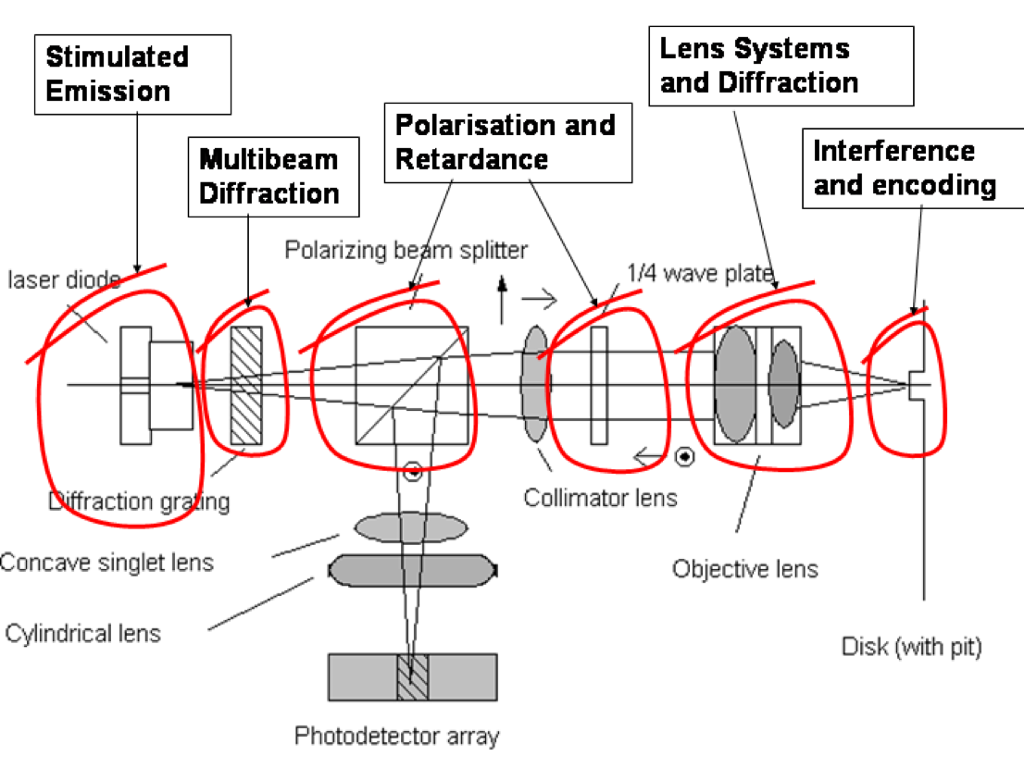
(b) Which two elements of the CD ROM optical head are used in combination to produce a particular optical phenomenon called astigmatism in which the beam shape changes along the optical axis. Explain briefly how the beam shape changes along the optical propagation axis using words and diagrams. (3 marks)
(c) What is element (2) used for in the CD ROM optical head? Name what function it is used for and describe in detail what it does and how it can improve the data reading performance. (4 marks)
(d) If n = 1.5 and the difference between the fast and slow axes for a wave plate is n = 103 , then calculate the minimum thicknesses of a 1/2 wave plate and of a 1/4 wave plate for light at = 525 nm. (2 marks)
(e) When reading a CD ROM, assume the reflected light intensity obeys a simple interferometric form I = I0 cos2 (/2) where is the phase difference between the two beams reflected from the top and bottom of the bump. A Blu-Ray Disc player uses light at a wavelength of = 405 nm. What bump height will give 100% contrast between 1s and 0 s for the DVD player (assume the coating film has a refractive index = 1.4). (4 marks)
(f) CD players use an objective with NA= 0.45, and laser wavelength = 780 nm whereas DVD players use an objective with NA= 0.6 and laser wavelength = 650 nm. What is the ratio of the spot areas (ACD/ADV D)? How will this affect the DVD/CD data capacity ratio? (2 marks)
Stimulated Emission Lens Systems and Diffraction Polarisation and Multibeam Retardance Diffraction Interference and encoding Polarizing bem splitter laser dio 1/4 wave plat raction grating Collimator lens Concave singlet lens Objective lens Cylindrical lens Disk (with pit) Photodetector array Stimulated Emission Lens Systems and Diffraction Polarisation and Multibeam Retardance Diffraction Interference and encoding Polarizing bem splitter laser dio 1/4 wave plat raction grating Collimator lens Concave singlet lens Objective lens Cylindrical lens Disk (with pit) Photodetector array
Step by Step Solution
There are 3 Steps involved in it

Get step-by-step solutions from verified subject matter experts
 Study Help