







Question: B1 A consumer has a generic utility function, u(11, 12), where of > day 0, 912 0 for i = 1, 2. The two goods
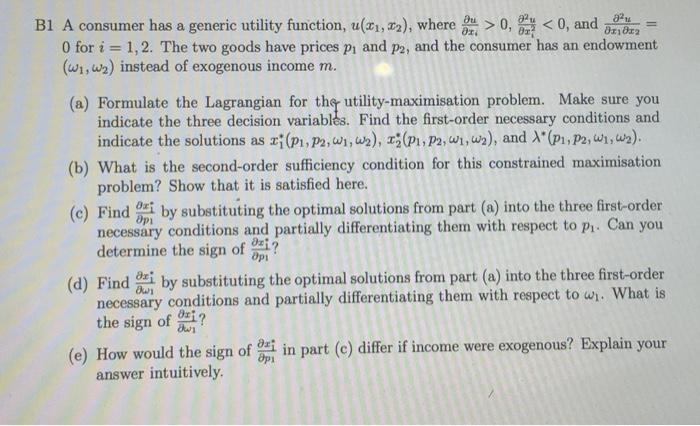
B1 A consumer has a generic utility function, u(11, 12), where of > day 0, 912 0 for i = 1, 2. The two goods have prices p, and p2, and the consumer has an endowment (w1, w2) instead of exogenous income m. (a) Formulate the Lagrangian for the utility-maximisation problem. Make sure you indicate the three decision variables. Find the first-order necessary conditions and indicate the solutions as I; (p1, p2, wi, wa), I; (P1, pa, w1, we), and A"(p1, pz, WI, wa). (b) What is the second-order sufficiency condition for this constrained maximisation problem? Show that it is satisfied here. (c) Find i by substituting the optimal solutions from part (a) into the three first-order necessary conditions and partially differentiating them with respect to p. Can you determine the sign of opi (d) Find ofi by substituting the optimal solutions from part (a) into the three first-order necessary conditions and partially differentiating them with respect to wi. What is the sign of gwi (e) How would the sign of "zi in part (c) differ if income were exogenous? Explain your answer intuitively
Step by Step Solution
There are 3 Steps involved in it

Get step-by-step solutions from verified subject matter experts
 Study Help