







Question: B2. Solow growth model. Consider the production function Y = K(AN)l-a. The aggregate capital stock accumulates according to Kt+1 K= sY4 - SK = -
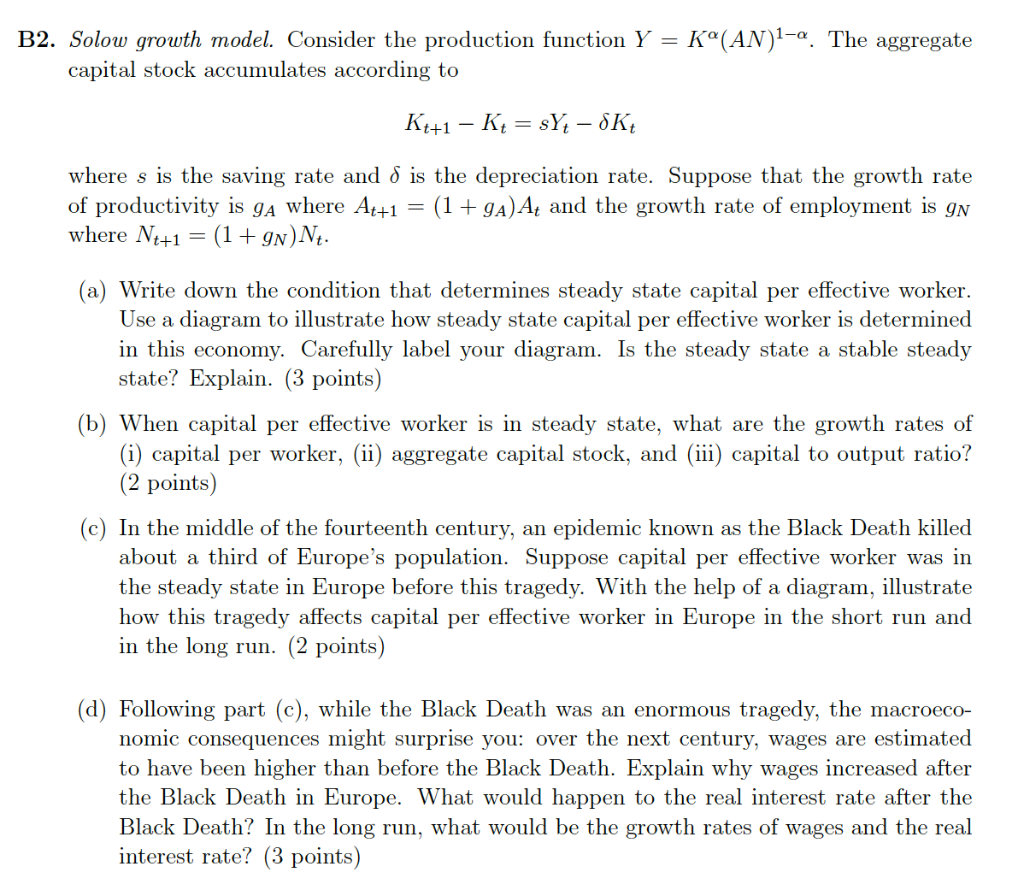
B2. Solow growth model. Consider the production function Y = K(AN)l-a. The aggregate capital stock accumulates according to Kt+1 K= sY4 - SK = - s where s is the saving rate and d is the depreciation rate. Suppose that the growth rate of productivity is 9a where At+1 (1 + 9A)At and the growth rate of employment is IN where N4+1 = (1 + gn)Nt. = = a (a) Write down the condition that determines steady state capital per effective worker. Use a diagram to illustrate how steady state capital per effective worker is determined in this economy. Carefully label your diagram. Is the steady state a stable steady state? Explain. (3 points) (b) When capital per effective worker is in steady state, what are the growth rates of (i) capital per worker, (ii) aggregate capital stock, and (iii) capital to output ratio? (2 points) (c) In the middle of the fourteenth century, an epidemic known as the Black Death killed about a third of Europe's population. Suppose capital per effective worker was in the steady state in Europe before this tragedy. With the help of a diagram, illustrate how this tragedy affects capital per effective worker in Europe in the short run and in the long run. (2 points) (d) Following part (c), while the Black Death was an enormous tragedy, the macroeco- nomic consequences might surprise you: over the next century, wages are estimated to have been higher than before the Black Death. Explain why wages increased after the Black Death in Europe. What would happen to the real interest rate after the Black Death? In the long run, what would be the growth rates of wages and the real interest rate? (3 points) B2. Solow growth model. Consider the production function Y = K(AN)l-a. The aggregate capital stock accumulates according to Kt+1 K= sY4 - SK = - s where s is the saving rate and d is the depreciation rate. Suppose that the growth rate of productivity is 9a where At+1 (1 + 9A)At and the growth rate of employment is IN where N4+1 = (1 + gn)Nt. = = a (a) Write down the condition that determines steady state capital per effective worker. Use a diagram to illustrate how steady state capital per effective worker is determined in this economy. Carefully label your diagram. Is the steady state a stable steady state? Explain. (3 points) (b) When capital per effective worker is in steady state, what are the growth rates of (i) capital per worker, (ii) aggregate capital stock, and (iii) capital to output ratio? (2 points) (c) In the middle of the fourteenth century, an epidemic known as the Black Death killed about a third of Europe's population. Suppose capital per effective worker was in the steady state in Europe before this tragedy. With the help of a diagram, illustrate how this tragedy affects capital per effective worker in Europe in the short run and in the long run. (2 points) (d) Following part (c), while the Black Death was an enormous tragedy, the macroeco- nomic consequences might surprise you: over the next century, wages are estimated to have been higher than before the Black Death. Explain why wages increased after the Black Death in Europe. What would happen to the real interest rate after the Black Death? In the long run, what would be the growth rates of wages and the real interest rate? (3 points)
Step by Step Solution
There are 3 Steps involved in it

Get step-by-step solutions from verified subject matter experts
 Study Help