







Question: & Back Term Structure Models II and Introduction to Credit Derivatives Due Aug l4, 1 Term Structure Models II and Introduction to Credit Derivatives Total
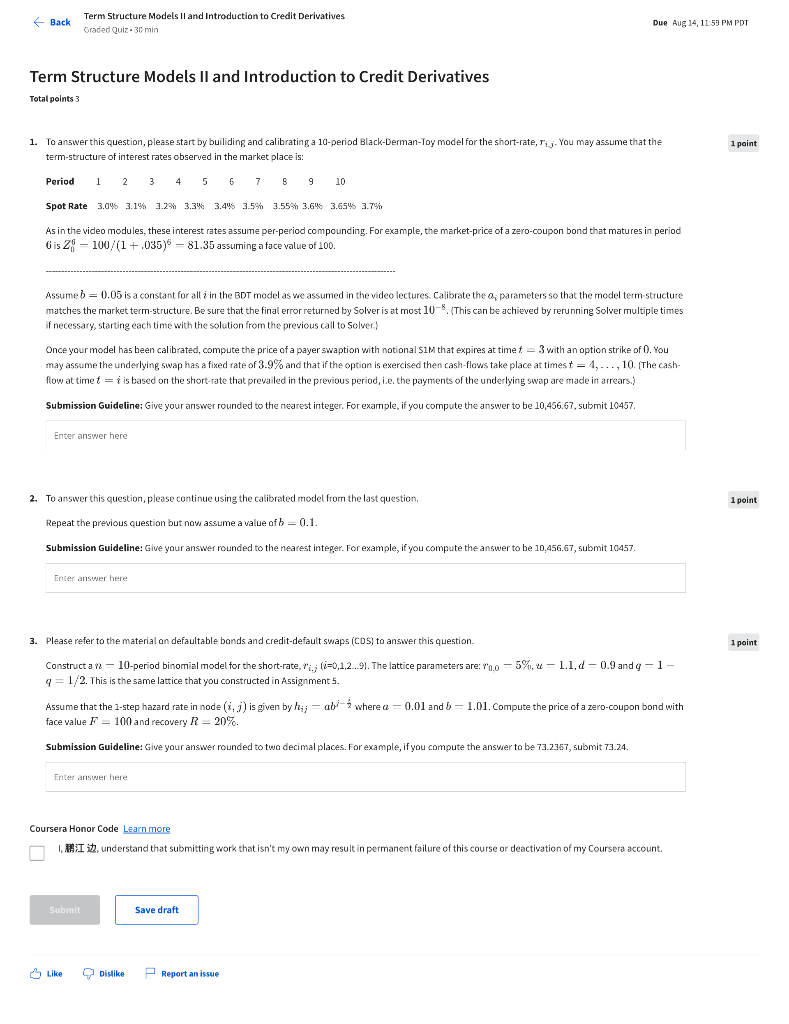
\& Back Term Structure Models II and Introduction to Credit Derivatives Due Aug l4, 1 Term Structure Models II and Introduction to Credit Derivatives Total points 3 1. To answer this question, please start by builiding and calibrating a 10-period Black-Derman-Toy model for the short-rate, Ti,j-You may assume that the term-structure of interest rates observed in the market place is: in As in the video modules, these interest rates assume per-period compounding. For example, the market-price of a zero-coupon bond that matures in period 6 is Z06=100/(1+.035)681.35 assuming a face value of 100 . Assume b=0.05 is a constant for all i in the BDT model as we assumed in the wideo lectures. Calibrate the ai parameters so that the model term-structure matches the market term-structure. Be sure that the final error returned by Solver is at most 108. \This can be achieved by rerunning Solver multiple times if necessary, starting each time with the solution from the previous call to Solver.\} Once your model has been calibrated, compute the price of a payer swaption with notional \$1M that expires at time t = 3 with an option strike of 0 . You may assume the underlying swap has a fixed rate of 3.9% and that if the option is exercised then cash-flows take place at times t =4,..,10. (The cashflow at time t=i is based on the short-rate that prevailed in the previous period, i.e. the payments of the underlying swap are made in arrears.i Submission Guideline: Give your answer rounded to the nearest integer. For example, if you compute the answer to be 10,456.67, submit 10457. 2. To answer this question, please continue using the calibrated model from the last question, Repeat the previous question but now assume a value of b=0.1. Submission Guideline: Give your answer rounded to the nearest integer. For example, if you compute the answer to be 10,456.67,54b mit 10457. 3. Please refer to the material on defaultable bonds and credit-default swaps (Cos) to answer this question. Construct an 10-period binomial model for the short-rate, ri,j(i=0,1,29). The lattice parameters are: 0,05%(0,u1.1,d0.9 and q1 q=1/2. This is the same lattice that you constructed in A.ssignment 5. Assume that the 1-step hazard rate in node (x,j) is given by hij=abj2i where a=0.01 and b=1.01. Compute the price of a zero-coupon bond with face value F=100 and recovery R=20%. Submission Guideline: Give your answer rounded to two decimal places. For example, if you compute the answer to be 73.2357, submit 73.24. Coursera Honor Code I. HBilis in inderstand that submitting work that isn't my own may result in permanent failure of this course or deactivation of my Coursera account, \& Back Term Structure Models II and Introduction to Credit Derivatives Due Aug l4, 1 Term Structure Models II and Introduction to Credit Derivatives Total points 3 1. To answer this question, please start by builiding and calibrating a 10-period Black-Derman-Toy model for the short-rate, Ti,j-You may assume that the term-structure of interest rates observed in the market place is: in As in the video modules, these interest rates assume per-period compounding. For example, the market-price of a zero-coupon bond that matures in period 6 is Z06=100/(1+.035)681.35 assuming a face value of 100 . Assume b=0.05 is a constant for all i in the BDT model as we assumed in the wideo lectures. Calibrate the ai parameters so that the model term-structure matches the market term-structure. Be sure that the final error returned by Solver is at most 108. \This can be achieved by rerunning Solver multiple times if necessary, starting each time with the solution from the previous call to Solver.\} Once your model has been calibrated, compute the price of a payer swaption with notional \$1M that expires at time t = 3 with an option strike of 0 . You may assume the underlying swap has a fixed rate of 3.9% and that if the option is exercised then cash-flows take place at times t =4,..,10. (The cashflow at time t=i is based on the short-rate that prevailed in the previous period, i.e. the payments of the underlying swap are made in arrears.i Submission Guideline: Give your answer rounded to the nearest integer. For example, if you compute the answer to be 10,456.67, submit 10457. 2. To answer this question, please continue using the calibrated model from the last question, Repeat the previous question but now assume a value of b=0.1. Submission Guideline: Give your answer rounded to the nearest integer. For example, if you compute the answer to be 10,456.67,54b mit 10457. 3. Please refer to the material on defaultable bonds and credit-default swaps (Cos) to answer this question. Construct an 10-period binomial model for the short-rate, ri,j(i=0,1,29). The lattice parameters are: 0,05%(0,u1.1,d0.9 and q1 q=1/2. This is the same lattice that you constructed in A.ssignment 5. Assume that the 1-step hazard rate in node (x,j) is given by hij=abj2i where a=0.01 and b=1.01. Compute the price of a zero-coupon bond with face value F=100 and recovery R=20%. Submission Guideline: Give your answer rounded to two decimal places. For example, if you compute the answer to be 73.2357, submit 73.24. Coursera Honor Code I. HBilis in inderstand that submitting work that isn't my own may result in permanent failure of this course or deactivation of my Coursera account
Step by Step Solution
There are 3 Steps involved in it
To address this complex question follow these steps Question 1 Building and Calibrating a 10period BDT Model Introduction to BDT Model The BlackDerman... View full answer

Get step-by-step solutions from verified subject matter experts
 Study Help