







Question: Back to Assignment Attempts 1 Keep the Highest 1 / 5 3. Voluntary contributions toward a public good Amy and Deborah are considering contributing toward
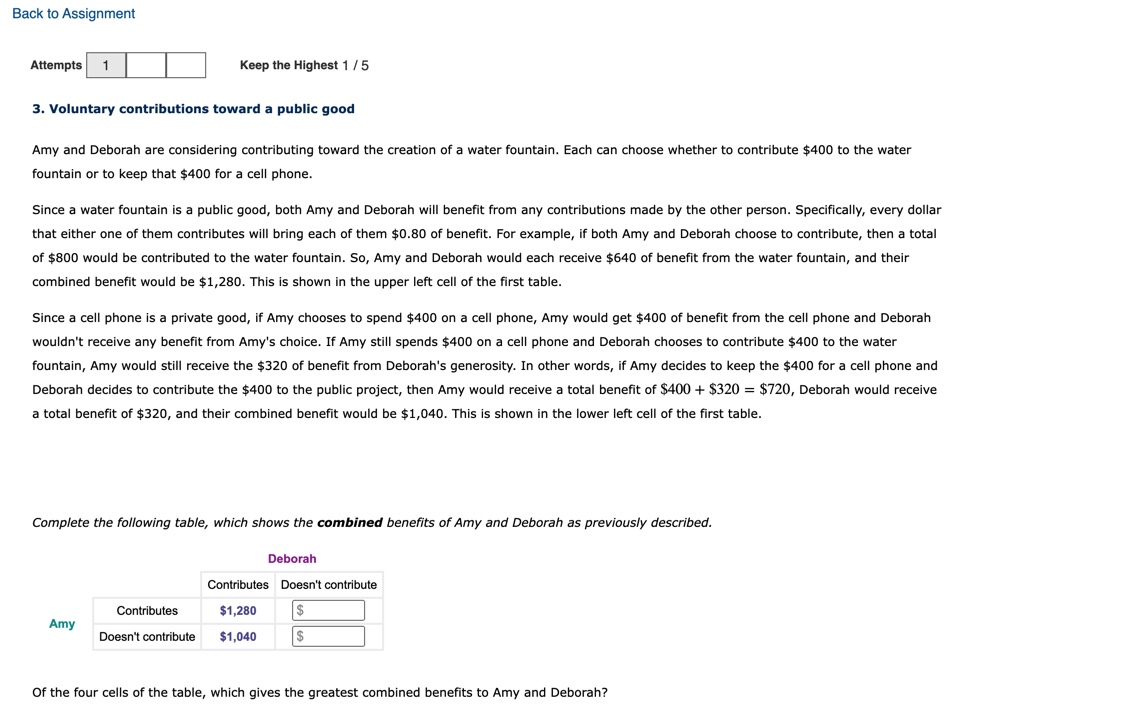
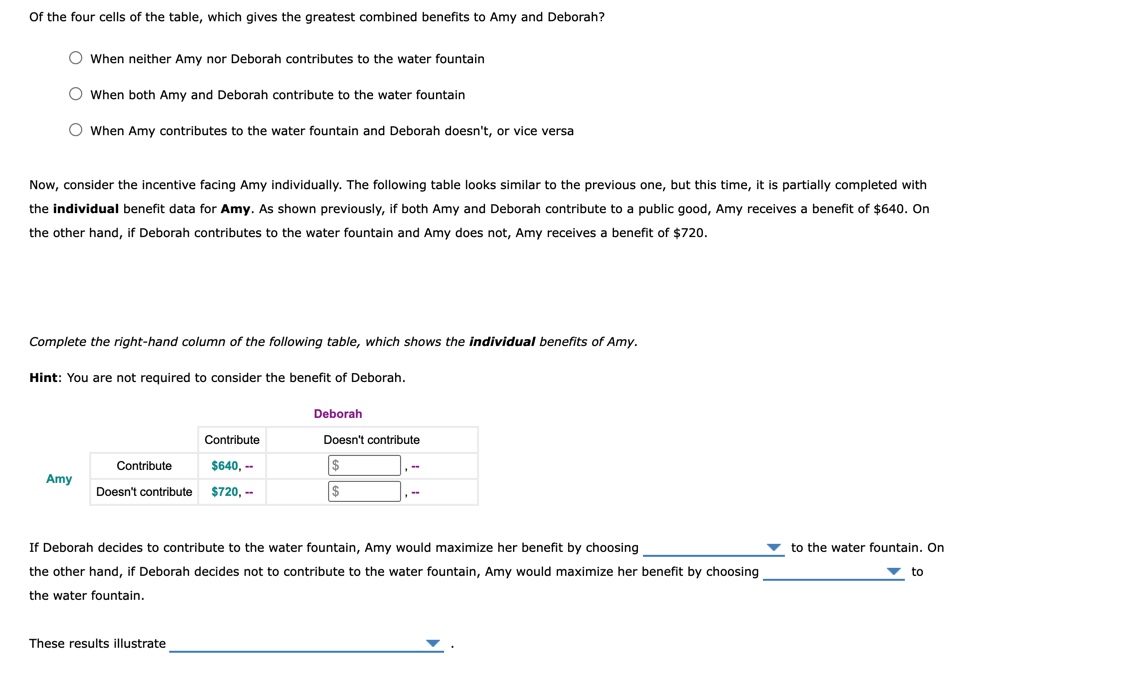
Back to Assignment Attempts 1 Keep the Highest 1 / 5 3. Voluntary contributions toward a public good Amy and Deborah are considering contributing toward the creation of a water fountain. Each can choose whether to contribute $400 to the water fountain or to keep that $400 for a cell phone. Since a water fountain is a public good, both Amy and Deborah will benefit from any contributions made by the other person. Specifically, every dollar that either one of them contributes will bring each of them $0.80 of benefit. For example, if both Amy and Deborah choose to contribute, then a total of $800 would be contributed to the water fountain. So, Amy and Deborah would each receive $640 of benefit from the water fountain, and their combined benefit would be $1,280. This is shown in the upper left cell of the first table. Since a cell phone is a private good, if Amy chooses to spend $400 on a cell phone, Amy would get $400 of benefit from the cell phone and Deborah wouldn't receive any benefit from Amy's choice. If Amy still spends $400 on a cell phone and Deborah chooses to contribute $400 to the water fountain, Amy would still receive the $320 of benefit from Deborah's generosity. In other words, if Amy decides to keep the $400 for a cell phone and Deborah decides to contribute the $400 to the public project, then Amy would receive a total benefit of $400 + $320 = $720, Deborah would receive a total benefit of $320, and their combined benefit would be $1,040. This is shown in the lower left cell of the first table. Complete the following table, which shows the combined benefits of Amy and Deborah as previously described. Deborah Contributes Doesn't contribute Contributes $1,280 $ Amy Doesn't contribute $1,040 $ Of the four cells of the table, which gives the greatest combined benefits to Amy and Deborah?Of the four cells of the table, which gives the greatest combined benefits to Amy and Deborah? O When neither Amy nor Deborah contributes to the water fountain When both Amy and Deborah contribute to the water fountain When Amy contributes to the water fountain and Deborah doesn't, or vice versa Now, consider the incentive facing Amy individually. The following table looks similar to the previous one, but this time, it is partially completed with the individual benefit data for Amy. As shown previously, if both Amy and Deborah contribute to a public good, Amy receives a benefit of $640. On the other hand, if Deborah contributes to the water fountain and Amy does not, Amy receives a benefit of $720. Complete the right-hand column of the following table, which shows the individual benefits of Amy. Hint: You are not required to consider the benefit of Deborah. Deborah Contribute Doesn't contribute Contribute $640, -- $ Amy Doesn't contribute $720, -- $ If Deborah decides to contribute to the water fountain, Amy would maximize her benefit by choosing to the water fountain. On the other hand, if Deborah decides not to contribute to the water fountain, Amy would maximize her benefit by choosing to the water fountain. These results illustrate
Step by Step Solution
There are 3 Steps involved in it

Get step-by-step solutions from verified subject matter experts
 Study Help