







Question: Background for problems 1-6: Volante Corp (VC) is a local distributor of organic produce to local Boston area restaurants and stores. Management believes that revenues
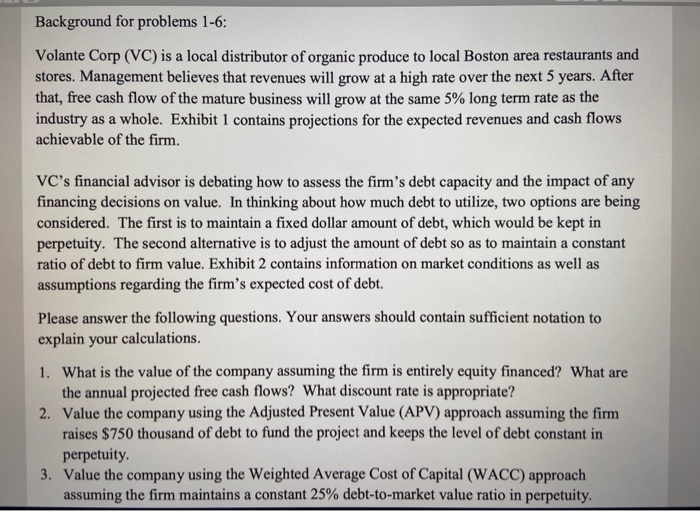
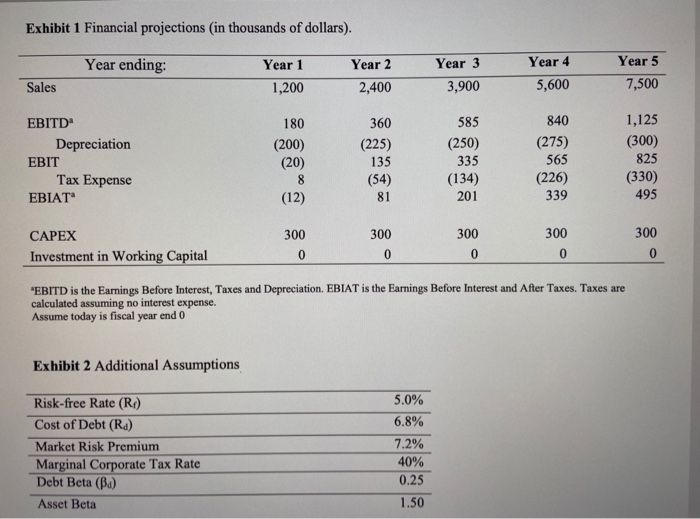
Background for problems 1-6: Volante Corp (VC) is a local distributor of organic produce to local Boston area restaurants and stores. Management believes that revenues will grow at a high rate over the next 5 years. After that, free cash flow of the mature business will grow at the same 5% long term rate as the industry as a whole. Exhibit 1 contains projections for the expected revenues and cash flows achievable of the firm. VC's financial advisor is debating how to assess the firm's debt capacity and the impact of any financing decisions on value. In thinking about how much debt to utilize, two options are being considered. The first is to maintain a fixed dollar amount of debt, which would be kept in perpetuity. The second alternative is to adjust the amount of debt so as to maintain a constant ratio of debt to firm value. Exhibit 2 contains information on market conditions as well as assumptions regarding the firm's expected cost of debt. Please answer the following questions. Your answers should contain sufficient notation to explain your calculations. 1. What is the value of the company assuming the firm is entirely equity financed? What are the annual projected free cash flows? What discount rate is appropriate? 2. Value the company using the Adjusted Present Value (APV) approach assuming the firm raises $750 thousand of debt to fund the project and keeps the level of debt constant in perpetuity. 3. Value the company using the Weighted Average Cost of Capital (WACC) approach assuming the firm maintains a constant 25% debt-to-market value ratio in perpetuity. Exhibit 1 Financial projections (in thousands of dollars). Year ending: Year 1 1,200 Year 2 2,400 Year 3 3,900 Year 4 5,600 Year 5 7,500 Sales EBITD Depreciation EBIT Tax Expense EBIAT 180 (200) (20) 8 (12) 360 (225) 135 (54) 81 585 (250) 335 (134) 201 840 (275) 565 (226) 339 1,125 (300) 825 (330) 495 300 CAPEX Investment in Working Capital 300 0 300 0 300 0 300 0 0 "EBITD is the Earnings Before Interest, Taxes and Depreciation. EBIAT is the Earnings Before Interest and After Taxes. Taxes are calculated assuming no interest expense. Assume today is fiscal year end 0 Exhibit 2 Additional Assumptions Risk-free Rate (RT) Cost of Debt (R) Market Risk Premium Marginal Corporate Tax Rate Debt Beta (B) Asset Beta 5.0% 6.8% 7.2% 40% 0.25 1.50 Background for problems 1-6: Volante Corp (VC) is a local distributor of organic produce to local Boston area restaurants and stores. Management believes that revenues will grow at a high rate over the next 5 years. After that, free cash flow of the mature business will grow at the same 5% long term rate as the industry as a whole. Exhibit 1 contains projections for the expected revenues and cash flows achievable of the firm. VC's financial advisor is debating how to assess the firm's debt capacity and the impact of any financing decisions on value. In thinking about how much debt to utilize, two options are being considered. The first is to maintain a fixed dollar amount of debt, which would be kept in perpetuity. The second alternative is to adjust the amount of debt so as to maintain a constant ratio of debt to firm value. Exhibit 2 contains information on market conditions as well as assumptions regarding the firm's expected cost of debt. Please answer the following questions. Your answers should contain sufficient notation to explain your calculations. 1. What is the value of the company assuming the firm is entirely equity financed? What are the annual projected free cash flows? What discount rate is appropriate? 2. Value the company using the Adjusted Present Value (APV) approach assuming the firm raises $750 thousand of debt to fund the project and keeps the level of debt constant in perpetuity. 3. Value the company using the Weighted Average Cost of Capital (WACC) approach assuming the firm maintains a constant 25% debt-to-market value ratio in perpetuity. Exhibit 1 Financial projections (in thousands of dollars). Year ending: Year 1 1,200 Year 2 2,400 Year 3 3,900 Year 4 5,600 Year 5 7,500 Sales EBITD Depreciation EBIT Tax Expense EBIAT 180 (200) (20) 8 (12) 360 (225) 135 (54) 81 585 (250) 335 (134) 201 840 (275) 565 (226) 339 1,125 (300) 825 (330) 495 300 CAPEX Investment in Working Capital 300 0 300 0 300 0 300 0 0 "EBITD is the Earnings Before Interest, Taxes and Depreciation. EBIAT is the Earnings Before Interest and After Taxes. Taxes are calculated assuming no interest expense. Assume today is fiscal year end 0 Exhibit 2 Additional Assumptions Risk-free Rate (RT) Cost of Debt (R) Market Risk Premium Marginal Corporate Tax Rate Debt Beta (B) Asset Beta 5.0% 6.8% 7.2% 40% 0.25 1.50
Step by Step Solution
There are 3 Steps involved in it

Get step-by-step solutions from verified subject matter experts
 Study Help