







Question: Background: In this Problem Set, questions 1-5 will have you look at some simple relationships among the payback period, IRR and the NPV for cash
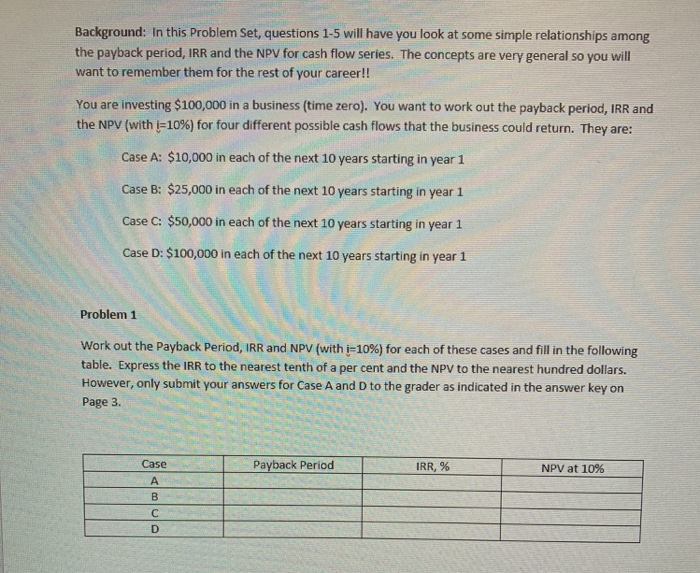
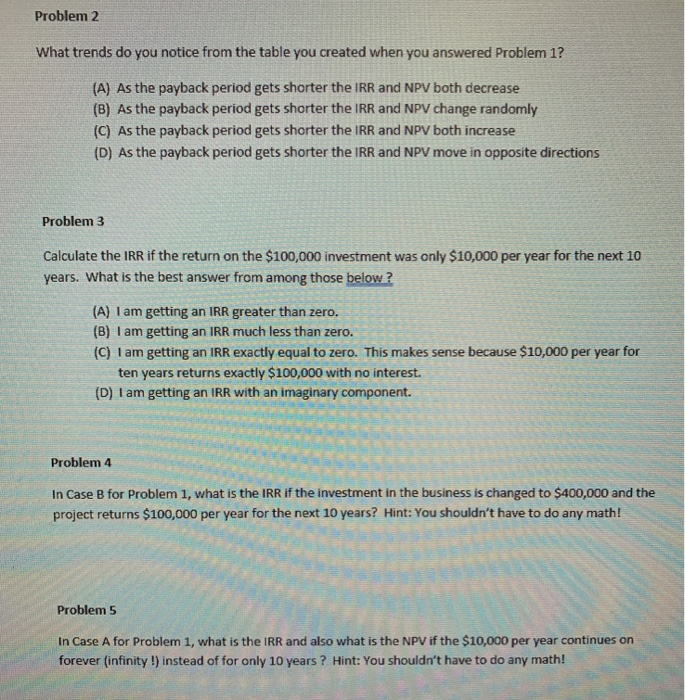
Background: In this Problem Set, questions 1-5 will have you look at some simple relationships among the payback period, IRR and the NPV for cash flow series. The concepts are very general so you will want to remember them for the rest of your career!! You are investing $100,000 in a business (time zero). You want to work out the payback period, IRR and the NPV (with =10%) for four different possible cash flows that the business could return. They are: Case A: $10,000 in each of the next 10 years starting in year 1 Case B: $25,000 in each of the next 10 years starting in year 1 Case C: $50,000 in each of the next 10 years starting in year 1 Case D: $100,000 in each of the next 10 years starting in year 1 Problem 1 Work out the Payback Period, IRR and NPV (with i=10%) for each of these cases and fill in the following table. Express the IRR to the nearest tenth of a per cent and the NPV to the nearest hundred dollars. However, only submit your answers for Case A and D to the grader as indicated in the answer key on Page 3 Case Payback Period IRR, % NPV at 10% DOW Problem 2 What trends do you notice from the table you created when you answered Problem 1? (A) As the payback period gets shorter the IRR and NPV both decrease (B) As the payback period gets shorter the IRR and NPV change randomly (C) As the payback period gets shorter the IRR and NPV both increase (D) As the payback period gets shorter the IRR and NPV move in opposite directions Problem 3 Calculate the IRR if the return on the $100,000 investment was only $10,000 per year for the next 10 years. What is the best answer from among those below ? (A) I am getting an IRR greater than zero. (B) I am getting an IRR much less than zero. (C) I am getting an IRR exactly equal to zero. This makes sense because $10,000 per year for ten years returns exactly $100,000 with no interest. (D) 1 am getting an IRR with an imaginary component. Problem 4 In Case B for Problem 1, what is the IRR if the investment in the business is changed to $400,000 and the project returns $100,000 per year for the next 10 years? Hint: You shouldn't have to do any math! Problem 5 In Case A for Problem 1, what is the IRR and also what is the NPV if the $10,000 per year continues on forever (infinity !) instead of for only 10 years ? Hint: You shouldn't have to do any math
Step by Step Solution
There are 3 Steps involved in it

Get step-by-step solutions from verified subject matter experts
 Study Help