



Question: Background Please describe churn and why it is important in general and why it is important to Southern Telecommunications Company (STC). Also, discuss STCs churn
Background
Please describe churn and why it is important in general and why it is important to Southern Telecommunications Company (STC). Also, discuss STCs churn rate goal and where it stands for Southern Region A.
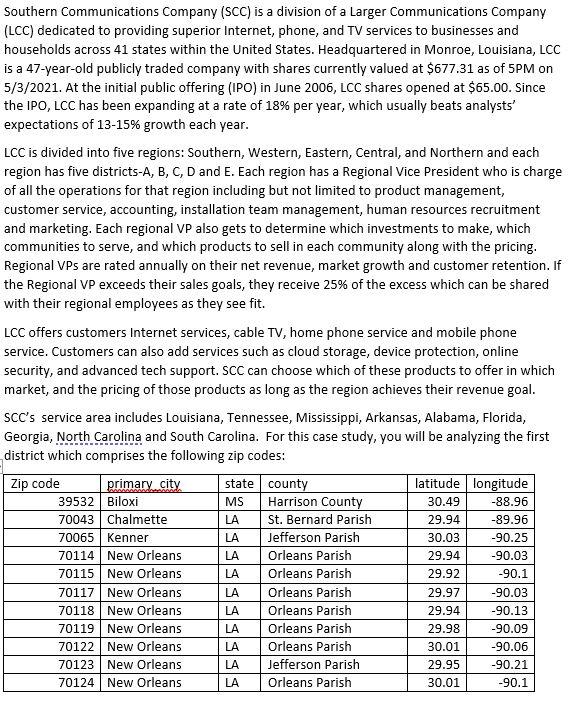
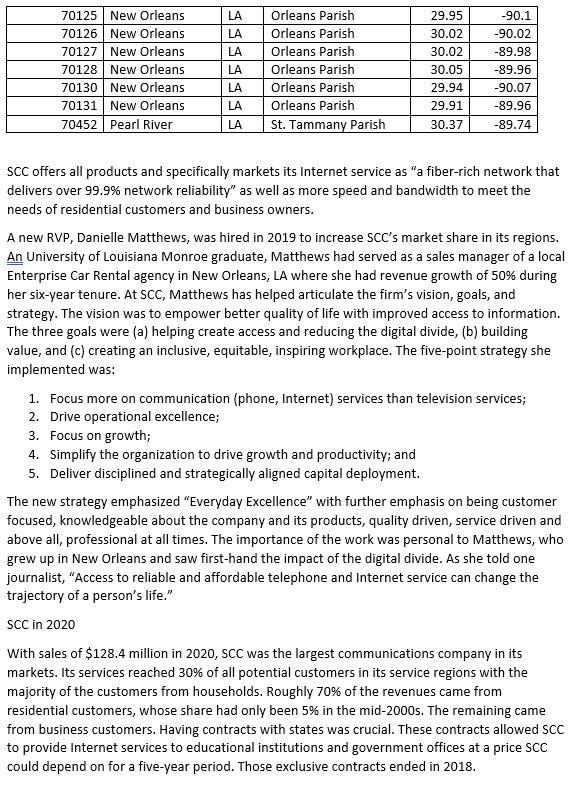
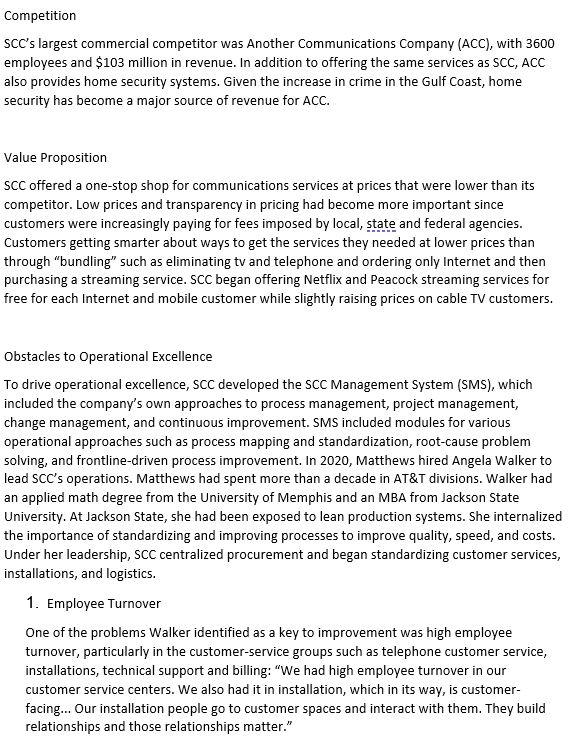
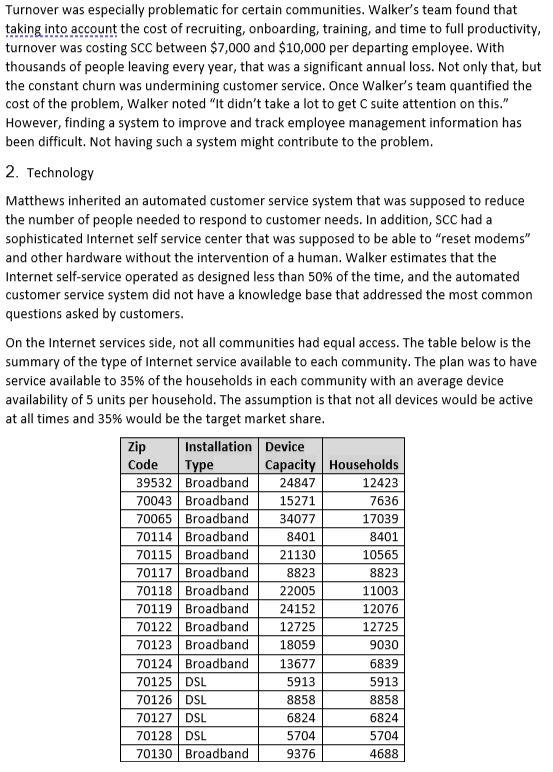
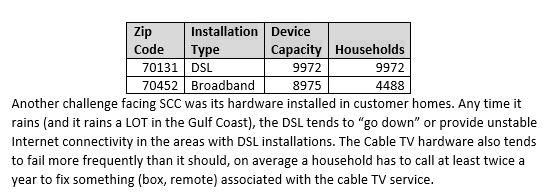
Southern Communications Company (SCC) is a division of a Larger Communications Company (LCC) dedicated to providing superior Internet, phone, and TV services to businesses and households across 41 states within the United States. Headquartered in Monroe, Louisiana, LCC is a 47-year-old publicly traded company with shares currently valued at $677.31 as of 5PM on 5/3/2021. At the initial public offering (IPO) in June 2006, LCC shares opened at $65.00. Since the IPO, LCC has been expanding at a rate of 18% per year, which usually beats analysts' expectations of 13-15% growth each year. LCC is divided into five regions: Southern, Western, Eastern, Central, and Northern and each region has five districts-A, B, C, D and E. Each region has a Regional Vice President who is charge of all the operations for that region including but not limited to product management, customer service, accounting, installation team management, human resources recruitment and marketing. Each regional VP also gets to determine which investments to make, which communities to serve, and which products to sell in each community along with the pricing. Regional VPs are rated annually on their net revenue, market growth and customer retention. If the Regional VP exceeds their sales goals, they receive 25% of the excess which can be shared with their regional employees as they see fit. LCC offers customers Internet services, cable TV, home phone service and mobile phone service. Customers can also add services such as cloud storage, device protection, online security, and advanced tech support. SCC can choose which of these products to offer in which market, and the pricing of those products as long as the region achieves their revenue goal. SCC's service area includes Louisiana, Tennessee, Mississippi, Arkansas, Alabama, Florida, Georgia, North Carolina and South Carolina. For this case study, you will be analyzing the first district which comprises the following zip codes: Zip code primary city state county latitude longitude 39532 Biloxi Harrison County 70043 Chalmette St. Bernard Parish 29.94 -89.96 70065 Kenner Jefferson Parish 30.03 70114 New Orleans Orleans Parish 29.94 -90.03 70115 New Orleans Orleans Parish 29.92 70117 New Orleans LA Orleans Parish 29.97 -90.03 70118 New Orleans Orleans Parish -90.13 70119 New Orleans Orleans Parish 29.98 -90.09 70122 New Orleans Orleans Parish 30.01 -90.06 70123 New Orleans Jefferson Parish -90.21 70124 New Orleans LA Orleans Parish 30.01 -90.1 30.49 -88.96 MS LA LA LA LA -90.25 -90.1 29.94 LA LA LA LA 29.95 70125 New Orleans 70126 New Orleans 70127 New Orleans 70128 New Orleans 70130 New Orleans 70131 New Orleans 70452 Pearl River LA LA LA LA LA LA Orleans Parish Orleans Parish Orleans Parish Orleans Parish Orleans Parish Orleans Parish St. Tammany Parish 29.95 30.02 30.02 30.05 29.94 29.91 30.37 -90.1 -90.02 -89.98 -89.96 -90.07 -89.96 -89.74 LA SCC offers all products and specifically markets its Internet service as "a fiber-rich network that delivers over 99.9% network reliability" as well as more speed and bandwidth to meet the needs of residential customers and business owners. A new RVP, Danielle Matthews, was hired in 2019 to increase SCC's market share in its regions. An University of Louisiana Monroe graduate, Matthews had served as a sales manager of a local Enterprise Car Rental agency in New Orleans, LA where she had revenue growth of 50% during her six-year tenure. At SCC, Matthews has helped articulate the firm's vision, goals, and strategy. The vision was to empower better quality of life with improved access to information. The three goals were (a) helping create access and reducing the digital divide, (b) building value, and (c) creating an inclusive, equitable, inspiring workplace. The five-point strategy she implemented was: 1. Focus more on communication (phone, Internet) services than television services; 2. Drive operational excellence; 3. Focus on growth; 4. Simplify the organization to drive growth and productivity; and 5. Deliver disciplined and strategically aligned capital deployment. The new strategy emphasized "Everyday Excellence" with further emphasis on being customer focused, knowledgeable about the company and its products, quality driven, service driven and above all, professional at all times. The importance of the work was personal to Matthews, who grew up in New Orleans and saw first-hand the impact of the digital divide. As she told one journalist, "Access to reliable and affordable telephone and Internet service can change the trajectory of a person's life." SCC in 2020 With sales of $128.4 million in 2020, SCC was the largest communications company in its markets. Its services reached 30% of all potential customers in its service regions with the majority of the customers from households. Roughly 70% of the revenues came from residential customers, whose share had only been 5% in the mid-2000s. The remaining came from business customers. Having contracts with states was crucial. These contracts allowed SCC to provide Internet services to educational institutions and government offices at a price SCC could depend on for a five-year period. Those exclusive contracts ended in 2018. Competition SCC's largest commercial competitor was Another Communications Company (ACC), with 3600 employees and $103 million in revenue. In addition to offering the same services as SCC, ACC also provides home security systems. Given the increase in crime in the Gulf Coast, home security has become a major source of revenue for ACC. Value Proposition SCC offered a one-stop shop for communications services at prices that were lower than its competitor. Low prices and transparency in pricing had become more important since customers were increasingly paying for fees imposed by local, state and federal agencies. Customers getting smarter about ways to get the services they needed at lower prices than through "bundling" such as eliminating tv and telephone and ordering only Internet and then purchasing a streaming service. SCC began offering Netflix and Peacock streaming services for free for each Internet and mobile customer while slightly raising prices on cable TV customers. Obstacles to Operational Excellence To drive operational excellence, SCC developed the SCC Management System (SMS), which included the company's own approaches to process management, project management, change management, and continuous improvement. SMS included modules for various operational approaches such as process mapping and standardization, root-cause problem solving, and frontline-driven process improvement. In 2020, Matthews hired Angela Walker to lead SCC's operations. Matthews had spent more than a decade in AT&T divisions. Walker had an applied math degree from the University of Memphis and an MBA from Jackson State University. At Jackson State, she had been exposed to lean production systems. She internalized the importance of standardizing and improving processes to improve quality, speed, and costs. Under her leadership, SCC centralized procurement and began standardizing customer services, installations, and logistics. 1. Employee Turnover One of the problems Walker identified as a key to improvement was high employee turnover, particularly in the customer-service groups such as telephone customer service, installations, technical support and billing: "We had high employee turnover in our customer service centers. We also had it in installation, which in its way, is customer- facing... Our installation people go to customer spaces and interact with them. They build relationships and those relationships matter." Turnover was especially problematic for certain communities. Walker's team found that taking into account the cost of recruiting, onboarding, training, and time to full productivity, turnover was costing SCC between $7,000 and $10,000 per departing employee. With thousands of people leaving every year, that was a significant annual loss. Not only that, but the constant churn was undermining customer service. Once Walker's team quantified the cost of the problem, Walker noted "It didn't take a lot to get C suite attention on this." However, finding a system to improve and track employee management information has been difficult. Not having such a system might contribute to the problem. 2. Technology Matthews inherited an automated customer service system that was supposed to reduce the number of people needed to respond to customer needs. In addition, SCC had a sophisticated Internet self service center that was supposed to be able to "reset modems" and other hardware without the intervention of a human. Walker estimates that the Internet self-service operated as designed less than 50% of the time, and the automated customer service system did not have a knowledge base that addressed the most common questions asked by customers. On the Internet services side, not all communities had equal access. The table below is the summary of the type of Internet service available to each community. The plan was to have service available to 35% of the households in each community with an average device availability of 5 units per household. The assumption is that not all devices would be active at all times and 35% would be the target market share. Installation Device Code Type Capacity Households 39532 Broadband 24847 12423 70043 Broadband 15271 70065 Broadband 34077 70114 Broadband 8401 8401 70115 Broadband 10565 70117 Broadband 8823 8823 70118 Broadband 70119 Broadband 24152 12076 70122 Broadband 12725 12725 70123 Broadband 18059 9030 70124 Broadband 70125 DSL 5913 5913 70126 DSL 8858 70127 DSL 6824 6824 70128 DSL 70130 Broadband 4688 Zip 7636 17039 21130 22005 11003 13677 6839 8858 5704 5704 9376 Zip Installation Device Code Type Capacity Households 70131 DSL 9972 9972 70452 Broadband 8975 4488 Another challenge facing SCC was its hardware installed in customer homes. Any time it rains (and it rains a LOT in the Gulf Coast), the DSL tends to "go down" or provide unstable Internet connectivity in the areas with DSL installations. The Cable TV hardware also tends to fail more frequently than it should, on average a household has to call at least twice a year to fix something (box, remote) associated with the cable TV service
Step by Step Solution
There are 3 Steps involved in it
1 Expert Approved Answer
Step: 1 Unlock

Question Has Been Solved by an Expert!
Get step-by-step solutions from verified subject matter experts
Step: 2 Unlock
Step: 3 Unlock