







Question: base on the lecture answer the questions below. please use 2-30) answer. 2-31) answer. 2-32) answer. note: for 2-31 it is needed at least 2
base on the lecture answer the questions below. please use 2-30) answer. 2-31) answer. 2-32) answer.
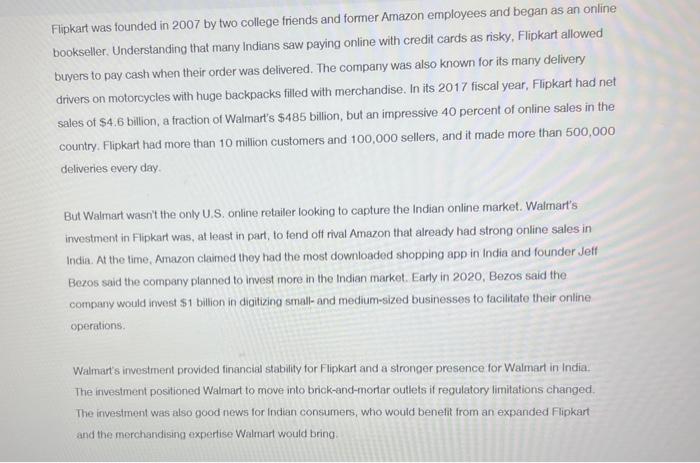
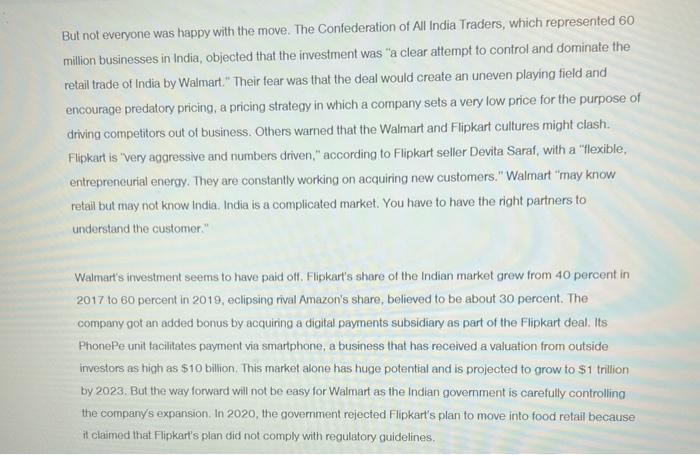
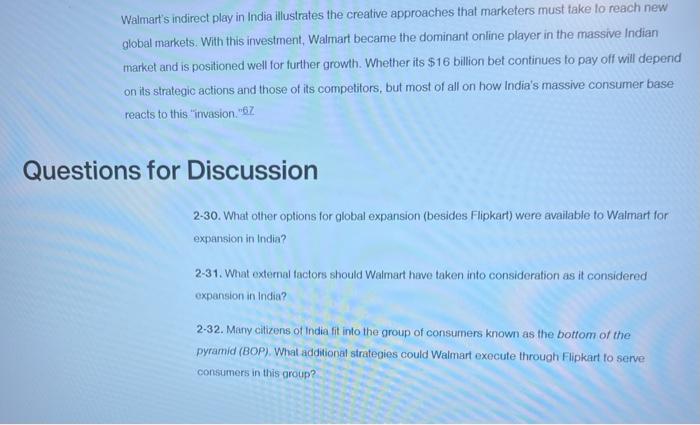
Marketing in Action Case: Real Choices at Walmart When businesses consider expanding into a new region of the world, the number of potential customers in the area is a major consideration. Perhaps that's why India, with its 1.38 billion people, is so attractive to Walmart, the brick-and-mortar king of retailing and a major force in online shopping. In 2018, the Indian retail market generated $800 billion a year in sales and was headed toward $1 trillion in the next two years, according to research firm Forrester. Online sales represented only about $20 billion of that amount. Betting on the growth of online retail in India. Walmart made a $16 billion investment in locally owned online retailer Flipkart a Most retail sales in India are through small individual "mom-and-pop stores. Over the provious decade, Walmart had tried to break into the market, but those small store owners were able to influence govemment regulators to create limitations on foreign direct investment (FDI) by international retailers. At that point, Walmart's presence there had been limited to 21 Best Price wholesale member-only stores (with plans to add 50 more). The investment in Flipkart provided a way for Walmart to reach the massive Indian market Flipkart was founded in 2007 by two college friends and former Amazon employees and began as an online bookseller. Understanding that many Indians saw paying online with credit cards as risky, Flipkart allowed buyers to pay cash when their order was delivered. The company was also known for its many delivery drivers on motorcycles with huge backpacks filled with merchandise. In its 2017 fiscal year, Flipkart had net sales of $4.6 billion, a fraction of Walmart's $485 billion, but an impressive 40 percent of online sales in the country. Flipkart had more than 10 million customers and 100,000 sellers, and it made more than 500,000 deliveries every day But Walmart wasn't the only U.S. online retailer looking to capture the Indian online market. Walmart's investment in Flipkart was, at least in part, to fend off rival Amazon that already had strong online sales in India. At the time, Amazon claimed they had the most downloaded shopping app in India and founder Jeff Bezos said the company planned to invest more in the Indian market. Early in 2020, Bezos said the company would invest $1 billion in digitizing small and medium-sized businesses to facilitate their online operations Walmart's investment provided financial stability for Flipkart and a stronger presence for Walmart in India. The investment positioned Walmart to move into brick-and-mortar outlets if regulatory limitations changed. The investment was also good news for Indian consumers, who would benefit from an expanded Flipkart and the merchandising expertise Walmart would bring But not everyone was happy with the move. The Confederation of All India Traders, which represented 60 million businesses in India, objected that the investment was "a clear attempt to control and dominate the retail trade of India by Walmart." Their fear was that the deal would create an uneven playing field and encourage predatory pricing, a pricing strategy in which a company sets a very low price for the purpose of driving competitors out of business. Others warned that the Walmart and Flipkart cultures might clash. Flipkart is very aggressive and numbers driven,"according to Flipkart seller Devita Saraf, with a "flexible, entrepreneurial energy. They are constantly working on acquiring new customers." Walmart "may know retail but may not know India, India is a complicated market. You have to have the right partners to understand the customer." Walmart's investment seems to have paid off. Flipkart's share of the Indian market grew from 40 percent in 2017 to 60 percent in 2019, eclipsing rival Amazon's share, believed to be about 30 percent. The company got an added bonus by acquiring a digital payments subsidiary as part of the Flipkart deal. Its PhonePe unit facilitates payment via smartphone, a business that has received a valuation from outside investors as high as $10 billion. This market alone has huge potential and is projected to grow to $1 trillion by 2023. But the way forward will not be easy for Walmart as the Indian government is carefully controlling the company's expansion. In 2020, the government rejected Flipkart's plan to move into food retail because it claimed that Flipkart's plan did not comply with regulatory guidelines Walmart's indirect play in India illustrates the creative approaches that marketers must take to reach new global markets. With this investment, Walmart became the dominant online player in the massive Indian market and is positioned well for further growth. Whether its $16 billion bet continues to pay off will depend on its strategic actions and those of its competitors, but most of all on how India's massive consumer base reacts to this "invasion "67 Questions for Discussion 2-30. What other options for global expansion (besides Flipkart) were available to Walmart for expansion in India? 2-31. What external tactors should Walmart have taken into consideration as it considered expansion in India? 2-32. Many citizens of India fit into the group of consumers known as the bottom of the pyramid (BOP). What additional strategies could Walmart execute through Flipkart to serve consumers in this group note: for 2-31 it is needed at least 2 factors. thanks 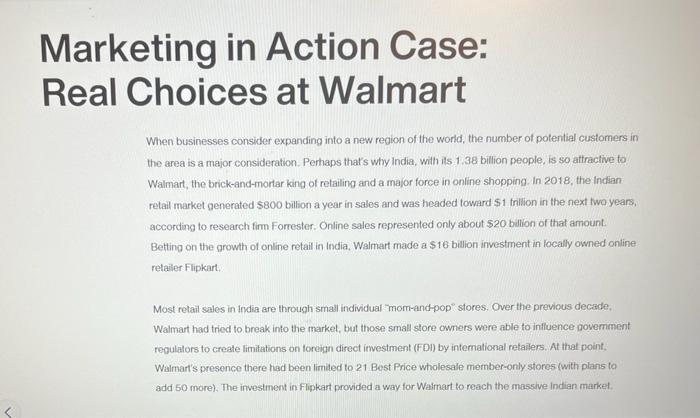
Step by Step Solution
There are 3 Steps involved in it
1 Expert Approved Answer
Step: 1 Unlock

Question Has Been Solved by an Expert!
Get step-by-step solutions from verified subject matter experts
Step: 2 Unlock
Step: 3 Unlock
 Study Help