Question: Base on the reading, job analysis has been considered the cornerstone of human resource management. Precisely how does it support managers making pay decisions? LO5
Base on the reading, job analysis has been considered the cornerstone of human resource management. Precisely how does it support managers making pay decisions?
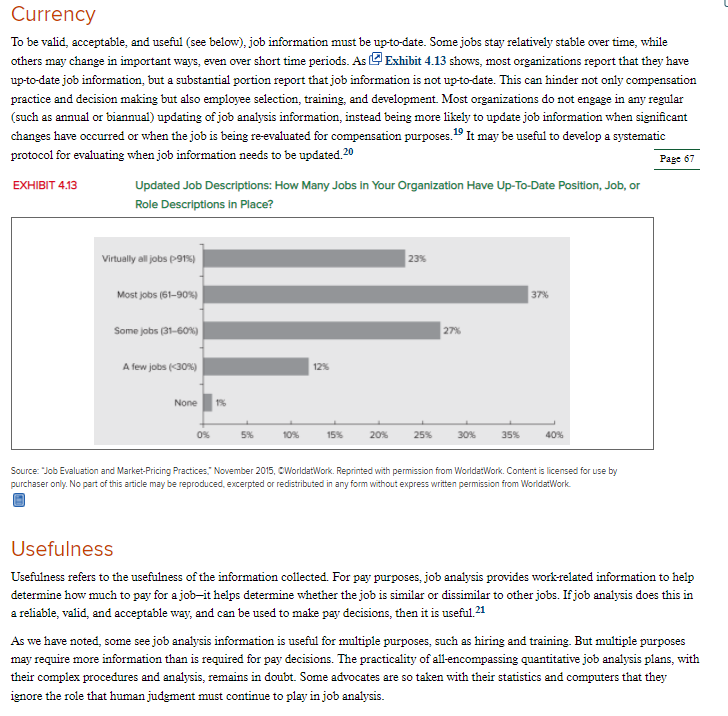
LO5 JUDGING JOB ANALYSIS Beyond beliefs about its usefulness, or lack thereof, for satisfying both employees and employers, there are several ways to judge job analysis. Reliability If something is measured tomorrow and the results are the same as those from today, or if I measure and get the same result you did, the measurement is considered to be reliable. This doesn't mean it is right-only that repeated measures give the same result. Reliability is a measure of the consistency of results among various analysts, various methods, various sources of data, or over time. Reliability is a necessary, but not sufficient, condition for validity. Research findings on employee and supervisor agreement on the reliability of job analysis information are mixed. For instance, experience may change an employee's perceptions of a job-he or she may have found new ways to do it or may have added new tasks to it. The supervisor may not realize the extent of the change. In such cases, the job the employee is actually doing may not be the same as the job originally assigned by the supervisor. Research also finds that reliability is lower for jobs that are more interdependent with other jobs. have more autonomy, or are less routine. 16 Obviously, the way to increase reliability in a job analysis is to reduce the sources of difference. Quantitative job analysis helps reduce variance. But we need to be sure that we do not eliminate the richness or the nuances of a job while eliminating the variance. Training can also improve reliability. 17 m a Validity Validity is the extent to which a process such as job analysis measures what it claims to measure. It is concerned with the question of whether the analysis creates an accurate portrait of the work. There is almost no way of showing statistically the extent to which an analysis is accurate, particularly for complex jobs. Consequently, validity examines convergence of results among different sources of data and methods. For example, validity might be assessed by measuring the extent to which the job analysis results represent the entire range of activities and responsibilities required by the job, and by measuring the extent to which there is agreement among a variety of people familiar with the job that the job analysis results are representative of the job. However, a sign-off on the results does not guarantee validity: 13 It might only mean everyone was sick to death of the process and wanted to get rid of the analyst so they could get back to work. Acceptability If jobholders and managers are dissatisfied with the initial data collected or with the process, they are not likely to buy into either the resulting job structure or the pay rates eventually attached to that structure. An analyst collecting information through one-on-one interviews or observation is not always accepted because of the potential for subjectivity and favouritism. However, quantitative computer-assisted approaches may also run into difficulty, especially if they give in to the temptation to try to collect too much information for too many purposes. Currency To be valid, acceptable, and useful (see below), job information must be up-to-date. Some jobs stay relatively stable over time, while others may change in important ways, even over short time periods. As Exhibit 4.13 shows, most organizations report that they have up-to-date job information, but a substantial portion report that job information is not up-to-date. This can hinder not only compensation practice and decision making but also employee selection, training and development. Most organizations do not engage in any regular (such as annual or biannual) updating of job analysis information, instead being more likely to update job information when significant changes have occurred or when the job is being re-evaluated for compensation purposes. 1 It may be useful to develop a systematic protocol for evaluating when job information needs to be updated 20 Page 67 EXHIBIT 4.13 Updated Job Descriptions: How Many Jobs in Your Organization Have Up-To-Date Position, Job, or Role Descriptions in Place? Virtually all jobs 91%) 23% Most jobs (61-90%) 37% Some jobs (31-60%) 27% A few jobs (




