







Question: Based off of Figure 2, explain what the switch will do when Computer A sends a frame to Computer B. Group of answer choices Since
Based off of Figure 2, explain what the switch will do when Computer A sends a frame to Computer B.
Group of answer choices
Since computer A's address is already in the table, the switch will not record the address of computer A.
Since Computer B's address is already in the table, the switch will not record the address of computer B.
Since computer A's address isn't already in the table, the switch will record the address of computer A.
Since Computer B's address in not in the table, the switch will forward the frame out of all ports except the port it came from. After receiving the frame from the switch, computer B will then reply back to the switch and the switch will record the address of computer B (B -> 2)
Since computer A's address is already in the table, the switch will not record the address of computer A.
Since Computer B's address in not in the table, the switch will forward the frame out of all ports except the port it came from. After receiving the frame from the switch, computer B will then reply back to the switch and the switch will record the address of computer B (B -> 2)
Since computer A's address is not in the table, the switch will forward the frame out of all ports except the port it came from. After receiving the frame from the switch, computer A will then reply back to the switch and the switch will record the address of computer A.
Since Computer B's address is in the table, the switch will not record the address of computer B.
Flag this Question
Question 2 1 pts
Based off of Figure 2 and the last question, explain what the switch will do when Computer B sends a frame to Computer C.
Group of answer choices
Since computer B's address isn't already in the table, the switch will record the address of computer B.
Since computer C's address is already in the table, the switch will forward the frame to computer C.
Since computer B's address isn't already in the table, the switch will record the address of computer B.
Since computer C's address isn't already in the table, the switch will not forward the frame to computer C.
Since Computer B's address is already in the table, the switch will not record the address of computer B.
Since computer C's address is already in the table, the switch will forward the frame to computer C.
Since Computer B's address isn't already in the table, the switch will record the address of computer B.
Since computer C's address isn't already in the table, the switch will record the address of computer C.
Flag this Question
Question 3 1 pts
Based off of Figure 2 and the last question, explain what the switch will do when Computer C sends a frame to Computer A.
Group of answer choices
Since Computer C's address is already in the table, the switch will not record the address of computer C.
Since computer A's address is already in the table, the switch will forward the frame to computer A.
Since Computer C's address is already in the table, the switch will not record the address of computer C.
Since computer A's address isn't already in the table, the switch will record the address of computer A.
Since Computer C's address isn't already in the table, the switch will record the address of computer C.
Since computer A's address is already in the table, the switch will forward the frame to computer A.
Since Computer C's address isn't already in the table, the switch will record the address of computer C.
Since computer A's address isn't already in the table, the switch will record the address of computer A.
Flag this Question
Question 4 1 pts
Based off of Figure 2 and the last question, explain what the switch will do when Computer A sends a frame to Computer D.
Group of answer choices
Since Computer A's address is in the table, the switch will record the address of computer A.
Since computer D's address is in the table, the switch will record the address of computer D.
Since Computer A's address isn't in the table, the switch will record the address of computer A.
Since computer D's address is not in the table, the switch will forward the frame out of all ports except the port the frame came from. After receiving the frame from the switch, computer D will then reply back to the switch and the switch will record the address of computer D (D -> 4)
Since Computer A's address is in the table, the switch will not record the address of computer A.
Since computer D's address is not in the table, the switch will forward the frame out of all ports except the port the frame came from. After receiving the frame from the switch, computer D will then reply back to the switch and the switch will record the address of computer D (D -> 4)
Since Computer A's address isn't in the table, the switch will record the address of computer A.
Since computer D's address is in the table, the switch will not record the address of computer D.
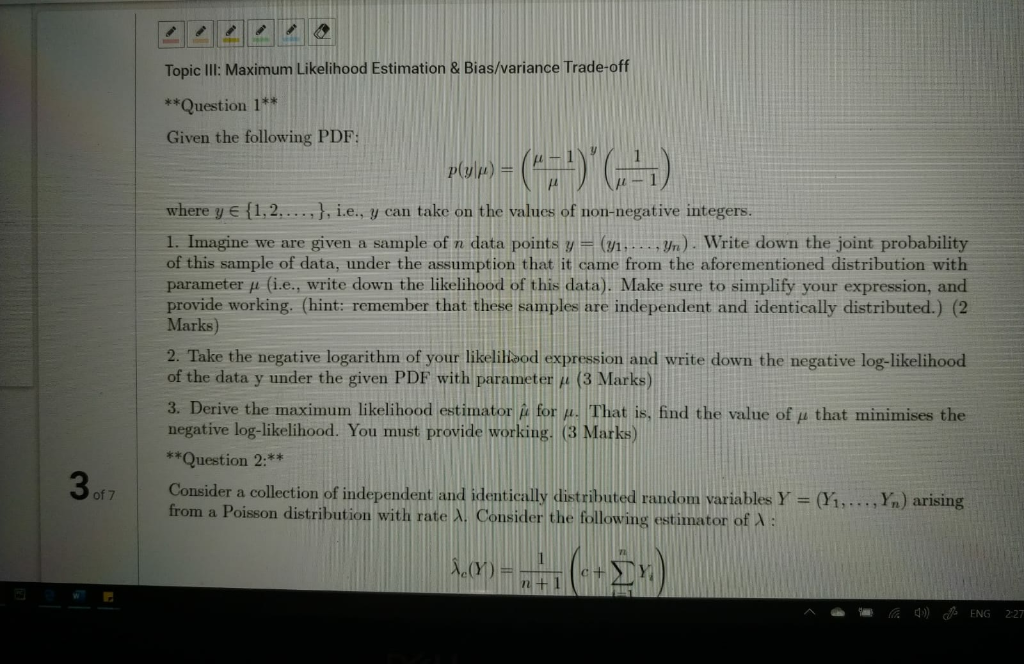
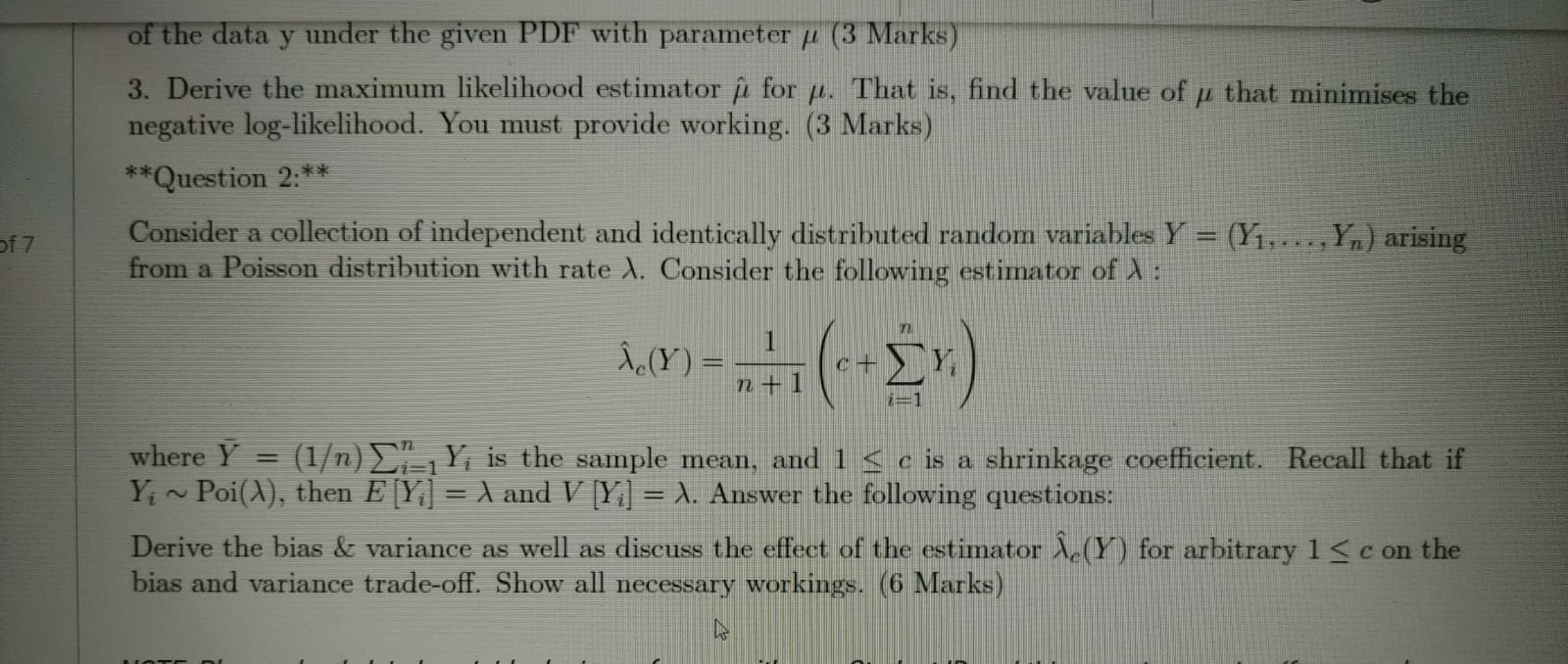
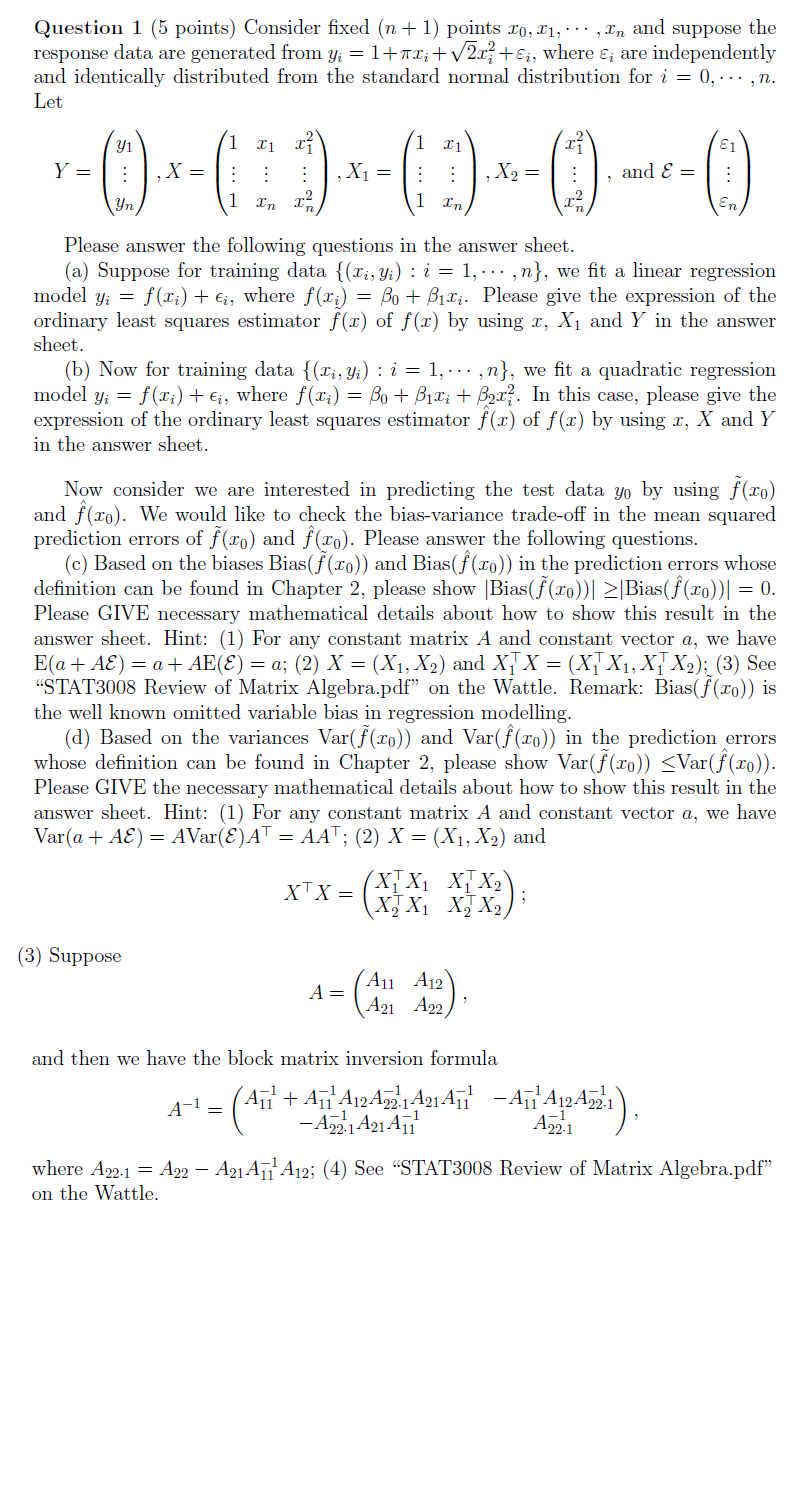
Topic III: Maximum Likelihood Estimation & Bias/variance Trade-off **Question 1** Given the following PDF: P(ylP) - where y E {1, 2. ..., }, i.e., y can take on the values of non-negative integers. 1. Imagine we are given a sample of n data points y - (11. ..., Un) . Write down the joint probability of this sample of data, under the assumption that it came from the aforementioned distribution with parameter / (i.e., write down the likelihood of this data). Make sure to simplify your expression, and provide working. (hint: remember that these samples are independent and identically distributed.) (2 Marks) 2. Take the negative logarithm of your likelihood expression and write down the negative log-likelihood of the data y under the given PDF with parameter / (3 Marks) 3. Derive the maximum likelihood estimator / for #. That is, find the value of a that minimises the negative log-likelihood. You must provide working. (3 Marks **Question 2:** 3 of7 Consider a collection of independent and identically distributed random variables Y = (Y1, . . ., Yn) arising from a Poisson distribution with rate A. Consider the following estimator of A : 24 1 W / ENG 2:27of the data y under the given PDF with parameter / (3 Marks) 3. Derive the maximum likelihood estimator / for p. That is, find the value of / that minimises the negative log-likelihood. You must provide working. (3 Marks) **Question 2:** of 7 Consider a collection of independent and identically distributed random variables Y = (Y1, ..., Y,) arising from a Poisson distribution with rate A. Consider the following estimator of A : A . ( Y ) = n + 1 where Y = (1) _ Y, is the sample mean, and 1 _ c is a shrinkage coefficient. Recall that if Yi ~Poi()), then E [Y,] = ) and V [Y,] = 1. Answer the following questions: Derive the bias & variance as well as discuss the effect of the estimator Ac(Y) for arbitrary 1
Step by Step Solution
There are 3 Steps involved in it

Get step-by-step solutions from verified subject matter experts
 Study Help