







Question: Based off the example above as a guide, complete and provide a analysis of the different subsystems: sales, general ledger, accounts receivable, accounts payable, general
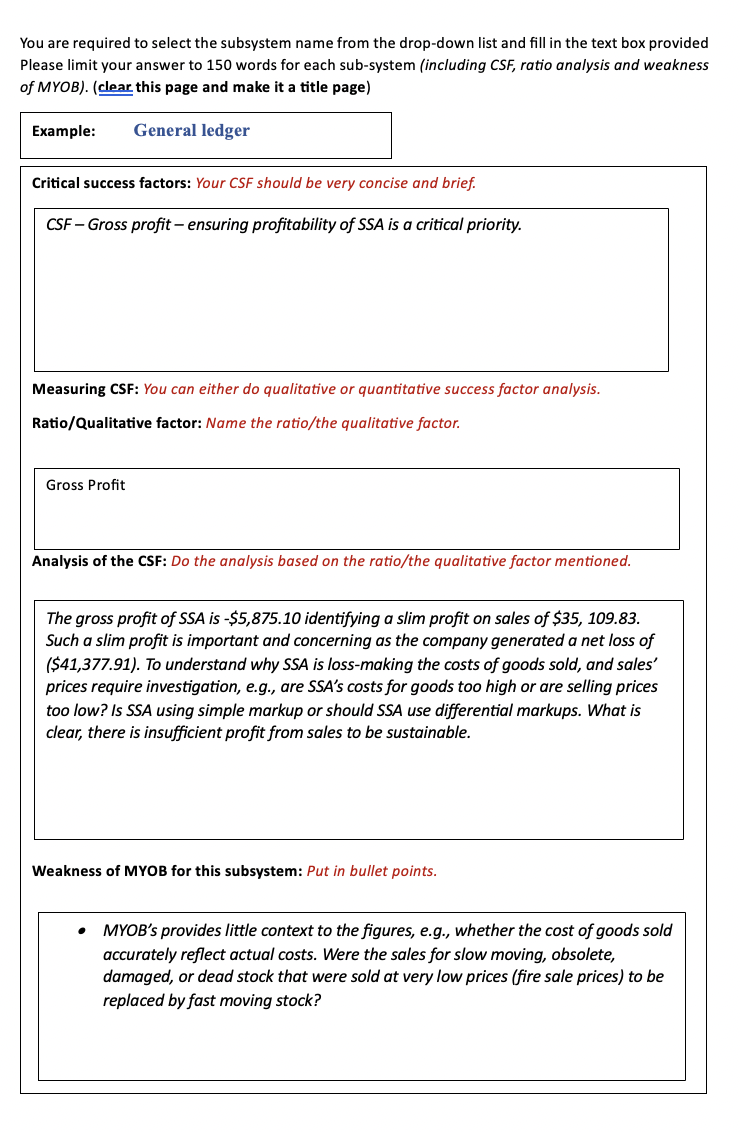
Based off the example above as a guide, complete and provide a analysis of the different subsystems: sales, general ledger, accounts receivable, accounts payable, general ledger and inventory. (note: 5 analysis needs to be done, one for each subsystem)
Link below provides balance sheet to help answer question, in terms of identifying/analysis of success factors:
https://www.studocu.com/en-au/document/queensland-university-of-technology/introducing-design/ssa-31july-reports-information-report/58028581
You are required to select the subsystem name from the drop-down list and fill in the text box provided Please limit your answer to 150 words for each sub-system (including CSF, ratio analysis and weakness of MYOB). (clear this page and make it a title page) Critical success factors: Your CSF should be very concise and brief. CSF - Gross profit - ensuring profitability of SSA is a critical priority. Measuring CSF: You can either do qualitative or quantitative success factor analysis. Ratio/Qualitative factor: Name the ratio/the qualitative factor. Gross Profit Analysis of the CSF: Do the analysis based on the ratio/the qualitative factor mentioned. The gross profit of SSA is $5,875.10 identifying a slim profit on sales of $35,109.83. Such a slim profit is important and concerning as the company generated a net loss of (\$41,377.91). To understand why SSA is loss-making the costs of goods sold, and sales' prices require investigation, e.g., are SSA's costs for goods too high or are selling prices too low? Is SSA using simple markup or should SSA use differential markups. What is clear, there is insufficient profit from sales to be sustainable. Weakness of MYOB for this subsystem: Put in bullet points. MYOB's provides little context to the figures, e.g., whether the cost of goods sold accurately reflect actual costs. Were the sales for slow moving, obsolete, damaged, or dead stock that were sold at very low prices (fire sale prices) to be replaced by fast moving stock
Step by Step Solution
There are 3 Steps involved in it

Get step-by-step solutions from verified subject matter experts
 Study Help